After arriving in Delhi, we spent the next five or six hours on the road to Bharatpur, a city of about a quarter million people in the Indian state of Rajasthan and popular with tourists because of its proximity to Keoladeo National Park, which was our ultimate destination.
We stayed in Pahersar, a small village 10 to 12 miles outside of Bharatpur. Our hotel, the Chandra Mahal Haveli, was built in 1840 in a Persian style--symmetrical, lots of tile work, large courtyards, plenty of landscaping, etc.
I can't remember what is important about that photo of Chris and Bonnie on the left. I think Chris couldn't get into her room or something. Our rooms opened onto this lovely courtyard.
In California, we see warning signs for rattlesnakes. It is a little different in India.
After breakfast we picked up Zachary at the military base and then drove to an area with a large open savannah. Zachary, Bob, Ella, and I got out of the jeep and started a walking safari and nature walk, something I am sure we would not have dared to do on our own (or without Zachary's rifle).
It didn't help that they first thing we came across was this:
One of my favorite African trees is the Candelabra Tree, a succulent that Zachary warned us not to touch as its sap can be a poisonous irritant. It stood out, not just because it was the only tree around, but because it didn't look like a typical leafy tree. There is no softness about this tree. Its sharp spines testify that it can survive the dry season. It also seems ancient, and it has the aura of an archetypal sentinel standing in the open cathedral of the savannah.
We came across a large herd of grazing Cape buffalo that took a special interest in our tiny group of four people. One rifle is no match for a stampeding herd of Cape buffalo, I thought to myself. But Zachary didn't seem to be at all concerned.
WE were concerned, however, or at least a trifle nervous. They kept inching closer and closer to us, and the only tree within running distance was that candelabra tree with the poisonous sap and spiny leaves!
We woke up at 6:00 a.m. and ate breakfast at 6:30. Breakfast typically consisted of our choice of eggs, bacon, sausage, fresh fruit, cereals, toast, juice, and hot chocolate (for Ella, who was obsessed with it and had it almost every day of our trip no matter how hot the weather was).
By 7:00 we were on our way to pick up a national park ranger named Zachary who had been assigned to accompany us anytime we were in the park. We passed by a large herd of Cape buffalo, one of Africa's "Big Five" game animals.
They reminded me a lot of a herd of American bison.
We had to go through this river to get to the military base where we were picking up Zachary and then again at the end of the day to drop him off:
Ella, as always, took it all in stride. She is a great traveler.
After a good night's sleep, we climbed back into our trusty vehicle for the most difficult drive of the trip, which, as you can see, made Ella very happy . . . or maybe just a bit loopy.
And off we went into the sunrise.
Kidepo Valley National Park is in the far northeast corner of Uganda, just south of the South Sudan border. The distance from Murchison Falls to Kidepo Valley NP is only 250 miles, but it took us over ten hours to get there. We did stop for a little over an hour at an elementary school along the way, but even at eight or nine hours that is a pretty slow drive that can be attributed to the poor road conditions.
At first, the road was paved and we made good time for a while.
We got to the entrance of Murchison Falls National Park at 6:45 p.m., just 15 minutes before the gates closed for the night. However, they did a ridiculous amount of paperwork that included making copies of our passports (which we later learned was standard for all national parks in Uganda). It took 25 minutes, and we didn't actually go through the gates until 7:10.
Not too far in we saw our first baboons walking down the road, kind of like an escort or welcoming committee.
A little later on, we saw an eagle owl at the side of the road that flew off when we drove by and then a mongoose that scampered across the road, both too fast for us to get a picture.
The highlight of the 45-minute-long drive through the park to our lodge was a huge wet hippo standing in the middle of the road facing oncoming traffic. The car in front of us wouldn't pass by it on the side, even though there appeared to be room. Apparently, hippos are known to charge cars. As cute as they are, they are mean dudes.
After a while, a boda-boda (motorcycle) came by and cautiously passed the hippo on the side. Shortly after that, a ranger drove up and directed us to turn off our car lights. He turned his flashlight beam to the far side of the road, and the hippo turned towards it like a moth to a flame. Though he still stood in the road, we could at least drive past his backside where he might not notice us.
Komodo National Park, a UNESCO World Heritage Site, comprises three major islands--Rinca, Komodo, and Padar--and a number of smaller islands. The park covers about 542,000 acres, or 847 square miles.
Rinca (pronounced REEN-cha) Island, one of the three largest islands but with fewer tourists than Komodo Island, is famous for its Komodo dragons. Just over 70 square miles, the island has a population of about 1,800 people and 1,300 Komodo dragons. I believe that is the biggest population of Komodo dragons on a single island in the park (and therefore in the world as Komodo dragons are endemic to this area). And yes, occasionally someone is killed by one of the dragons. Our guides told us that Komodo dragons are not venomous, but have dozens of fatal bacteria in their bite. Some scientists insist, however, that there is also venom in the dragon's saliva. A human who is bitten by a Komodo dragon at the very least may lose the limb that was bitten, and may even die. Go here to see Smithsonian magazine's list of the most infamous Komodo dragon attacks on humans.
After being ferried onshore at Rinca Island by Elfrid in his motorboat . . .
. . . we were greeted by this very large statue of fighting dragons--something we would have loved to see played out in real life.
Bob was about to live the dream he had as a little boy--to see a Komodo dragon in the wild.
We slept well (other than multiple trips to the bathroom due to the amount of water we imbibed in order to stay hydrated), and got up around 5:15. I took a freezing cold shower, only to learn from Bob after HIS shower that there was hot water. Darn! The power stayed on and I was able to blow dry my hair, a big event.
We ate a breakfast of scrambled eggs (Bob) and a cheese omelet (me) with orange juice and the usual pineapple slices and toast with butter and jam. Bob coined the phrase: "Indonesia, where the butter is always soft!"
We were on the klotok by 6:30 and were, as far as we could tell, the first boat moving. We passed dozens of boats like ours with people just getting up or eating breakfast on the deck. The four-beat rhythm of our engine certainly disturbed the peace and would have awoken anyone who was still sleeping.
.
No two klotoks are the same. We enjoyed the variety.
This one reminds me of the finger of God giving life to Adam in the Sistine Chapel.
Our next destination was the island of Borneo, with our chief objective being visiting the Tanjung Puting National Park to see orangutans.
When we disembarked from the plane and saw this sign in the Pangkalan Bun Iskandar Airport, we knew we were in the right place.
I knew almost nothing about Borneo before this trip, and I don't know anyone else who has traveled there, and yet with 288,869 square miles it is the 3rd largest island in the world after Greenland and New Guinea. (Other Indonesian islands in the top 20 are Sumatra at #6, Sulawesi at #11, and Java at #13. I was surprised to see that Iceland is way down at #18!)
See the map below for help with Borneo's location. Thailand and Cambodia are to the northwest and New Guinea and Australia are to the southeast. The long, thin, diagonal island to the left is Sumatra, where we began our journey.
Borneo itself is divided between three countries. The bulk of it (below the red line) belongs to Indonesia and is called Kalamantan, the part to the north of the red line belongs to Malaysia, and the tiny independent nation of Brunei is located on the northern shore about 2/3 of the way up the coastline. The city we flew into, Pangkalan Bun, is circled on the map below.
We were picked up at the airport by a young man named Sam who would be our guide for the next few days. We figured out that he has been a guide since 2014 and is about 28 years old, making him the youngest guide we had on the trip. We got in a taxi, which drove for about 15 minutes to the dock at Kumai Bay.
We boarded our klotok, a traditional Indonesian wooden boat used for river transport. It has two levels and sits high on the water. The main deck had a table and three chairs, two twin mattresses on the ground (with My Little Pony and Cinderella sheets), the two more chairs at the front near the bow. All of the upper deck other than the bow was covered with a tarp that provided shade and protection from the rain.
The lower deck had a toilet, the kitchen, and the captain's area. There was a captain, a young man who did any task needed, an elderly woman who was the cook, and our guide to take care of the two of us.
Starting at Kumai (marked with the red pin below), we motored south to the Sekonyer River, which heads east. (It is not shown on this map.)
The map below, while not accurate in proportion, shows the direction of the Senkonyer River.
Bob was a happy boy.
It was a scorcher of a day, and the air felt heavy with humidity, but the scenery was wonderful and the movement of the boat gave us a breeze.
The klotok boat was moved by a loud, pulsating engine from which it gets its name ("klot tok tok tok"). The rhythmic pounding is like an earworm, and once we started putting phrases to the beat, we could not stop. There was "TanjungPuting, Tanjung Puting, Tanjung Puting" and "Indonesia, Indonesia, Indonesia" and "I am hungry, I am hungry, I am hungry" and "I like ice cream, I like ice cream, I like ice cream" and "Upsy daisy, upsy daisy, upsy daisy" and "What's your problem, what's your problem, what's your problem" and a hundred others.
We saw quite a few klotoks on the river, each with its own personality. The river is the only way to get anywhere. It would be difficult if not impossible to hack your way through the jungle.
A stone orangutan marks the entrance to the Tanjung Puting National Park, over a million acres of forest set aside by the Dutch colonial government in the 1930s for the protection of orangutans and proboscis monkeys. It was the first site in Indonesian Borneo set aside for the study of wild orangutans. It was named a UNESCO Biosphere Reserve in 1977 and a national park in 1982. It is a popular ecotourism destination, but continues to be threatened by illegal logging and mining activities.
Fat drops of rain started splashing into the river . . .
. . .so Sam and the assistant unrolled the shades on either side of the klotok to keep us dry.. We were visiting during the dry season, but that doesn't mean that it doesn't rain--it just doesn't rain as much.
A delicate butterfly joined us under our canopy.
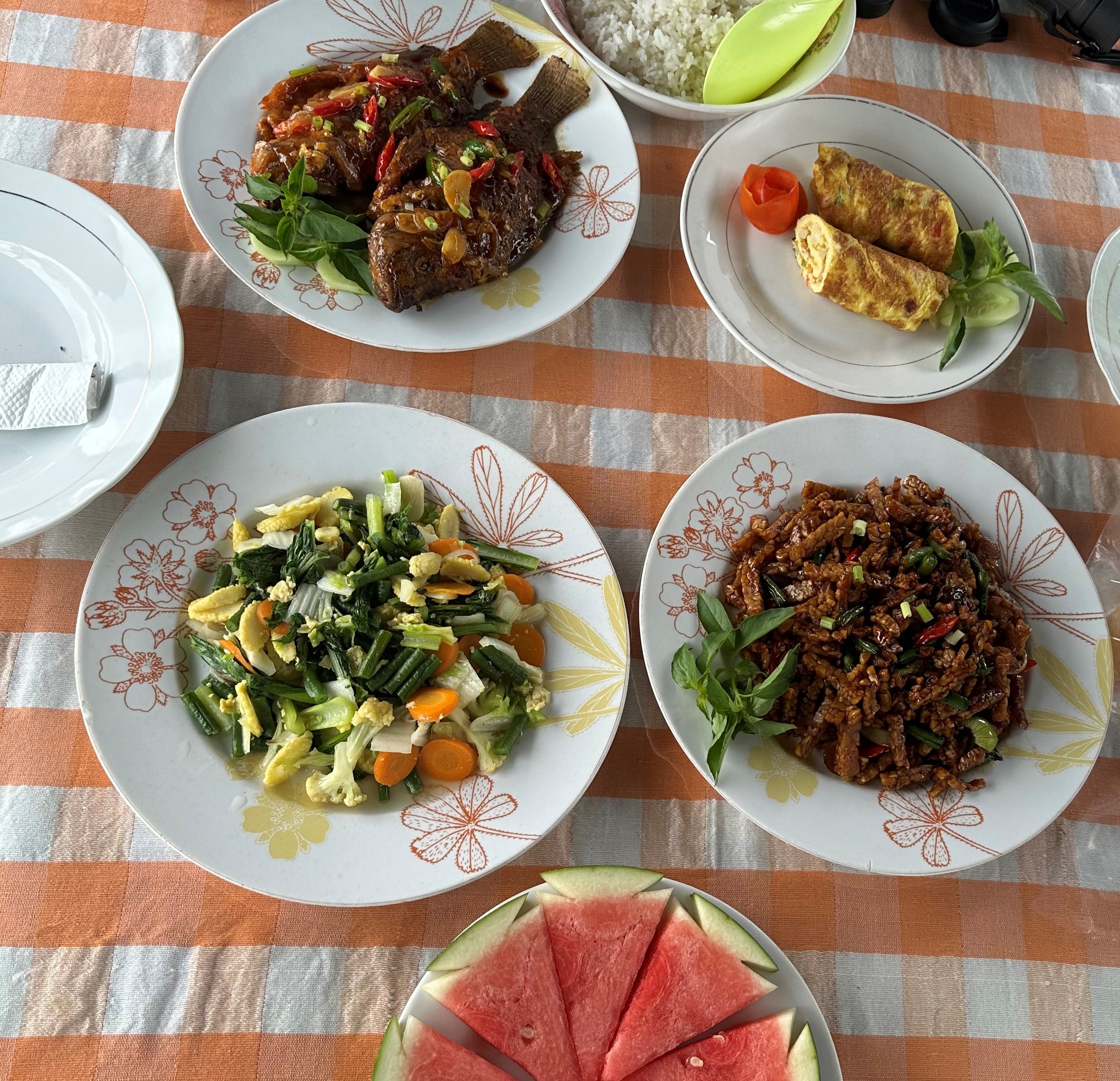
About an hour into the journey we had an amazing lunch that included fermented soy marinated in a wonderful spice, tilapia (whole) seasoned with chilis, rolls of fried eggs, steamed mixed veggies, and rice. In my journal I noted that it was perhaps the best meal we had had so far on the trip.
We saw a few Pinocchio-nosed proboscis monkeys hanging out in the trees. I didn't get a very good photo . . .
. . . but if you are familiar with the American comedian and actor Jimmy Durante, popular in the 1930s through the 1970s and known for what he called his schnozzola (big nose), you have a pretty good idea of what a proboscis monkey looks like.
Sam pointed out a orangutan nest high in a tree.
Then we caught glimpses of orangutans in the tall grasses and dense foliage. Just as when we saw our first Sumatran orangutans, it was a rush to see our first Bornean orangutans.
They are a critically endangered species, numbering less than 14% of what existed as recently as the mid-20th century
We passed this dock for one of the lodges (not ours) and admired the orangutan welcoming committee:
We docked at the Rimba Lodge, where we had booked a cabin so that Bob would have electricity for his CPAP machine. The alternative was sleeping on mattresses on the upper deck (where there was no electricity, no privacy, and a shared bathroom).
We had about 1 1/2 hours to kill, so first we took a look at a poisonous green viper curled up in a tree near the office (It was still there the next morning) . . .
. . . and then we crashed in our room. Sam told us later that it was 98% humidity. Our cabin only had electricity from 6:00 PM to 6:00 AM, so it was crushing heat and humidity in our room. What could we do but go to sleep?
By the way, here is our bathroom--the same all-in-one features we would see on the boats. The trick in showering in one of these is keeping the toilet paper dry.
We met up with Sam and our klotok at about 3:00 and finished our trip to the first of our main destinations on the river: Tanjung Harapan, a park where researchers and rangers feed the local orangutan population once a day. We started our visit in the information center, which was full of facts about orangutans, rehabilitation/conservation efforts, and this area.
On one of the information plaques, I was happy to see proof that the United States has been involved in the conservation efforts here.
After finishing up at the information center, we walked for about 1/2 mile on a very nice trail to the feeding station.
It was still unbearably hot and humid. Sam gave each of us one of these fans that twist up into a nice little packet and can be put in a pocket or bag. Later on during the trip, I bought a couple more at a stall at the airport for about twice the price we paid Sam.
As we drew near to the feeding platform, we stopped to read this placard that asked us to be quiet and respectful, stay with our guide at all times, keep a distance of at least 5 meters from the orangutans, refrain from using flash photography or selfie sticks, keep food and water out of view of the orangutans, and pick up any trash we might see. As far as we could tell, everyone obeyed the rules.
We noticed that unlike our jungle experiences in Sumatra, most of the tourists here were not locals, but rather Europeans, Australians, and a few Americans.
There were a few orangutans hanging around (literally) and waiting for lunch to show up. I loved the mamas with babies clinging to their backs or fronts. The mamas never seemed concerned enough to put an arm around the baby, which had the good sense to hold on tight.
I was blown away by how comfortably these huge animals walked along the smallest of branches, all four feet gripping like hands.
As soon as the bananas were spread out on the deck, the orangutans lumbered out of the bushes and onto the platform in their distinct manner of walking on their front knuckles. Males are distinguished from females by the growths on the side of the face and under the chin. That's a male on the left and a female in the center. That male was definitely large and in charge.
He reminded me of King Louie in The Jungle Book.
I took a dozen videos, but here are my two favorites. In this first one, how cute is that baby on its mama's back? And note how carefully she approaches the alpha male, backing carefully away when he turns towards her.
In this one, notice the teenager, in typical teenager fashion, stuffing everything he can into his mouth and grabbing what more he can with his hands before leaving. Hilarious! (Note that I assume it is a "he." We saw a mother orangutan do exactly the same thing later on.)
The diners came and went, some staying for a while on the platform, and others using the "grab and run" technique. There were at least 12 altogether, and possibly as many as 16. I couldn't get over the mamas and babies. We saw littles ones playing with each other, but the smallest never let go of mom.
Because the orangutans are fed only once a day, they aren't habituated to getting all their food from the feeding station.
We headed back to our klotok, which was docked in a pile of similar boats crammed against the shore. To get to our boat we had to go through at least three other boats, jumping from deck to deck. It's an accident and lawsuit waiting to happen. Oh wait, this is Indonesia. It's like this everywhere.
Back on our own klotok, we were greeted with a plate of hot fried bananas. They were by far the best fried bananas I've ever eaten. They were almost as good as good chocolate.
Motoring along, we stopped next to some trees with a large group of proboscis monkeys trying to settle down for the night, but the kids weren't having it. I counted 12, but I think there were at least 20, including a few long-tailed macaques. (Watch it full screen to get a better view.)
Sometimes we saw the numerous tails hanging straight down before we saw the bodies.
The proboscis monkey faces never ceased to entertain.
Also, check out the proboscis monkey's long feet.
What a beautiful place.
We headed back to the Rimba Lodge for a short rest before dinner.
We were greeted by the camp mascot, but all we really cared about was the tiny AC unit above our beds. The heat had zapped all of our energy, and we pretty much could not move off our beds until 7:00, which is when we headed back to the klotok to eat dinner.
It was another fantastic meal: rice, fried eggplant, potatoes and chicken, cooked greens, fried noodles, and watermelon and cantaloupe. It was an A+ meal.
Back at the Rimba Lodge, we had things other than that green viper to worry about.