Showing posts with label Slavery. Show all posts

Wednesday, February 14, 2024

NORTH CAROLINA: RALEIGH

 October 2022

On my last day I had several hours to kill after my son went to work and before I had to head to the airport, so I decided to take a look at North Carolina's capital city, Raleigh, named after Sir Walter Raleigh of Roanoke Colony fame. With a population of about 475,000, it is the 41st largest city in the United States, the 2nd most populous city in North Carolina after Charlotte, and one of the fastest growing cities in the country. In 2011 was ranked by Time as the third most-educated city in the US. 

Andrew Johnson, the 17th President of the US, was born here in 1808. Other notables include Olympic figure skater Kristi Yamaguchi, American Idol star Clay Aiken, and writer David Sedaris.

I was headed for the capitol building, but I detoured when I saw Christ Episcopal Church, built in 1848 to 1853. I love this sculpture entitled Peaceable Francis.


Down the street and around the corner is the First Baptist Church, completed in 1859.

Saturday, February 10, 2024

NORTH CAROLINA: CHAPEL HILL

 October 2022

Chapel Hill is a smallish city of about 62,000 in North Carolina dominated by the prestigious University of North Carolina at Chapel Hill. It is similar to the town where we currently live in both population and the university presence, but it feels a little more rural.  The climate is a bit more temperate than ours, and it gets about three times as much rain. Many of the streets look like this:


Since visiting Chapel Hill, I have learned that it is or was the home of many well-known folks, including former presidential candidate John Edwards, the musician Ben Folds, the author John Grisham, the journalist Charles Kuralt, novelist Betty Smith (A Tree Grows in Brooklyn), the  musician James Taylor, and author Thomas Wolfe (You Can't Go Home Again). Pretty impressive.

We had someone who wanted to go on a walk and hopefully chase that ball she was so lovingly guarding.

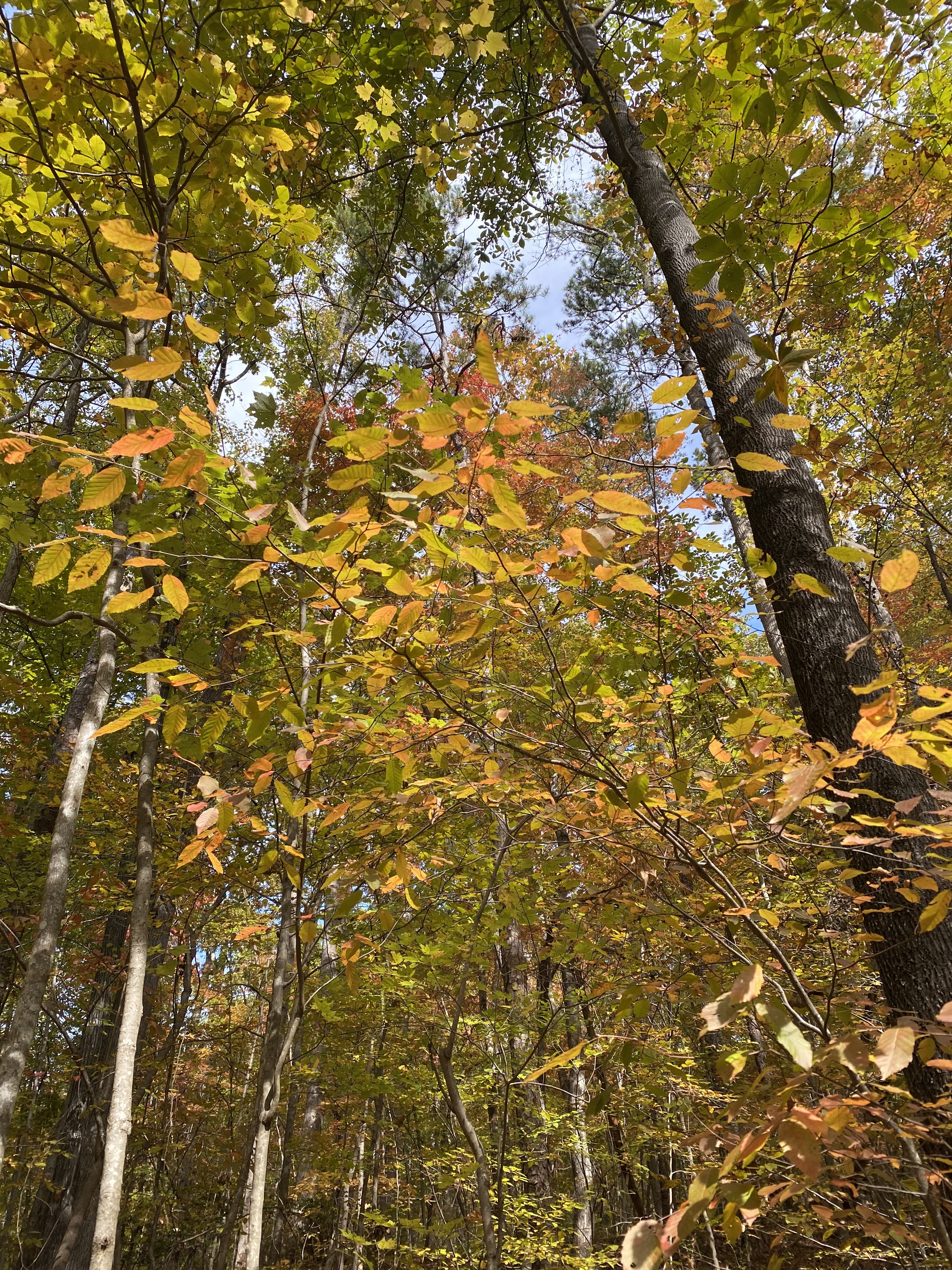
She got her wish. Not far from where our son was living when I visited are peaceful woods with wandering trails. The autumn colors were just beginning to emerge.

I was helping my kindergarten granddaughter with her "Flat Stanley" project where the child draws a picture of herself, then sends it "on a vacation" to visit a relative. The relative takes the child's self-portrait around and photographs it in a variety of places. It was fun to show "my granddaughter" the sights.

Monday, May 15, 2023

COLOMBIA: CARTAGENA, PART I

 March 15, 2023

Bob had arranged in advance for a private city tour in Cartagena, and after we dropped off our luggage at our hotel, we were joined by what turned out to be our best guide of the trip, a young woman named Carolina. She was excellent in perceiving our likes and dislikes and adjusting the tour accordingly.

Cartagena, founded by Spain in 1533 and located on the Caribbean coast of northern Colombia, is a city of almost a million people. It is a major port (one of the largest in South America) and historically part of world exploration and trade. 


Our hotel was kitty-corner from the Castle San Felipe de Barajas, a fortress built in 1536 by African slave labor under Spanish rule. It is an imposing presence and defended the city from attacks many times in the past. Along with the historic city center, it was declared a UNESCO World Heritage Site in 1984. These days it is used for social and cultural events. 

Our first destination was the Convent of Santa Cruz de la Popa, a convent built by the Spaniards atop Mount la Popa, the highest hill in Cartagena (about 500 feet high). From that spot we pretty much had a 360° view of the city. 

We could see the downtown/business district skyscrapers, which are almost all white. The contrast to the poverty-stricken areas full of cardboard shacks on our way up the mountain was pretty stark. 

Wednesday, April 12, 2023

JAMAICA: FINAL THOUGHTS

 Post trip, February 2023

We have developed a habit of listing our insights, most memorable experiences, questions, and so on after we return from a trip.  Here is our list for Jamaica:


Jamaica is very big, bigger than it looks on a map, and maybe it seems so big because it takes forever to drive anywhere because the roads are so awful.

The tap water is drinkable, surprising because the infrastructure (for things like roads) is so horrible. 

People are very friendly and usually open to conversation. (Chad is very friendly, which highlighted this for us.)

Jamaica has amazing natural diversity, both flora and fauna. For example, there are at least four types of unique, beautiful hummingbirds, lots of endemic species, many plant varieties that were unfamiliar to us, etc.

For such a relatively small area, the landscape/climate is quite diverse--beaches to mountains.

There are no big predators!

Stray dogs are everywhere, and they all look the same: mid-size, short hair, tan/caramel-colored. They never approached us, but they weren't afraid of us either.

There were a few feral cats, but not nearly as many as dogs.

There are SO many styles of hair--braids in every design, dreads, natural fuzz, shaved, etc.  I think there is more "hair diversity" here than anywhere we've been.

Many of the beautiful landscapes feel inaccessible, including steep mountain roads without turnouts and beautiful beaches on the northern coast with no parking.

The tourism potential here is much bigger than the tourism reality. The all-inclusive resorts dominate and the rest of the country has very little international tourism.

"Tourist atractions," like the botanical gardens or the Greenwood Great House, are at the end of horrible roads or are not adequately marked with signage. Some of the properties are also not very well maintained.

They don't have decent souvenirs. They could do a lot better in this area as well.

In contrast, Bob Marley's house is well-marked, well-maintained, and tourist-friendly. You can definitely tell where the international travelers like to go.

At the the better developed sites, like Dunn's River Falls or Konoko Falls, the system is very inefficient. Nothing is automated. They are 20 years behind in tourist technology.

Restaurants are so slow, even U.S. chains like Pizza Hut and Burger King, and even the nicer hotel restaurants. There is no culture of efficiency. Everything is very laid back.

Outside of tourist areas, and even within them, the standard of living looks pretty low. There are a lot of shacks and a lot of litter.

We did not notice any satellite dishes. Do they have TV? Is it all cable?

There were no diet drinks, and Pepsi reigned over Coke 10 to 1.

KFC and Pizza Hut dominate the U.S. chains.

There is very little public art. We saw only a few murals, not many statues or sculptures, and almost no live music anywhere. That may have been the biggest surprise of all.

The churches were small and non-descript, and were dominated by Anglican and Baptist churches (white and black, respectively), with almost no Catholic churches or other churches.

We never saw any evidence of an LDS presence (missionaries, chapels), although there are 6 wards, 12 branches, and a stake there.

About 99% of the population appears to be of African descent, but the owners of large businesses that we came into contact with (rum distillery, Greenwood Great House, etc.) are white.

We had very knowledgeable tour guides who weren't formally educated for their job.

Well-dressed school children wear clean, pressed uniforms.

The locals don't seem to want to talk about their history of slavery. We can't figure out why. They just seem to largely ignore that part when discussing the cultural and historical past.

To say they love Bob Marley is an understatement.

Some people wore face masks, but not many--about the same as in the U.S.

Compared to Puerto Rico (Jamaica is 1.2x larger but has 280,000 fewer people), Puerto Rico has much better infrastructure: nicer roads, better cared-for sites, better food, better signage, etc.

We felt safe. The locals never felt threatening.  The only time we felt unsafe was on the roads. Jamaicans are crazy drivers and the roads, as noted earlier, are awful.

Almost everywhere we went, "the credit machine was down." Prices were often given in U.S. dollars, so to convert to Jamaican (at whatever rate they wanted) probably cost more than just paying in U.S. currency. We liked having both USD and Jamaican dollars available. We paid for very little on a credit card and almost never could use an American Express card ("Don't leave home without it").

One U.S. dollar = 151 Jamaican dollars. That made conversion from Jamaican to U.S. difficult.  For example, something that cost 25,000 Jamaican dollars would be about $165 U.S.

Thursday, March 30, 2023

JAMAICA: OCHO RIOS AND DUNN'S RIVER FALLS AND KONOKO FALLS

 February 18, 2023

Ocho Rios (Spanish for "eight rivers") is a town on the north Jamaican coast. Many believe Christopher Columbus first set foot in Jamaica just outside the city.

Our hotel in Ocho Rios was a once grand multi-building complex, but it is now in a bit of a dilapidated state. Our room had no hot water, no AC, no wifi, and a cockroach on the bed.


However, they had a great sign on the office wall.
We were worn out by heat, humidity, and walking, and in spite of all the hotel issues, we just needed sleep.

The next morning we were in no rush to get started. Chad was snorkeling, and we had a plan to meet at 11:00, so we drove down to the Ocho Rios Craft Market. It was about the junkiest tourist trap we've ever seen, not even meriting a photo. Nothing was original. It all looked like it was made in China. There were multiple stalls, all selling the same items, and every vendor claimed to have made the items in his/her booth. We decided we needed breakfast instead of shopping.

Definitely not a breakfast spot:

Sunday, March 26, 2023

JAMAICA, DAY 3: GREENWOOD GREAT HOUSE AND FALMOUTH

February 17, 2023

Bob got up early for a morning of bird watching, and I slept in until 7:30. The hotel included a breakfast buffet with boiled bananas and sweet potatoes, fish hash, some bread-like items I don't know the names for, scrambled eggs, sausage, and French toast. It was all good, and the view of Montego Bay made it taste even better.  Chad was out there snorkeling, and he said the water was crystal clear and the fish were amazing.


I had a lazy morning, and when Bob got back we headed out to the Greenwood Great House. GPS led us down roads that could hardly be called roads--narrow, rutted dirt paths that wound around tin shacks. There were virtually no indicators, like signs, for example, indicating that we were going in the right direction. It was hard to believe most tourists wouldn't be deterred by the roads or would get lost on their way to the house. We persevered, however, and finally pulled up to the rear of a large, dilapidated erstwhile manor.

Friday, March 10, 2023

JAMAICA, DAY 2, PART 2: SPANISH TOWN AND THE WORTHY PARK RUM PLANTATION

 February 16, 2023

Our next stop was a brief one in Spanish Town, the Spanish and then British capital of Jamaica from 1534 until 1872, a period of 338 years. 

On our way there we passed this interesting street sign. I have no idea why a hamburger would adorn a street sign, but it made me hungry. Maybe that is the point?


When we were researching where to go in Jamaica, I checked what the U.S. State Department had to say about safety. They gave Spanish Town a 4, which essentially means "Don't go there." When Bob asked his contact in Jamaica about that, she just laughed and said not to worry, just don't go at night. That was somewhat comforting. 

Originally called Villa de la Vega, the city was the second capital of the royal Spanish realm of Jamaica. It was seized in 1655 when English troops conquered the island, and the English renamed the area "Spanish Town." Jamaica's wealth was on full display here for the next 217 years. The most notable events that occurred around its main square include the reading of the Emancipation Proclamation in 1834 and the Full Freedom proclamation in 1838. In 1872 the seat of government was moved to Kingston.

We focused on the four large buildings that border Emancipation Square.

This is the "Old King's House," erected in 1762. For almost 100 years, it was the residence of the governor of Jamaica. The aforementioned Emancipation Proclamation of 1834 was read from its steps. From a distance, it still looks pretty grand.

Sunday, February 26, 2023

JAMAICA 1: GETTING THERE, PORT ROYAL, AND FORT CHARLES

 February 15, 2023

Many years ago my husband began doing research on his third great-grandfather, Captain George Cannon of the Isle of Man, who was a slave ship captain. One thing led to another, and soon he was deeply immersed in learning more about his ancestor's life and work. He posted some of his findings on his blog, and that created some fun connections with family members--known and previously unknown. 

Over the years we have made an effort to visit sites related to Captain Cannon, going first to his home in Peel, Isle of Man, in 2006. In 2014 we took a sobering trip to the Ghana coast where Captain Cannon picked up slaves. (See posts on Fort Amsterdam, Cape Coast Castle, Fort St. Anthony, Elmina Castle, and Fort William.)

For many years, Bob has wanted to visit the third point of the slave trade triangle, Jamaica. He had employed a researcher on the island to see what could be found, but he wanted to see the ports and shores with his own eyes. I had a long weekend in February with Lincoln's birthday and President's Day off, and it seemed like the time was right. 

In addition, during the Covid shutdown, Bob had been contacted by Chad Cannon, a distant cousin (I think a third cousin once removed?) who was also a descendant of Captain Cannon (Chad's great-great-grandfather was Bob's great-grandfather's brother), and Chad and his wife Sarah came out for a visit one weekend to get acquainted and discuss Bob and Chad's mutual roots. When Bob started planning this trip to Jamaica, he reached out to them to see if they might be interested in joining us. Sarah ended up not being able to get away from work, but Chad was a welcome addition to our trip.

So that's the background for our Jamaican Adventure.

Bob and I had a 1:00 AM flight out of LAX--brutal, but it meant we were able to spend a full day at work before driving to the airport, and that we would arrive at our destination in the morning.  It is our typical MO. 

The international terminal at LAX is a lot nicer than in used to be, and we usually plan to eat in the food court there when we arrive.


Tuesday, November 17, 2020

LOUISIANA: NEW ORLEANS, Part 2 - National World War II Museum and New Orleans Museum of Art

November 6-10, 2019 

I visited two really good museums while I was in New Orleans: The National World War II Museum and the New Orleans Museum of Art.

1. The National World War II Museum

At the end of a long day of conferencing, I grabbed a taxi (Uber was SUPER slow in New Orleans, but a cab was always waiting at the hotel) and headed to what Congress designated in 2003 as America's official National World War II Museum. The museum's website states, "The National WWII Museum tells the story of the American experience in the war that changed the world--why it was fought, how it was won, and what it means today--so that all generations will understand the price of freedom and be inspired by what they learn."


Originally called the D-Day Museum, the museum opened (appropriately) on June 6, 2000. It is affiliated with the Smithsonian Institution and is worth much more time than I was able to give to it. Since its opening it has had many expansions and added many new exhibits. It is a must-see museum, whether your are a war buff or history aficionado or neither. Just go.

I started in the European theater section, and was reminded that the United States lost far fewer of its service members than its enemies did.

The war was also NOT a popular cause in the early years.

Saturday, October 14, 2017

BALTIMORE, MARYLAND: INNER HARBOR

In Baltimore, "Inner Harbor" refers both to a body of water (part of the 39-mile-long Patapsco River, which flows into Chesapeake Bay) and to the developed waterfront area.  I was surprised to learn that it was in this harbor that the Battle of Baltimore took place during the War of 1812. It was where Francis Scott Key was held in a British ship during the conflict, and from where he saw the huge American flag flying over Fort McHenry on the morning of September 14, 1814. It seems too far away from the fort for all of that.

The Inner Harbor is a little bit quirky. For example, check out these dragon boats:
That glass-topped building behind them is the National Aquarium (I'm not sure why it is the "National" one), which is the biggest tourist attraction in Maryland, drawing 1.5 million visitors annually.

Did we go there? No. We should have, just like we should have gone to this colossal Barnes & Noble and the Hard Rock Cafe. 

Instead we visited the Historic Ships exhibits. My husband likes ships more than I do.

Four historic ships are docked in Inner Harbor and have been turned into floating museums. We first stopped to see the USS Constellation, "The Flagship of the Anti-Slave Trade." It was built in 1854 and used during the Civil War for many things, including blockades of the South:


Wednesday, September 13, 2017

ANNAPOLIS, MARYLAND: AROUND TOWN AND ST. ANNE'S CHURCH

We couldn't find a parking space in downtown Annapolis near the State House, so we parked about a mile away. The good part about that was that we got to enjoy the beautiful scenery of Chesapeake Bay. The bad part is that it was about 100° and about 90% humidity.


As we got near to downtown Annapolis, it was a nice surprise to come upon this public art piece showing a man telling stories to three children:
That soda behind the girl on the right almost looks like it belongs there.

Then we learned that it's not just ANY man--it's Alex Haley, author of the epic saga Roots (1976), which became a record-breaking television miniseries in 1977. (By the way, did you know Haley also co-authored The Autobiography of Malcolm X? That came out in 1965.) Roots tells the story of six generations of Haley's own family. The Kunta Kinte - Alex Haley Memorial commemorates the arrival of Haley's ancestor and other slaves in this very harbor:

I had a flashback to the Kunta Kinte statue in Atlanta outside the Martin Luther King Museum, which shows Kunta Kinte holding aloft his baby daughter Kizzy, much like Mufasa holds up his newborn cub Simba in The Lion King.

Thursday, April 20, 2017

ST. KITTS: ROMNEY MANOR, CARIBELLE BATIK, AND WINGFIELD ESTATES

St. Kitts is an island with a surprising number of things to see, especially considering that it is only 18 miles long and an average of 5 miles across.

My brother headed off on his own journey to climb Mount Liamuiga, the 3,792-foot-tall volcano that dominates the western end of the island. 
Picture borrowed from here

The remaining five of us toured Basseterre (see last post), and then headed out of the city in our rental car on a trip along the coast. 

Just a note about renting a car. On most of the Eastern Caribbean islands, the steering wheel is on the right and you drive on the left side of the road as you do in Great Britain, the opposite of what we're used to. It can be a little disconcerting at first, but you'll get used to it quickly. However, driving is further complicated on St. Kitts because the roads are almost all only wide enough for one car, so if there is two-way traffic, one car pulls as far over to the left as possible.The roads were clearly not built for a lot of automobiles. 

No wonder that in some places, St. Kitts feels like an uninhabited tropical jungle:


Our first stop was one I had requested, a batik factory. I had read that batik is one of the main crafts of the Caribbean, and Romney Manor is the place to go to see it made.

Long before batik became popular here, however, he first European settler of this area was Sam Jefferson, the third-great-grandfather of Thomas Jefferson. He established a home on St. Kitts in the early 17th century, but sold part of his estate to the Earl of Romney in the mid-17th century. Successive Earls of Romney owned this area through the mid-19th century. In 1834, contrary to the wishes of British Parliament, the Lord Romney of the day freed all his slaves, making the Romney Estate the first one in St. Kitts to emancipate its slaves.

Moving forward to the 20th century, since 1974 the Caribelle Batik company has been operating a highly successful business from this spot. The name "Caribelle" can be broken down into its two key parts: "Carib" (for Caribbean) and "belle" (meaning beautiful). And beautiful it is:

Tuesday, November 25, 2014

AFRICA: GHANA, FORT WILLIAM (AKA ANOMABU )

Our last stop in Ghana was a trip to Fort William, also known as Fort Anomabu because of the town in which it is located. We were well-seasoned slave-site sightseers by this time, having been to Fort Amsterdam, Cape Coast Castle, Fort St. Anthony, and Elmina Castle, but for some reason Anomabu was especially haunting. Again, we were the only tourists there for most of our visit, and the sheer isolation carried its own eerie feeling.

The building that sits on the shores Anomabu today was constructed by the British in 1760. It hasn't changed much, at least not in the past 140 years:
Anomabu in the 1870s. Photo from here.

Monday, November 17, 2014

AFRICA: LDS CHURCH IN GHANA, PART I

One of the things I really looked forward to on this trip was the opportunity to attend church in Ghana. As we drove along the Ghana coast, we noted LDS chapels in almost every town of any size, and if not a building, at least a sign for the church with an arrow pointing down a dirt road. The LDS Church presence is very strong on the coast, a miracle considering it's been there less than 40 years.
Graph from here
I've already discussed the fact that Bob's third-great-grandfather was a slave trader on these shores, and it was partly to better understand that part of Bob's ancestry that we went to West Africa, but there is another part of the Cannon history that drew us to Ghana. In 1978, Bob's uncle Ted Cannon (his dad's brother) and his wife Janath were called to serve an LDS mission in Ghana and Nigeria with another couple, Rendell and Rachel Mabey. The two senior couples were the first official LDS missionaries in West Africa, and what they found when they got there was astonishing, and I'll get to that story in a minute. First, a few words and pictures about our experience attending Sacrament Meeting in the Cape Coast 2nd Ward.

Unlike many of the other LDS buildings we had seen during our travels, this one wasn't the typical American-style architecture:
It looked more like a hotel or apartment building, and it's probably a lot more practical for Ghana than the more Westernized versions of an LDS chapel we had seen in other towns.There was a nice entry:
. . . with a nice barbed wire fence:
 . . . coupled with a welcoming sign. (However, I think you're only welcome if you come when the gate is open.)