Showing posts with label castle. Show all posts

Wednesday, October 15, 2025

GERMANY: GRAFENECK

 May 21, 2025

This post is one of the hardest ones I think I have ever written. The subject matter is difficult, and six months out, I find I am still trying to process this day's events, both those that happened in 2025 and those that occurred exactly 85 years earlier in 1940.

Everyone has heard of Auschwitz-Birkenau, Dachau, Sobibor, and other concentration camps, but I am guessing that very few Americans are familiar with Bernberg, Hadamar, Brandenburg, Hartheim, Sonnenstein, and--the one that matters most to me and my siblings--Grafeneck. Each of these were "extermination centers" that were part of the Nazi Aktion T4 program. 

Aktion T4 preceded the concentration camps extermination program, and in fact was a foundation for the killing methods used in the camps and the beginning of the systematic mass murder system that led to the Holocaust. Its goal was to rid Germany of "life unworthy of life," the mentally ill and disabled. 

A propaganda poster in the Grafeneck Memorial
Documentation Center showing a strong German trying
to "support" two mentally ill creatures and noting that
supporting a handicapped person until the age of 60
costs 50,000 Reichsmarks.

Victims were brought against their will and generally without the knowledge of their families to one of the six facilities I listed above. There they were gassed using carbon monoxide, which took about 20 minutes--a much slower process than the Zyklon B (hydrogen cyanide) gas later used in the concentration camps--and their bodies were cremated. The Nazis called these "mercy deaths." Families were notified that their relative died of some randomly chosen but plausible cause, and often a container of indiscriminate ashes was sent to the family. 

Sunday, August 24, 2025

GERMANY: DRESDEN

 Sunday, May 18, 2025

We were up at 7:00 AM, ate breakfast in our hotel at 8:00, and left at 8:45 to catch a 9:00 church service.

Except . . . I failed as navigator and took us to the wrong church. Somehow we ended up at Christ Church, a Lutheran church whose claim to fame is that it is Dresden's only remaining church with two steeples and was the first Art Nouveau church in Germany. It was built in 1903-1905 and was badly damaged by bombs during the bombing in February 1945 that destroyed much of the city. (More on the bombing in a minute.) It was repaired enough to make it usuable in 1950-1951 and thoroughly restored in 1973-1980.

We walked all around the church searching for an unlocked door, but we didn't find one. We did discover this beautiful sculpture of Christ with a lovely green patina. It made it worth the stop.

We finally found the church we had been looking for, the Frauenkirche, or Church of Our Lady. 

The church was destroyed during the infamous February 1945 firebombing of Dresden, a joint RAF and USAF operation that included four attacks over three days, destroying more than 1,600 acres of the city's center and killing approximately 25,000 people. This bombing preceded the bombing of my mother's hometown of Pforzheim by ten days, and she would often weep on the anniversary of this event as well as on the anniversary of the bombing of Pforzheim.
Dresden after the bombing. From Wikipedia.

A bronze plaque in the square shares this memory from Church Inspector Weinert (translated here from the German): "On Thursday, February 15th, around 11 a.m., as I was entering the dead city, searching for the cathedral dome in the milky fog, I was shocked to see nothing. An hour earlier, my wife, searching for me, had witnessed this tragedy: after an initial, quiet crackling, the dome slowly collapsed, and then, with a tremendous bang, the outer walls of the church burst, and a pitch-black cloud of dust filled the entire area."
View from City Hall after the bombing. 

Monday, August 18, 2025

GERMANY: WITTENBERG

 May 17, 2025

About 50 miles northwest of the sleepy little town of Torgau and also positioned on the Elbe River is Wittenberg, a somewhat larger city with 45,000 inhabitants. A university was established here in 1502, which attracted two important luminaries to its faculty line-up: Martin Luther and his friend and fellow reformer Philip Melanchthon.

Luther's and Melanchthon's portraits were painted by Lucas Cranach the Elder,
the most famous German portraitist of his day, who painted at least ELEVEN portraits
of Luther and over THIRTY of Melanchthon..

Wittenberg is a typical charming German town, maybe even more charming than most because unlike many other German cities of any size, it was spared destruction during World War II. Its religious history protected it from the Allies' bombs. However, it was occupied by the Soviets after the war and became part of East Germany in 1949.


Germany has their own version of "George Washington Slept Here." Two windows in this pretty building are marked with this information: Karl August (1757-1828), who was the Duke of Saxe-Weimar, visited the city in 1820, and Napoleon I, aka Napoleon Bonaparte (1769-1821), King of France, slept here in 1806 and 1813. 

Tuesday, August 12, 2025

GERMANY: TORGAU

 May 17, 2025

Torgau is a smallish town in eastern Germany on the Elbe River that today has a population of about 20,000 people. Probably its biggest claim to fame is that it is the place where the US and Soviet armies first met at the end of World War II on April 25, 1945. Eventually, Torgau became part of the region controlled by the Soviet Union and known in the United States as East Germany.

But that was not our interest in the city. We had planned a few days in this area of Germany--Saxony--to become better acquainted with the religious reformer Martin Luther, who established Torgau as a key center for the Protestant Reformation. Luther traveled here more than 60 times from his home in nearby Wittenburg to consult with princes and theologians, and Torgau was where he consecrated the first church intentionally built as a Protestant church.

Our first stop was at the Hartenfels Castle, which was built in the 15th century, making it the largest completely preserved early Renaissance castle in all of Germany. 

One of the most interesting things about the castle is that is has a moat surrounding it that is full of greenery and logs rather than water.

That is because the moat is home to two brown bears. This tradition dates back to the castle's origins. After a pause beginning in the 19th century, the bears were reinstanted in the 1950s with a gift from the Leipzig Zoo. Benno and Bea, who are brother and sister, are the latest residents, having lived here since 2013. We only saw one of them, but I can't tell you which one.


Wednesday, September 4, 2024

IRELAND, DAY 3: MINARD CASTLE, THE DINGLE PENINSULA, AND SLEA HEAD DRIVE

 July 6, 2024

Our plan had been to start the day at Blarney Castle, but when we tried to get tickets online, they were sold out. That's okay--we didn't feel a great need to kiss the Blarney Stone and taking one thing off the schedule made for a more relaxed day.

We left the B&B at about 9:30 or 10:00 and headed west towards the Dingle Peninsula.

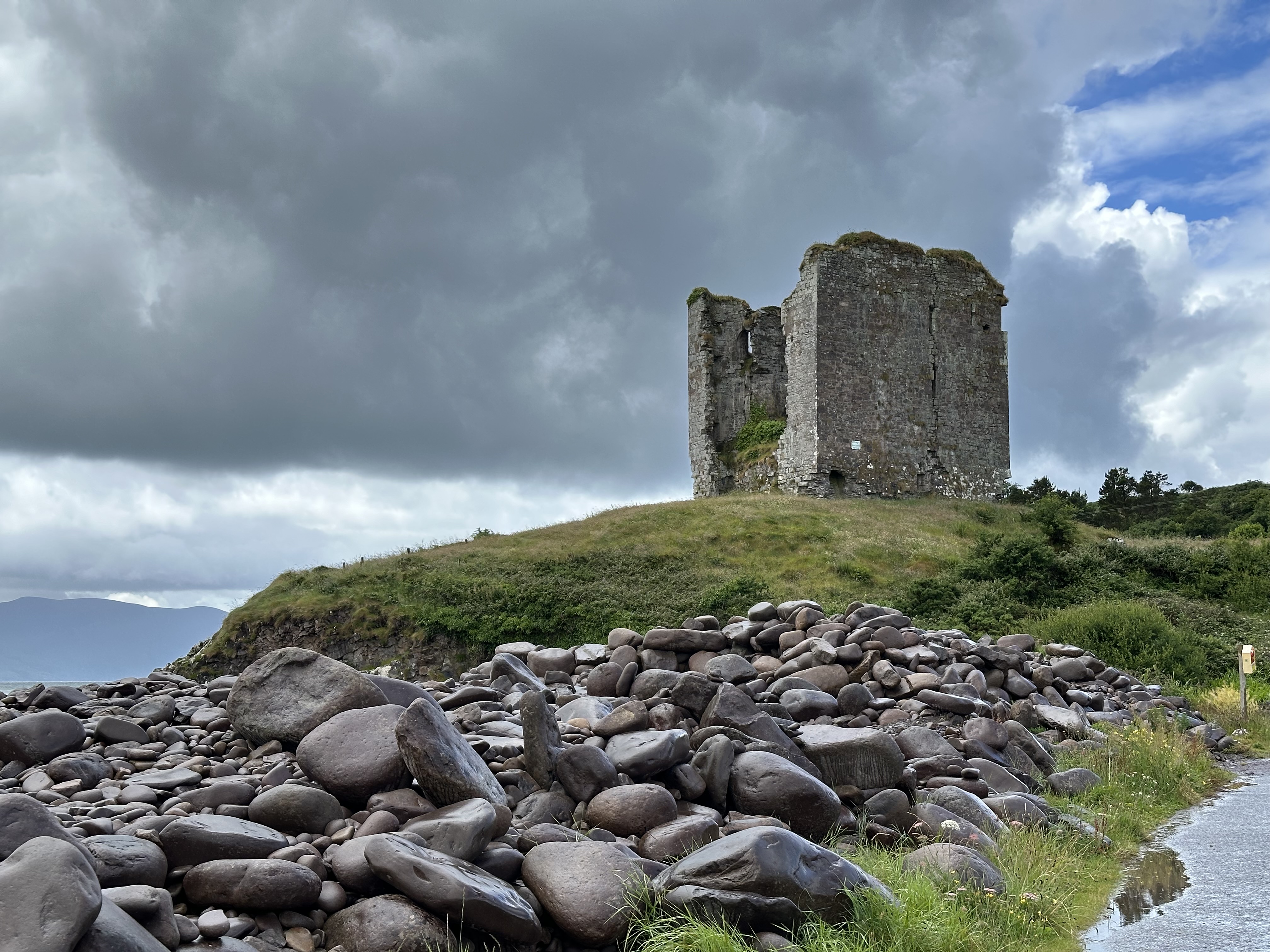
Our first stop on the Dingle Peninsula was Minard Castle.

To get there from the main road, we drove down a very narrow single-lane road. Every now and then there was a turnout so two cars could pass, but in most spots even our tiny car seemed to hug both sides of the road, and if two cars meet in an area like this, they both have to pull over into the weeds in order to pass.

Eventually, we came upon a windswept hill crowned by a lonely mid-16th century monolithic three-story ruin . . .

. . . that looks over a desolate bay of the cold Irish Sea.

Saturday, August 24, 2024

IRELAND, DAY 2: ROCK OF CASHEL AND HORE ABBEY

 July 5, 2024

We were hitting jet lag on the afternoon of our first full day in Ireland, so I picked up a Coke Zero at the gas station. I was intrigued by the ingenuity of the attached cap. That's a great way to keep the cap with the bottle for recycling.


Not long after entering County Tipperary, we came across a blocked off right-of-way for a herd of milk cows. Now that's something you don't see everyday (or any day) in California.

Eventually we made it to Cashel, a little town of about 4,400 people with a BIG tourist draw, St. Patrick's Rock, more commonly known as the Rock of Cashel. The word "cashel" means "fort" or "castle" in Irish.

We had to park at the base of the rock and trudge up the hill, but the view looking up was quite impressive.

Sunday, August 18, 2024

IRELAND, DAYS 1-2: TRAVEL, ARRIVAL, AND EXPLORING KILKENNY

 July 3-4, 2024

We left home at about 3:00 PM and made it through downtown LA and to our parking garage in about two hours.  Not bad.


We had an uneventful check-in for a non-stop flight to Dublin on Aer Lingus, a new airline for us. We were seated on the 3rd or 4th to the last row in the center section of a 2-4-2 configuration, but the last five rows or so only had three middle seats, making the aisles wider in the back near the bathrooms. Genius. Anyway, we both had aisle seats with an empty seat between us. Miraculous! And another miracle--I slept for a good part of the 9 1/2 hour flight, a rarity for me. We did have two meals. Dinner was tortellini with tomato sauce, salad, a roll, and chocolate mousse that was pretty good. Breakfast was a hot bagel with melted cheese and a sausage patty--not so good.  I watched one movie, Disenchanted with Amy Adams, sequel to Enchanted. Worst move I've seen in a long time. You can't win them all.

For a relatively small airport, we had a long walk between getting off the plane and passport control, but by then our suitcases were waiting for us. We walked to the car rental area to get our car from Budget and discovered why our rental (and every other rental we looked at) had been so cheap. They REQUIRE customers to buy insurance, which added $400, plus we had to put down a $2,000 security deposit. They must have lots of problems with people who can't drive on the left side of the road and with a steering wheel on the right. We had a very small Renault Clio with a manual transmission, but Bob, fortunately, is an absolute pro at shifting with his left hand and driving on the left side of the road.  
Our plan was to immediately leave Dublin and drive to Kilkenny, a distance of about 80 miles, which we thought might take an hour and a half. However, traffic was very heavy leaving Dublin, and not long after leaving the car rental place, the car began beeping at irregular intervals. Then the tire light came on, so we figured the low tire pressure caused the beeping. We got off the freeway, found a gas station, filled the tires, then figured out how to turn off the tire warning light. Sixty seconds into our drive, the beeping came back. Ultimately, I figured out that it was a sensor for lane control. Every time Bob began to drift towards a line in the road without signally, it beeped--and that was often. I found the instructions for how to disable that feature, and we continued our drive in peace.

Monday, March 4, 2024

GERMANY 2000: ULM, ROTHENBURG OB DE TAUBER, SPEYER

 December 20-21, 2000

We had taken the southern route near the Alps and the Austrian border on our way from Neuschwanstein to Salzburg, and on our way back into Germany we took the Autobahn from Salzburg to Ulm, bypassing Munich, which was a bit of a disappointment, but my mother said we were short on time and stopping in Munich would slow us down too much.  We also would have liked to stop in Dachau, which was just a few miles off our route, but again, my mother said no--there wasn't much to see.  

As far as I know, my mother never visited a Nazi concentration camp. If she did, it was one of the many things she didn't want to talk about.

Two of our most memorable experiences of the trip happened in Ulm, and I'll get to those later. Ulm is a city of about 126,000 situated on the Danube River. Founded in 850, it is noted primarily for two things: being the birthplace of Albert Einstein in 1879 and having a Gothic church with the tallest steeple in the world (530 feet).

Our hotel was right by the massive cathedral, which my mother said is the largest Protestant church building in the world, but it actually ranks 4th in the world and 2nd in Germany behind the Berlin Cathedral. Still, it is a massive 5,950 square meters (or over 64,000 square feet) inside, seats 2,000, and is, indeed, the tallest church (of any denomination) in the world.


Wednesday, February 28, 2024

AUSTRIA 2000: SALZBURG

  December 18-19, 2000

Mom was excited to take us to Salzburg, one of the cultural centers of Europe for centuries. The area has had inhabitants since the Neolithic Age (10,000 - 4,500 BCE), so even for Europe it is old. Salz means "salt," and the name "Salzburg" first showed up in the 8th century when the local economy focused on salt mining.

We arrived on a stormy, blustery evening, the only really bad weather of the trip. Outside our somewhat dingy hotel, Mom had us park the car on the sidewalk, which seemed strange to us then but more normal to us now that we've spent more time in Europe. 


I wish I had better photos of the beautiful Christmas decorations. This much-faded photo I took doesn't do them justice.

But this nice picture of the city that I clipped from a brochure shows the city's elegance. The historic city center of Salzburg has been designated a UNESCO World Heritage Site.

Friday, February 23, 2024

GERMANY 2000: NEUSCHWANSTEIN CASTLE, FUSSEN, AND THE WEISKIRCHE

 December 18, 2000

Neuschwanstein Castle is one of those places that everyone has seen, at least on postcards and calendars and in travel guides. With 1.5 million visitors a year, it is one of the most popular tourist sites in Europe. We were excited to visit and see it with our own eyes.  It did not disappoint, at least on the outside. It is very photogenic. These are brochure clippings from my scrapbook:


And this is information about King Ludwig II of Bavaria, who built it. It makes a great story!

Located on the northern edge of the Alps about 60 miles southwest of Munich and not too far from the Austrian border, the castle is perched half-way up a mountain and can be seen from a distance on approach.


Monday, May 15, 2023

COLOMBIA: CARTAGENA, PART I

 March 15, 2023

Bob had arranged in advance for a private city tour in Cartagena, and after we dropped off our luggage at our hotel, we were joined by what turned out to be our best guide of the trip, a young woman named Carolina. She was excellent in perceiving our likes and dislikes and adjusting the tour accordingly.

Cartagena, founded by Spain in 1533 and located on the Caribbean coast of northern Colombia, is a city of almost a million people. It is a major port (one of the largest in South America) and historically part of world exploration and trade. 


Our hotel was kitty-corner from the Castle San Felipe de Barajas, a fortress built in 1536 by African slave labor under Spanish rule. It is an imposing presence and defended the city from attacks many times in the past. Along with the historic city center, it was declared a UNESCO World Heritage Site in 1984. These days it is used for social and cultural events. 

Our first destination was the Convent of Santa Cruz de la Popa, a convent built by the Spaniards atop Mount la Popa, the highest hill in Cartagena (about 500 feet high). From that spot we pretty much had a 360° view of the city. 

We could see the downtown/business district skyscrapers, which are almost all white. The contrast to the poverty-stricken areas full of cardboard shacks on our way up the mountain was pretty stark. 

Wednesday, February 1, 2023

PORTUGAL: SLEEPING IN FATIMA AND A TRIP TO ESTREMOZ

  July 1-2, 2022

After a long day of sightseeing, we were ready to dump our stuff at our hotel, grab a bite to eat, and go to bed. The only problem was that we couldn't find our hotel, the SDivine Fatima Hotel. Our GPS placed in in the center of a roundabout. We had to call the hotel twice for directions. We finally found it just off the roundabout on one of the many exits, but set back from the road with no visible signage.

We were still in the city of Fátima, and it was fun to see this azulejo depiction of the Visitation of Our Lady of the Rosary to the three shepherd children.

After unloading our luggage, we set out on foot to find something to eat. The only thing we found open was a butcher shop that made sandwiches and "toasts," or grilled sandwiches (kind of like paninis). The guy behind the counter spoke as much English as I spoke Portuguese, so we had a pretty funny pantomime exchange. He gave us some meat and cheese samples to try, and we pointed at what we wanted. When Bob asked for mayonnaise for his sandwich, the butcher was horrififed, basically refusing. The sandwiches were good, at least my toastsed one with melted cheese oozing out the sides was!

We also shared some very good sausage and olives.

The next day we got off to an early start because we planned to cover a significant distance.