Showing posts with label garden. Show all posts

Monday, March 16, 2026

INDIA 2025: WALKING TOUR OF AMRITSAR

 November 22, 2025

Our guide in Amritsar, Roop, was a devout Sikh, complete with a pale lilac turban and a long beard. He was great. Unfortunately, I didn't get a photo of his face, but here is a great picture of his turban.


Amritsar is the spiritual and cultural center for Sikhs, much as Varanasi is for Hindus, and is considered a holy city in Sikhism. It was established in 1574 by the fourth (of ten) Sikh guru, Guru Ram Das. Situated in the state of Punjab and only 17 miles from the border with Pakistan and with a population of about 1.5 million, it is also an important economic and political location. 

Roop picked us up from our hotel and took us to the historical area of town, which was, like other large cities in India, crowded, noisy, and jam-packed with fascinating things to see. I think I would enjoy walking up and down the main streets every day just to see what was going on.

Note the sign for international drink of choice: 
Coca-Cola

A sword-wielding man riding a horse perched atop an elaborately carved base dominates what is known as "Heritage Street," a pedestrian promenade that runs between Town Hall and the Golden Temple (see next post). This is Ranjit Singh, the founder and first maharaja (prince or king) of the Sikh Empire, who ruled from 1801 until 1839. He is revered for uniting the Punjab province and for leading a cultural and artistic renaissance. A few interesting facts about him are that he lost an eye to smallpox as an infant, was short and unattractive, and was basically illiterate.

Another interesting fact is that for the last 26 years of his life he owned (and often prominently displayed on the front of his turban or as an armlet) the famous Koh-i-Noor diamond, one of the largest cut diamonds in the world. 

Tuesday, January 6, 2026

GERMANY: HITLER'S MUNICH

 May 25, 2025

Our very last joint activity on our family trip to Germany was a guided tour of Hitler's Munich. But before I get to that, I just have to throw in this photo of a silver lion that we passed in the Old Town square. Munich has several statues of lions, once a symbol of Bavarian strength. Besides the Old Town Square, they can be found flanking the entrance to the Munich Palace, on the top of the triumphal arch, and at the Lowenbrau Brewery. My high school mascot was a lion, and I'm a big fan of the books The Wizard of Oz and The Lion, the Witch, and the Wardrobe, both of which prominently feature a lion, so I am always drawn to statues of lions. This one looks powerful. I like it!


Munich is considered the birthplace of the Nazi Party (aka National Socialism or NSDAP), and a visit to Munich is not complete without seeing a few of the sites involved with the Nazi Party, especially in the 1920s and 1930s.

Our first stop on the tour was the Hofbrauhaus, a historic beer hall that started as a supplier for the Bavarian court. 

Our guide took us up a long stairway . . .

. . . to this dining hall. It was here in February 1920 (so early!) that 30-year-old Hitler, the propaganda chief of the National Socialist Party, announced the party's official program to a gathering of about 2,000 people. Seventeen months later, on July 29, 1921, he was elected to be the head of the Nazi Party here.

Friday, July 18, 2025

INDIA, AGRA: THE TAJ MAHAL AND A STONE FACTORY

 December 28, 2024

Before our trip, when we told anyone we were going to India, their first question was, "Are you going to see the Taj Mahal?" Yes, of course! This UNESCO World Heritage Site is the #1 tourist attraction in India (although it is being overtaken by a city I haven't heard of--Ayodhya--308 miles to the east). UNESCO declared it "the jewel of Islamic art in India and one of the universally recognized masterpieces of the world's heritage." It was also named one of the "New 7 Wonders of the World" in 2001. Taj Mahal is Hindi for "Crown Palace." It is interesting to note that out of the 7 to 8 million visitors it hosted in 2024, less than 1 million were international tourists and the rest were domestic.

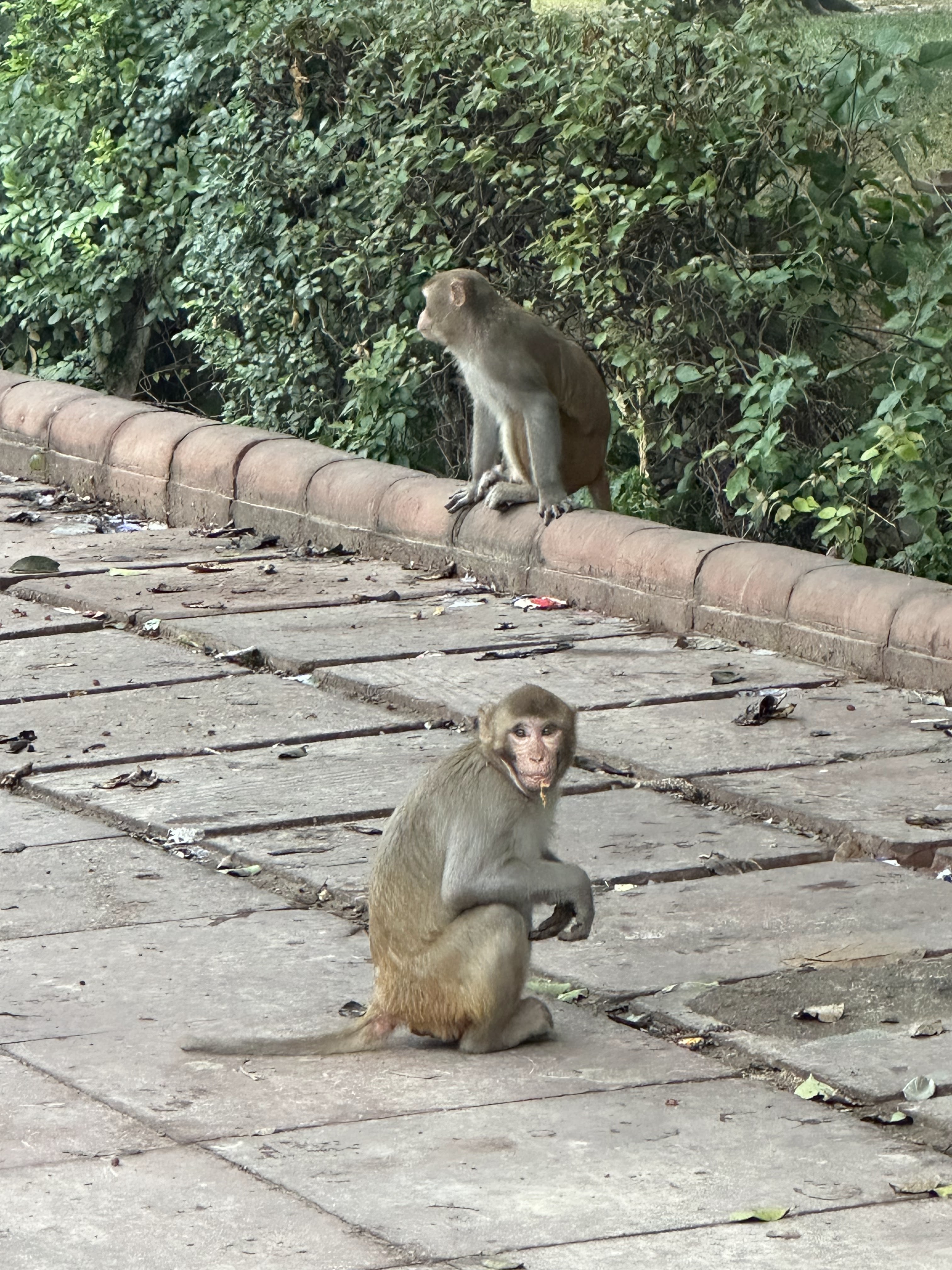
To get to "the Taj," as it is fondly called, you first have to pass through the Monkey Guard, a long walk from the parking area to the Taj itself that is guarded by aggressive macaque monkeys.


There are a lot of them, both underfoot . . . 

. . . and overhead.

Tourists are given plenty of warning to use caution around the monkeys. The sign at right has five bullet points of advice. I should have paid more attention to the one that says "Don't make direct eye contact with monkeys." More on that at the end of this post.

Saturday, May 31, 2025

INDIA, DELHI: HUMAYUN'S TOMB

 December 22, 2024

After church we got on the road for a city tour of New Delhi. I can't say this enough, but the traffic is CRAZY in the city. There is no respect for lanes, and there is lots of honking. Tourists should not drive.


Our first stop was Humayun's Tomb, built for the Mughal emperor Mirza Nasir al-Din Muhammad (aka "Humayun," and I have no idea how the names relate to each other) by his first wife and chief consort, Empress Bega Begum and with the patronage of Humayun's son, the great Emperor Akbar, in the 1570s. The Empress was so devastated by her husband's death that she dedicated the remainder of her life to the construction of the most magnificent mausoleum up to that time in the Empire. It was the first monumental Islamic mausoleum in India as well as the first garden tomb, and it greatly influenced that design of the Taj Mahal 80 years later.

The tomb and surrounding property was declared a UNESCO World Heritage Site in 1993, which enabled it to undergo extensive restoration. It didn't take long for us to discover what an excellent guide we had. His name was Sajeet, and Bob found him online. I wish I had more info to share because he was one of the best guides we have ever had. 

The tomb complex has an impressive 67-acre footprint and includes over 100 tombs in addition to Humayan's Tomb, as well as several ponds and  gardens.

It was pretty busy the day we were there.


Sunday, August 18, 2024

IRELAND, DAYS 1-2: TRAVEL, ARRIVAL, AND EXPLORING KILKENNY

 July 3-4, 2024

We left home at about 3:00 PM and made it through downtown LA and to our parking garage in about two hours.  Not bad.


We had an uneventful check-in for a non-stop flight to Dublin on Aer Lingus, a new airline for us. We were seated on the 3rd or 4th to the last row in the center section of a 2-4-2 configuration, but the last five rows or so only had three middle seats, making the aisles wider in the back near the bathrooms. Genius. Anyway, we both had aisle seats with an empty seat between us. Miraculous! And another miracle--I slept for a good part of the 9 1/2 hour flight, a rarity for me. We did have two meals. Dinner was tortellini with tomato sauce, salad, a roll, and chocolate mousse that was pretty good. Breakfast was a hot bagel with melted cheese and a sausage patty--not so good.  I watched one movie, Disenchanted with Amy Adams, sequel to Enchanted. Worst move I've seen in a long time. You can't win them all.

For a relatively small airport, we had a long walk between getting off the plane and passport control, but by then our suitcases were waiting for us. We walked to the car rental area to get our car from Budget and discovered why our rental (and every other rental we looked at) had been so cheap. They REQUIRE customers to buy insurance, which added $400, plus we had to put down a $2,000 security deposit. They must have lots of problems with people who can't drive on the left side of the road and with a steering wheel on the right. We had a very small Renault Clio with a manual transmission, but Bob, fortunately, is an absolute pro at shifting with his left hand and driving on the left side of the road.  
Our plan was to immediately leave Dublin and drive to Kilkenny, a distance of about 80 miles, which we thought might take an hour and a half. However, traffic was very heavy leaving Dublin, and not long after leaving the car rental place, the car began beeping at irregular intervals. Then the tire light came on, so we figured the low tire pressure caused the beeping. We got off the freeway, found a gas station, filled the tires, then figured out how to turn off the tire warning light. Sixty seconds into our drive, the beeping came back. Ultimately, I figured out that it was a sensor for lane control. Every time Bob began to drift towards a line in the road without signally, it beeped--and that was often. I found the instructions for how to disable that feature, and we continued our drive in peace.

Thursday, April 4, 2024

FRANCE 2000: CHARTRES AND VERSAILLES

 December 24, 2000

It was Christmas Eve AND Sunday and we were not sure what would be open, but we began our day by driving to Chartres to see its massive Gothic cathedral, built mostly between 1193 and 1250 and with additions as recent as the 17th century. Considered to be one of the most beautiful cathedrals in Europe, it was added to the UNESCO World Heritage Sites in 1979.

The story is told that during World War II, the city itself was heavily bombed in August 1944. An order was given to destroy the cathedral as it was thought to be in use by the Germans as an observation post. An American army officer named Colonel Welborn Barton Griffith, Jr., challenged the order, volunteering to go behind enemy lines to investigate. He entered the cathedral and after searching it from the crypt to the bell tower, declared it free of Germans by ringing the bell and waving an American flag from the tower. The cathedral was spared. Tragically, Colonel Griffith was killed in action later on that day a few miles north of the city. Posthumous medals and awards from both the US and France are not enough to recognize his bravery and foresight.  (Photo from Wikipedia)

Unlike many of the other cathedrals of Europe, the stained glass windows also survived the war. When the war started in 1939, master glass artisans dismantled hundreds of the precious stained glass windows, and with the help of local volunteers, packaged the windows in crates and stored them in the crypt. Just before German invaders reached the area, the French people hauled them across the country to be stored in an underground quarry. In August 1944, bombs blew out the cathedral's temporary windows.

The cathedral is massive--430 feet long and 151 feet wide with a nave height of 121 feet. It covers 117,060 square feet. The two towers are 344 and 371 feet.  

Wednesday, February 28, 2024

AUSTRIA 2000: SALZBURG

  December 18-19, 2000

Mom was excited to take us to Salzburg, one of the cultural centers of Europe for centuries. The area has had inhabitants since the Neolithic Age (10,000 - 4,500 BCE), so even for Europe it is old. Salz means "salt," and the name "Salzburg" first showed up in the 8th century when the local economy focused on salt mining.

We arrived on a stormy, blustery evening, the only really bad weather of the trip. Outside our somewhat dingy hotel, Mom had us park the car on the sidewalk, which seemed strange to us then but more normal to us now that we've spent more time in Europe. 


I wish I had better photos of the beautiful Christmas decorations. This much-faded photo I took doesn't do them justice.

But this nice picture of the city that I clipped from a brochure shows the city's elegance. The historic city center of Salzburg has been designated a UNESCO World Heritage Site.