Showing posts with label desserts. Show all posts

Tuesday, July 7, 2026

BELIZE 2026: CAYE CAULKER DAY 2

 March 16, 2026

Bob had arranged a birding tour for our second day on Caye Caulker, which meant we got up at 5:30 AM. That was Joy #1. Joy #2 was when the first thing we did was get on a motorboat. After my experience on the water the previous day, that was exactly want I did not want to do.

However. it was a serene sea that we set out upon, and we never went very far from shore, and so my concerns were for naught.


Caye Caulker is actually two islands separated by a 20-foot channel know as The Split that was created by Hurricane Hattie in 1961. The southern island is home to the main village and tourist activity, and the northern island, where we were headed, is mostly uninhabitated and covered with mangrove forests.

Wednesday, September 4, 2024

IRELAND, DAY 3: MINARD CASTLE, THE DINGLE PENINSULA, AND SLEA HEAD DRIVE

 July 6, 2024

Our plan had been to start the day at Blarney Castle, but when we tried to get tickets online, they were sold out. That's okay--we didn't feel a great need to kiss the Blarney Stone and taking one thing off the schedule made for a more relaxed day.

We left the B&B at about 9:30 or 10:00 and headed west towards the Dingle Peninsula.

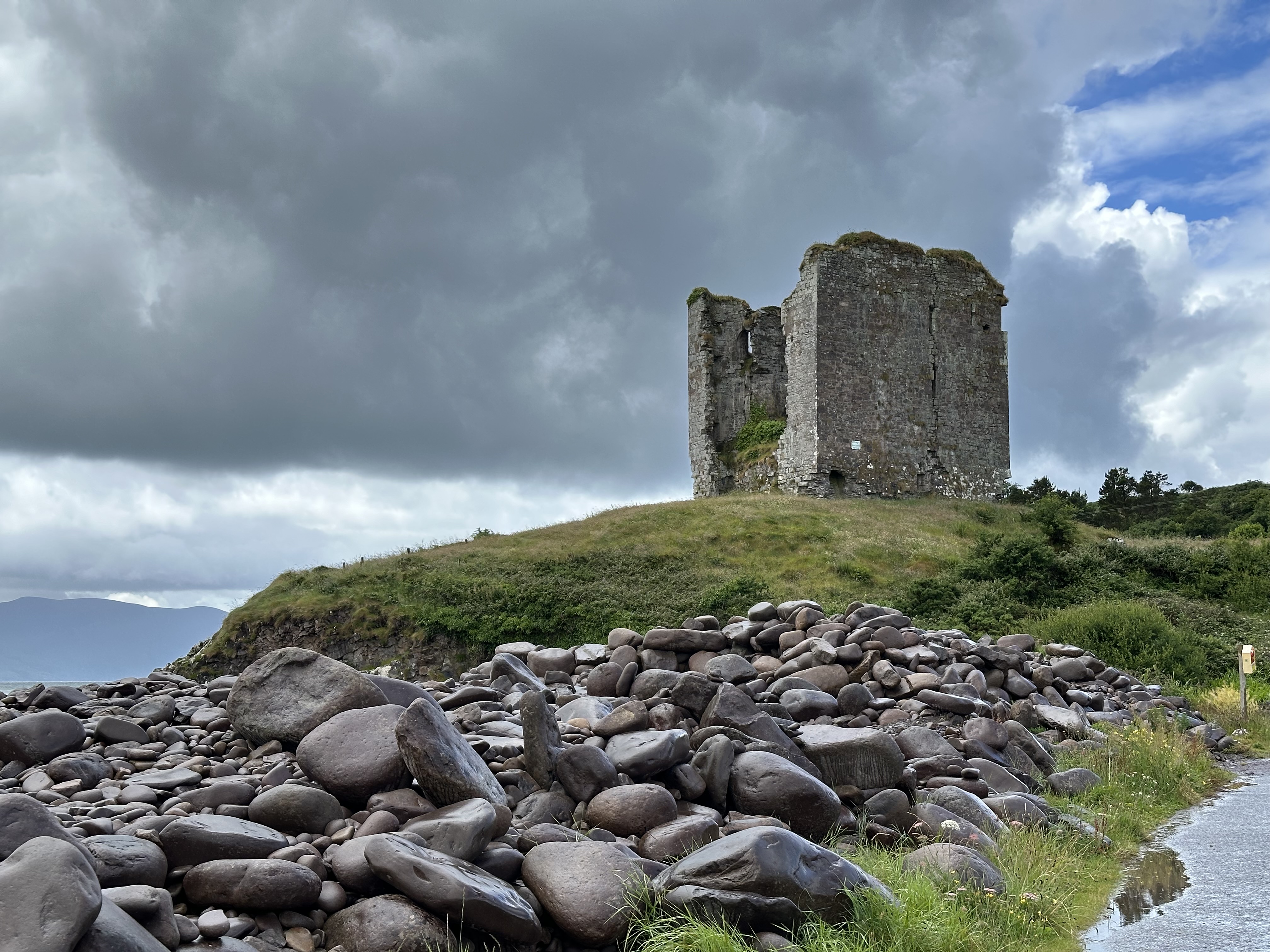
Our first stop on the Dingle Peninsula was Minard Castle.

To get there from the main road, we drove down a very narrow single-lane road. Every now and then there was a turnout so two cars could pass, but in most spots even our tiny car seemed to hug both sides of the road, and if two cars meet in an area like this, they both have to pull over into the weeds in order to pass.

Eventually, we came upon a windswept hill crowned by a lonely mid-16th century monolithic three-story ruin . . .

. . . that looks over a desolate bay of the cold Irish Sea.

Wednesday, July 24, 2024

TUNISIA, DAY 2 CONT.: KAIROUAN - MAUSOLEAM SIDI ABID AL-GHARIANI, ZAWIYA OF SIDI SAHIB, THE EL JEM AMPHITHEATER, COUNTRY ROADS, THE MEDINA, AND A PARTY AT OUR HOTEL

March 21, 2024

As we walked deeper into the old town section of Kairouan, we came to the Mausoleum of Sidi Abid Al-Ghariani.

This building was built as a madrasa (school for studying the Quran) in the 14th century by a Kairawani scholar known as Al-Jadidi. After he died while on a pilgrimage to Mecca in 1384 AD, his disciple Sidi Abid Al-Ghariani carried on his work. When Sidi Abid died in 1402 AD, he was buried here, and ever since the school has borne his name. 

It is a spectacular example of the local architectural style.


Check out this amazing craftsmanship:


I think this must be the tomb, but we were not allowed to go into the room itself and this photo was taken from the door.

Friday, May 24, 2024

SICILY: TAORMINA

 March 16, 2024

We took a 5:30 AM cab to the Naples Airport for our flight to Catania, Sicily, aboard an EasyJet plane, our first for that airline. We not only had to pay for our carry-on bags, but there was truly NO legroom. It was probably the tightest seating we've ever had. (Reminder to self: Say "no" to EasyJet in the future.) Luckily, the flight was just 50 minutes long. 

We picked up our rental car from Alamo--a VW Golf that was much too small for the four of us and our carry-ons, but we had no choice but to make do. One of our first sightings was Mount Etna. One of the tallest and most active volcanoes in Europe, it was impossible to miss. It's current height (subject to change in the next eruption) is 11,104 feet. In 2021, Etna had so many eruptions that its height actually increased by 100 feet! I read that it is two-and-a-half times taller than Pompeii, which really surprises me.  It has a hiking trail and was named a UNESCO World Heritage Site in 2013, but this was about as close as we got to it.

Our first destination was a viewpoint at the top of a very narrow, very steep, very windy road, but we were compensated for our discomfort by views of the Ionian Sea, the section of the Mediterranean Sea that basically lies between Italy and Greece.

We pulled off in a place where our car would (hopefully) not be hit so we could admire the scenery and some old stairs.


We noted that the climate and vegetation reminded us of Southern California, but perhaps a little more lush.

Tuesday, September 20, 2022

PORTUGAL: OBIDOS CASTLE

 June 26, 2022

After swooning over the basilica and palace in Mafra, we headed north towards Óbidos, a distance of about 45 miles. (We never had to drive very far in Portugal to get to the next amazing destination.)


No urban sprawl here. We drove through some beautiful country. This windmill looks just like the ones near us.


Tuesday, August 30, 2022

PORTUGAL, LISBON: MUSEO GULBENKIAN, IGREJA MUSEO SAO ROCQUE

 June 24, 2022

After our morning at the BelĂ©m Tower and JerĂ³nimos Monastery, we got an Uber to take us to the Gulbenkian Art Museum.  A word here about Uber in Portugal: CHEAP. We rarely paid more than $7 for a ride, including a tip. We had planned to take the Lisbon metro everywhere, but why? This was faster and didn't break the bank, and somehow we were still getting in 10,000+ steps/day.

Established in 1957, the Gulbenkian Art Museum houses one of the most important private art collections in the world. It includes many pieces sold off by Leningrad's Hermitage Museum in 1930 and 1931, as well as works by the likes of Renoir, Rubens, Rembrandt, Rodin, Monet, Manet, Gainsborough, Ghirlandaio, Degas, Turner, and others.

Calouste Gulbenkian was born in what is now Turkey in 1869 and died in Lisbon in 1955. He made a fortune in petroleum and gave a lot of that fortune to philanthropic organizations. He also collected over 6,400 pieces of art during his lifetime, and a good portion of it is held by the museum that bears his name in Lisbon. Of the roughly 6,000 items held by the museum, about 1,000 are on display at any given time.

I was kind of hoping this gentleman in the lobby was Mr. Gulbenkian, but the plaque on the wall says he is Jean-D'Aire, the Burgher of Calais, and he was sculpted by Auguste Rodin in 1913.


The collection covers a wide swath of history and culture. The bas relief on the left is from Assyria in the 9th century BC, and the chimney tiles on the right are from 17th century Turkey.

Wednesday, August 17, 2022

PORTUGAL: SINTRA'S QUINTA DA REGALEIRA AND LUNCH

 June 23, 2022

Our second stop in Sintra was a large property called Quinta da Regaleira. In Portugal, a quinta is a large, primarily rural estate, especially one with a luxurious mansion or palace. The 10-acre property comprises steep hills and a warren of roads, footpaths, stairways, and tunnels that make it seem far larger than it is.


Our guide Filipa dropped our group of eight at the top of the property, gave us general guidelines and directions, and told us when to meet her at the bottom of the hill near the palace. We set out as a group and stayed together as we made our way through the luxuriant forests and gardens that were designed and created by Carvalho Monteiro, an eccentric Brazilian-Portuguese businessman, collector, and book lover who bought the property from the Viscountess of Regaleira in 1892. Between 1904 and 1910 and with the aid of Italian architect Luigi Manini, Monteiro created a dazzling and enigmatic estate that paid tribute to his varied interests. After 1942, the property changed hands several times, finally being acquired by the Sintra Town Council in 1997, which opened it to the public the following year. The property and castle are a key part of Sintra's designation as a UNESCO World Heritage Site

Given our time constraints, we couldn't do the exquisite gardens justice. This is a place that needs repeated visits and free exploration. However, what we did see was extraordinary. I would like to have met the two men whose imagination led to the creation of this park.

Towers and turrets along the way were not only good for photos, but provided less-obstructed views of the surrounding forest.
If you look very carefully at the photo on the above right, you'll see the Moorish Castle that we could see from the Sintra Pena Palace wall walk. Here's a zoomed-in version:

Tuesday, April 26, 2022

TEXAS, HOUSTON: THE GRAFFITI BUILDING AND SHIPLEY DO-NUTS

 November 29, 2021

Bob knows I love street art/good graffiti, and somehow he found out about the Houston Graffiti Building, located near downtown Houston, and added it to our itinerary. A bunch of old industrial buildings have been "repurposed" as an outdoor art museum. There don't appear to be businesses inside these buildings as the parking lot only had the cars of the people who came to take pictures of the art. 

I don't think any of the art is meant to be permanent, and the pictures I have found online of this site are different than the ones I took, but this is how I will remember our visit. I don't think too many words are needed--just enjoy.

This video shows the front section parallel to the parking lot. From here we circumnavigated the complex until we returned to the parking lot.

Sunday, August 23, 2020

MEXICO CITY: SHRINE OF THE VIRGIN OF GUADALUPE

 March 14, 2018

Arnold picked us up at 9:00 AM with optimistic plans to visit two major sites: the Shrine of the Virgin of Guadalupe and Teotihuacan.  But before any of that, we made a quick stop at the Plaza de Tres Culturas, or Square of Three Cultures, where Aztec, Colonial, and 20th century cultures are mixed into a not-very-seamless whole. #1 is a Tlatelolco archological site--an old market dating to the 14th century, #2 is the Santiago de Tlatelolco Church, built in the early 17th century, and #3 is the largest apartment complex in Mexico, built in the 1960s.

We took a few photos and then continued on to one of the major tourist draws of Mexico, the Shrine of the Virgin of Guadalupe, which turned out to be a huge walled plaza containing several important structures related to Juan Diego's visions of the Virgin Mary in the mid-16th century. A very important pilgrimage site for Catholics, according to Arnold it gets 25-million visitors a year and is second only to the Vatican as the most visited Catholic pilgrimage site in the world. It reminds me a little bit of Temple Square in Salt Lake City, the "pilgrimage site" for members of my own faith (which gets only 3- to 5-million visitors a year).

The story is that Juan Diego, a middle-class Mexican native born in 1474, was one of the first converts to Catholicism in the 1520s. One day, on his way over Tepeyac Hill to perform his religious duties at the Franciscan monastery, he had a vision of the Virgin Mary, who told him in his own native language who she was and asked him to request that a chapel be erected on that site in her honor so that she could bless the lives of those who called on her. Juan Diego ran to tell the bishop, but was told to come back another day. As he was returning home, Juan Diego saw the Virgin again and told her what had transpired. She told him to try again, which he did the following morning. This time the bishop asked for a sign that the apparition truly was who Juan Diego said she was. Juan Diego saw the Virgin again on his trip home, and she agreed to provide a sign the following day.
Image from here

But Juan Diego arrived home to find his uncle deathly ill. He could not return the next day to the assigned spot to meet the Virgin. A day late, he was on his way back to the bishop to get someone to give his uncle last rites, skirting the area where he had seen his visions out of embarrassment. Not surprisingly, the Virgin found him anyway and gently said the words that are inscribed over the main entrance to the Basilica: "No estoy yo aquĂ­ que soy tu madre?"  ("Am I not here, I who am your mother?") She assured him that she had healed his uncle, and she told him to go up the hill and gather the flowers he would find growing there. Normally only cactus and scrub grew on the hill, but Juan Diego found a glorious field of flowers. After filling his cloak with the blooms, he returned to the Virgin, who rearranged the flowers and sent him on his way to the bishop. When Juan Diego arrived and dropped the flowers from the cloak at the bishop's feet, an image of the Virgin was imprinted on the cloak.

Wednesday, October 30, 2013

FIRST IMPRESSIONS OF KOTOR, MONTENEGRO

Montenegro was another one of the countries on our grand tour of the Balkans that I knew almost nothing about. Slightly smaller than Connecticut, it is a tiny country, even by Balkan standards, but it is full of personality and chutzpah. In spite of the wars and break up of the Yugoslavian Union in the early 1990s, Montenegro elected to stay attached to Serbia in a loose union, but ten years later they became increasingly upset about Slobodan Milosovic's policies in Kosovo. Finally, in 2006, Montenegrins narrowly voted for independence, and, unlike many of the other Yugoslavian defectors, had a peaceful separation from Serbia.
Once we finally got across the Albanian-Montenegro border, we had a beautiful drive to Kotor, Montenegro's prime tourist city.
We immediately came into contact with local residents on their way to (or home from?) work:

Friday, June 21, 2013

LAKE BLED, SLOVENIA

We left for the Balkans on Tuesday, May 21st, just a few hours after I finished grading my finals and submitting final grades.  When we checked our bags at LAX, the British Airways guy at the counter, who actually was British, asked, "What country is Zagreb in?"  That was our first indication that we were heading off on a somewhat unusual adventure.

After twenty-one stressful hours of travel from home to LAX to London to Frankfurt to Zagreb that required some running on both of the connections, we arrived in Croatia at 10:20 p.m.  We had arranged a late pick-up for our car, which we rented from Oryx, a Croatian car rental agency.  Bob had also rented a GPS unit, without which we figured we would be doomed.  Everything was ready and waiting for us.

Then the real fun began.

For whatever reason, the GPS took us down a series of dark, narrow residential streets.  We wandered aimlessly for almost an hour, while Sophia, which is what we named the disembodied GPS voice, insisted that we had arrived.  Finally, we got the GPS to work properly, and with only a few more dead ends, we made it to our hotel, the Best Western Premiere Astoria, at around 12:30 a.m.  We learned that the street names that showed up on the Garmin GPS Navigator almost never agreed with the posted street names. That should have been our first clue that trouble lay ahead, but we were too tired to think about it.

The next morning we dragged ourselves out of bed and down to the buffet breakfast that came with our room.  It was phenomenal, one of the best we have ever had in any hotel, and it was a terrific start to our first full day.

Monday, February 18, 2013

FLORIDA: THE EVERGLADES

Our main goal in going to Florida last month was to visit the Everglades, a huge area of subtropical wetlands in Southern Florida that is the third largest national park in the United States (behind Death Valley and Yellowstone).  I had a definite preconception of what the Everglades would look like, and while there were parts of the park that were what I expected, I was stunned by the variety and accessibility of this incredibly beautiful place.Almost immediately upon entering the park, we were greeted by a rather large alligator relaxing at the side of the road.  We saw him on four different occasions, and while he was in a slightly different place or position each time, we never actually saw him move, and he never responded to our presence.  Right there my first misconception was exposed.  I always thought alligators were aggressive and dangerous.  Every alligator we saw was pretty passive.  

A hundred yards or so down the road was another alligator almost totally submerged in a bit of water, and on the bank near her were twenty to thirty little baby alligators. It was quite the sight:
Here is Bob taking a picture of the babies.  Unfortunately, they scooted away pretty quickly as he approached.  The mother, who is floating in that pool, never moved:
At another place in the park we saw eight to ten large alligators sunning themselves on the bank:
They have quite the overbite:
There could be a violent story behind this picture of two alligators and a single white feather, but we didn't see it.  In fact, several wading birds seemed completely comfortable walking past these guys:
I was intrigued by the violin shape of alligators as they swim:
There were often alligators right next to the walkways, but other than warnings that there was a stiff fine for attempting to feed them, we never saw a "danger" sign posted or heard a lecture from a ranger about being careful.  I don't think they have a problem with aggressive gators.  Note the alligator in the grass behind Bob:

Besides the alligators. there was an amazing variety of birds, many of which did not seem to be afraid of us at all.  

We were especially intrigued by these black vultures:
Bob, as a lawyer, felt a special kinship with them:
Apparently, the vultures aren't the most popular birds in the park:
We also really liked these birds, called anhingas, which, like the vultures, were also quite fearless:
They were real show-offs:

This wood stork could have come right out of Aesop's fables:

Thanks to Bob, I know that this is a small blue heron:

. . . and this beautiful bird with its wispy tail is a great egret:

I think my favorite was the great blue heron, seen here during the day:
. . . and at night:
. . . in the water, and on land:

We saw many of these zebra longwing butterflies, which I've since learned are the Florida state butterfly:

On one of the trails, we ran across this turtle just after she had laid and buried a clutch of eggs:

The park has dozens of trails and walkways that allow visitors to see all kinds of environments. I think that was the most surprising thing about the Everglades--the number of distinctly different biomes: 


One last thing worth noting is the food available just before entering the park.  This place, of course, caught Bob's eye and required a stop:

We enjoyed the food:

. . . and the unique ambience:


However, even better than the Gator Grill was Robert Is Here, a farm stand loaded with amazing fruits, vegetables, salsas, various bottled items . . .
. . . and the largest avocados I have ever seen:


However, the food highlight of our entire trip was this amazing, incredible, delectable, divine, fresh strawberry-key lime milkshake.  I must confess that I had more than one.
It is worth going back to Florida for.