Showing posts with label Roman ruins. Show all posts

Monday, August 5, 2024

TUNISIA, DAY 3, CONT.: NORTH AFRICA AMERICAN CEMETERY, CARTHAGE, THE ANTONIN BATHS, AND OUR FINAL IFTAR DINNER

 March 22, 2024

We had two more destinations on our last day in Tunisia, three if you count dinner. The first was the North Africa American Cemetery, 27 acres dedicated in 1960 to hold 2,841 of our troops killed in the North Africa campaigns of World War II. 

There are 26 American military cemeteries outside of the US, and this is the only one on the African continent.

I was intrigued by the trimming of these trees, and that's a lot of manicured green lawn, don't you think?


We started in an office where I think we signed in. We caught our first glimpse of the cemetery through the windows.

They had a Purple Heart on display and a document signed by Lyndon Johnson. On the page on the right, a passage reads: "The Purple Heart has been conferred individually upon those buried or commemorated here who gave their lives in action."

It was nice to see the American and Tunisian flags standing together. The plaque over the fireplace is one from the American Battle Monuments Commission, who administers this cemetery.

Friday, May 24, 2024

SICILY: TAORMINA

 March 16, 2024

We took a 5:30 AM cab to the Naples Airport for our flight to Catania, Sicily, aboard an EasyJet plane, our first for that airline. We not only had to pay for our carry-on bags, but there was truly NO legroom. It was probably the tightest seating we've ever had. (Reminder to self: Say "no" to EasyJet in the future.) Luckily, the flight was just 50 minutes long. 

We picked up our rental car from Alamo--a VW Golf that was much too small for the four of us and our carry-ons, but we had no choice but to make do. One of our first sightings was Mount Etna. One of the tallest and most active volcanoes in Europe, it was impossible to miss. It's current height (subject to change in the next eruption) is 11,104 feet. In 2021, Etna had so many eruptions that its height actually increased by 100 feet! I read that it is two-and-a-half times taller than Pompeii, which really surprises me.  It has a hiking trail and was named a UNESCO World Heritage Site in 2013, but this was about as close as we got to it.

Our first destination was a viewpoint at the top of a very narrow, very steep, very windy road, but we were compensated for our discomfort by views of the Ionian Sea, the section of the Mediterranean Sea that basically lies between Italy and Greece.

We pulled off in a place where our car would (hopefully) not be hit so we could admire the scenery and some old stairs.


We noted that the climate and vegetation reminded us of Southern California, but perhaps a little more lush.

Tuesday, May 14, 2024

ITALY: POMPEII

 March 15, 2024

One of the reasons we started our trip in Naples was because we wanted to visit the ancient city of Pompeii, the legendary city covered by ash for centuries before being discovered. To get to Pompeii from Naples, we took a train ride of about 40 minutes. 

We were hoping to find a place to eat between the Pompeii station and the ruins. No problem. There was a line-up of five or six restaurants along the road that led to the main entry gate for the ruins. We chose a place with friendly staff, and (ironically, as this was a major tourist area) I had one of the better meals of the trip: gnocchi with cheese sauce and a wonderful pizza I shared with Bob.


We met up with our guide Dario, an archaeologist who gives tours of the site, and began a three-hour walk through what used to be a wealthy town of somewhere between 10,000 and 20,000 people before it was buried in 13 to 20 feet of volcanic ash by the eruption of Mount Vesuvius in 79 AD.
The ruins were discovered in the late 16th century, but excavation didn't begin until 1750, over 150 years later. In 1763, during the excavations, an inscription was found that identified the site as Pompeii.

Our initial impression on walking in was already WOW!  The UNESCO article on this site and its companion site Herculaneum (which my sister and BIL visited on the day they arrived before we got there) notes, "Pompeii and Herculaneum are the only Roman cities ruins preserved in such an exceptional way and have no parallels in integrity and extent in the world. [They] provide a full picture of Roman life from the 1st century BC to the 1st century AD through the urban, architectural, decorative and daily life aspects that have been preserved."


Tuesday, February 14, 2023

PORTUGAL: EVORA, PART II - EVORA CATHEDRAL, ROMAN RUINS, A LOST CAR, AND DINNER AT TABERNA TIPICA

 July 2, 2022

As I noted in the last post, we realized that we hadn't really paid attention to where we had parked the car, and so we decided we had better retrace our steps before we went any farther. We knew the more places we went, the less likely we'd be able to remember how to get back to the starting place. By the time we had walked about two blocks and made two turns, we realized we had no idea where to go next. There were so many narrow, twisting alleys and staircases that looked the same. We also disagreed on the general direction to go to find the car. I was sure it was one direction, and Bob was convinced it was another. We had no real landmarks in mind. We were in serious trouble.

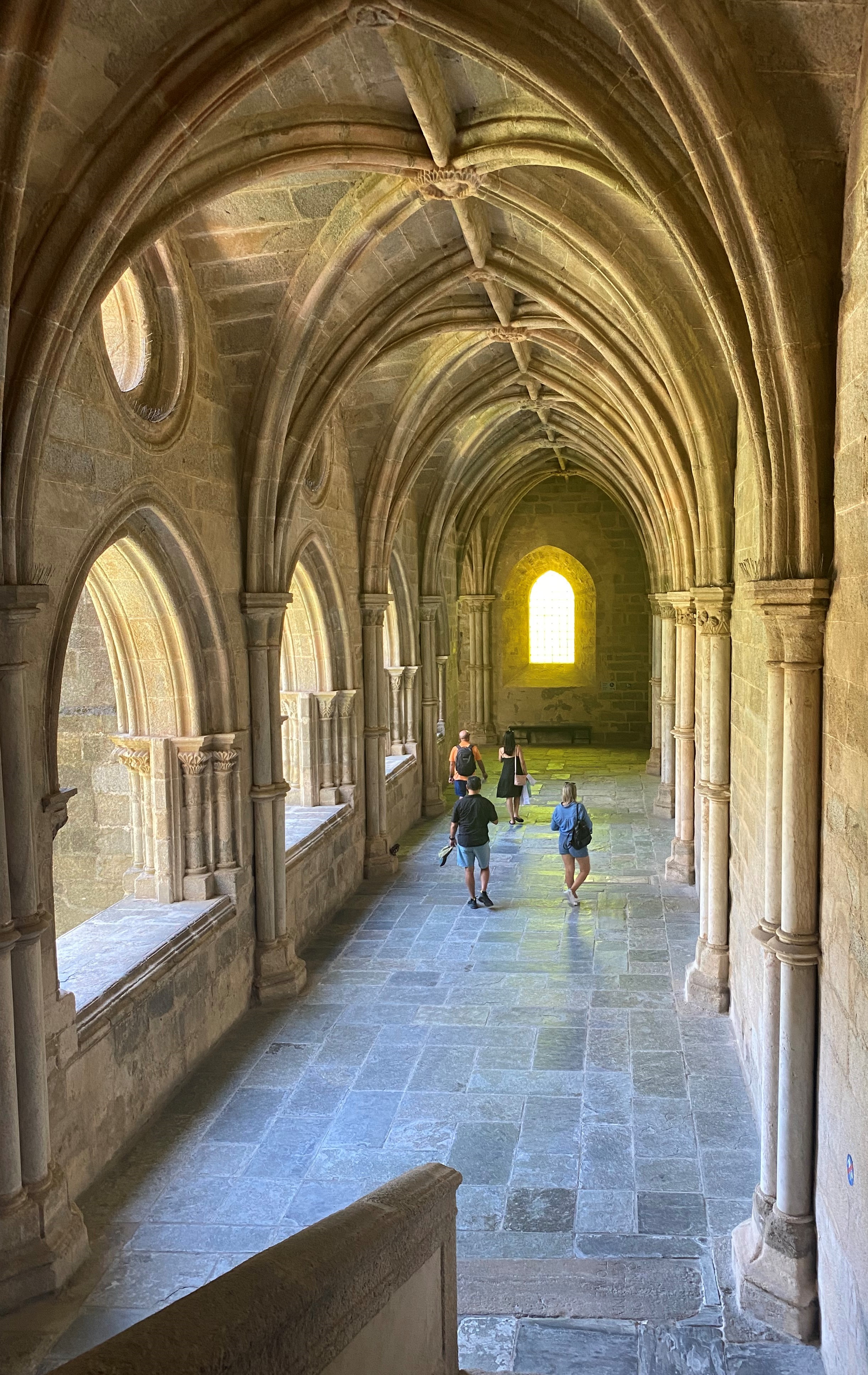
However, in our wanderings, we did come across several other sites on our list, starting with the mid-gothic Cathedral of Évora, the oldest and largest medieval cathedral in Portugal. Construction started in the 12th century and was completed in the 14th century, although significant changes and additions were made up until the early 1700s. This cathedral is one of the structures cited in the UNESCO World Heritage Site designation for Évora.


A few years ago I read the book The Cloister Walk by Kathleen Norris, which tells of the author's experience living in a Benedictine monastery for nine months. I think of her quiet, soul-searching prose every time we stroll down a cloister walkway, and somehow at the Évora Cathedral the laughter of running children made this particular experience that much more spiritual.


Off the cloister is a funeral chapel that contains the tomb of the cathedral's founder, Bishop King Peter, as well as the Archbishop of Évora who died in the 20th century. (However, I am not sure if I have these labeled correctly because there are also a few other tombs connected to the cloister.)


Monday, June 29, 2015

ISRAEL: CAESAREA

When our group left Jerusalem and headed for Tiberias on the Sea of Galilee, we took a wide swing away from the West Bank to visit some ruins on the beautiful Mediterranean Sea. Caesarea was built by Herod the Great in about 25-13 BC to serve as the administrative center of the Judaean Province of the Roman Empire. In a very savvy move, Herod dedicated the city to the emperor, Caesar Augustus.                                                                                               Herod is the ruler referenced in Matthew 2 to whom the Magi came to inquire about the location of the King of the Jews, whose star they had seen in the east. Of course, Herod, as the current King of the Jews, was not too keen on having a rival, so he ordered all the baby boys in Bethlehem to be killed. An angel warned Joseph in a dream of Herod's plot, and he and Mary and the infant Jesus fled to Egypt, where they stayed until Herod's death. When they returned, the family moved to Nazareth so as not to be under Herod's son Archelaus.

Herod the Great was an all-around bad dude. He was ambitious and cruel, a dreadful combination. In three different fits of jealousy, he had his brother-in-law murdered, and then his sons, and then his wife. Augustus noted, "It is better to be Herod's dog than one of his children."  No kidding.

On the other hand, Herod is probably called Herod "the Great" because of his massive building program, which included building Caesarea, building the fortress Masada, and rebuilding the Temple in Jerusalem. He didn't skimp either. 

Clearly, Herod was an important man with a lot of power.
Sand dunes on the way to Caesarea
Caesarea is also a key Christian site. This is the city from which Pontius Pilate governed during the time of Jesus. It was here that Paul converted the centurion Cornelius, the first non-Jew, after Peter had a vision in Joppa of the unclean animals caught in a net (Acts 10). Later, Paul was imprisoned at Caesarea for two years, and during that time he defended himself to Agrippa, the grandson of Herod the Great. Paul told Agrippa about his sordid past as a Christian persecutor and about the vision that led to his conversion, and then he testified of Christ. Agrippa responded with the famous words: "Paul, almost thou persuadest me to be a Christian" (Acts 26).

These days Caesarea is a very wealthy area. In fact, it has the only golf course in Israel, and it has a stunning beach:
We were there on a day when the radiant hue of the sky was surpassed by jewel tones of the Mediterranean Sea:
Clouds were moving in, and we needed to see the Mediterranean up close before the threat of rain became a reality:
. . . VERY up close: