Thursday, September 20, 2012

BREISACH, GERMANY: Part 2, We Return to the German Side of the Rhine

After our ship had docked at Breisach, and after our morning tour to the Black Forest, we had two options for afternoon tours: the one to Colmar that the Kenisons, Joneses, and we took, and another to some World War II sites that the DeLongs and Jackmans took.  (I think after our pre-cruise travel, some of us were World War II-ed out.)  After our tours, we returned to Breisach in the late afternoon to get back on the boat and head to our next destination. Fortunately, our group of three couples had just enough time to do a few essential things before reboarding.

For example, we enjoyed the wonderful cobblestone streets.  I just can't get enough of them.

We made our way up one of those streets . . .
. . . towards St. Stephen's Cathedral:
. . . through the Hagenbach Tower, mentioned in city records as early as 1319.  It was a lookout and a gate to cathedral square, but also served as a prison.
The view from the top of the hill was beautiful:

Unfortunately, the cathedral was closed, but we were intrigued by the "patio" with an armless stone statue of Christ hanging on one of the posts:

The medieval church steeple had a wonderful clock, which reminded us that we'd better get moving back towards our boat before too long:
However, there were a few more things to look at.  For example, Breisach had possibly the best doggie doo-doo sign I've ever seen:
Internet translation: "Hey, Gentlemen!  Hey, Ladies!  The heaps are in the bag.  The bag in the trash."
Also, there was a very unique piece of art in the village square, a bull bursting through the bricks and bearing a headless woman-figure on his back:


There were lots of papery-white flowers to enjoy:


I have a thing for windows, and Breisach had some wonderful ones:


At the end of the day, we had just enough time for one last critical stop:

Next: Back to France

Sunday, September 16, 2012

COLMAR, FRANCE: Part 2

As I mentioned in the previous post on Colmar, it is the birthplace of Frederic Auguste Bartholdi, the sculptor known to Americans for creating the Statue of Liberty.  His home has been turned into a museum. We did not go inside, but we did enjoy his sculpture in the courtyard entiteld Les Grande Soutiens du Monde (The Great Support of the World). The three supports are Justice, Labour, and Patriotism or Peace.

We also visited St. Martin's Church.  It seems that everyone has a St. Martin's.  He was the guy who cut a piece of his cloak off to give to a beggar.  This one was constructed between 1234 and 1365 of a unique yellow stone


Like so many of the churches in this region, the roof was spectacular.  I've been trying to visualize a roof like this on my house.  What do you think?

We also stopped by St. Matthew's Convent, a Franciscan Church built in the late 12th century.  It became a Protestant church after the Reformation in the 16th century.
It was very, very simple inside, but there was a wonderful frieze of paintings around the balcony:
I can't go in a church without admiring the beautiful stained glass windows.  I'm guessing that's Luther on the left:

The reason many tourists go to Colmar (aside from the ten things I mentioned in my previous post) is what is inside the Musee D'Unterlinden, seen below:
This former Dominican Convent has a Gothic chapel that was built in the 13th century and is currently used as an art museum:
As in many of the museums and churches we visited, we saw some art restorationists at work:

The Unterlinden Museum is known for its regional masterpieces that date from the end of the Middle Ages, the most spectacular piece in the art collection being the Isenheim Altarpiece by Matthias Grunewald in 1506-1515. In its original form it was a complex structure with wings that folded out and provided different views.  The main and center painting is of the Crucifixion, and the base shows Christ being laid in the tomb:
This altarpiece was painted for a local monastery that specialized in hospital work and was particularly known for caring for those with the plague and its related skin diseases. The crucified Christ in this painting has pock-marked skin, showing the plague patients that He shares their grief and understands their pain:
Photo from here
Photo from here
It was highly unusual during the early 1500s for Christ to be depicted in such twisted agony.  However, the story is that those afflicted with disease were able to look on this image and be cured.

As an interesting modern interpretation, there is a dramatic a series of crucifixion fixtures on the wall to left of the altarpiece that were created from thick wire and shaped to match the same form as the Christ in the painting:


The altarpiece itself has been sawed apart so that visitors can see all the paintings.  One wing shows a choir of heavenly angels on the left and Mary bathing Jesus on the right:
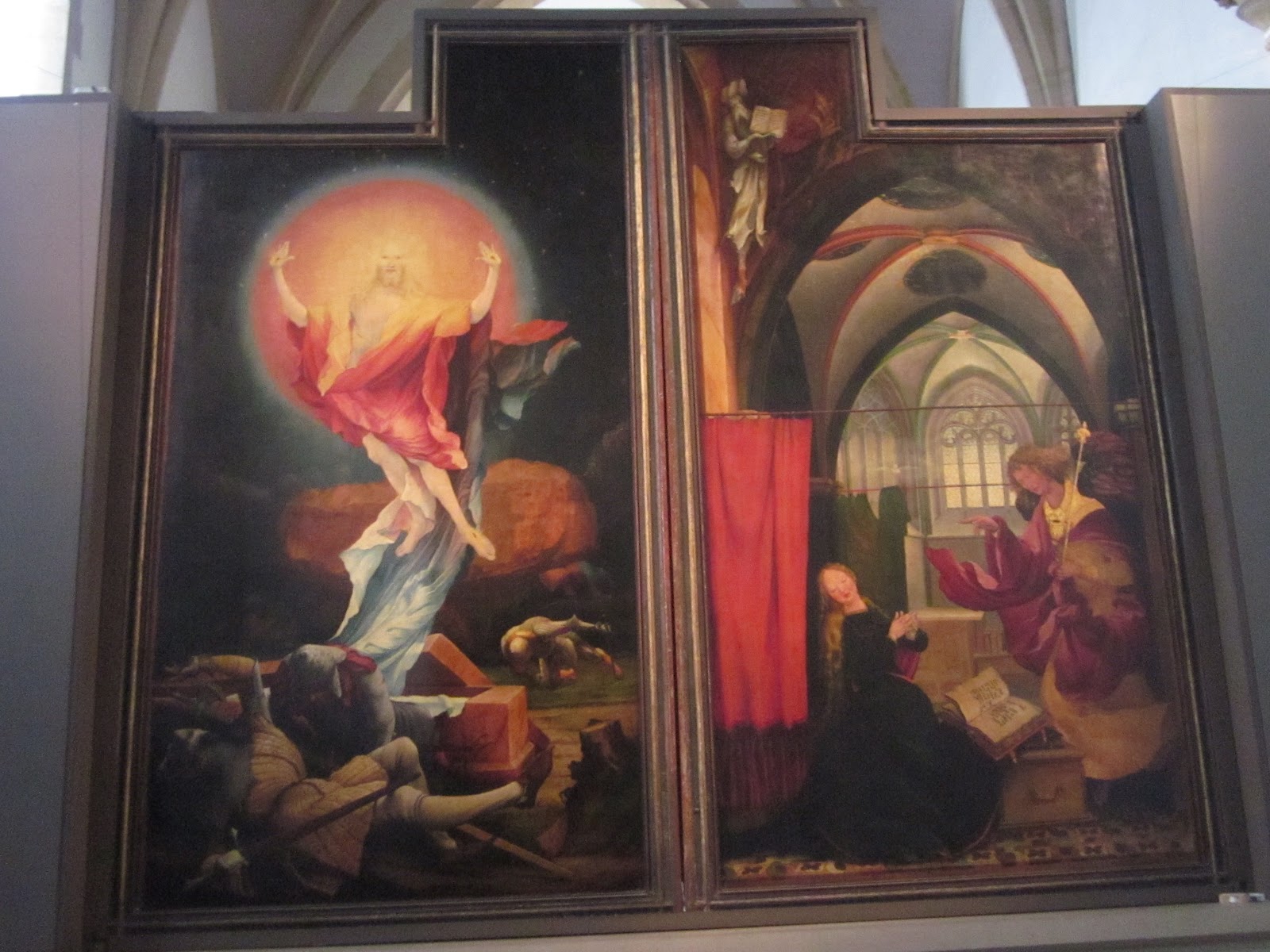
The other wing shows the Resurrection on the left and the Annunciation on the right:

One more section shows the temptation of St. Anthony on the left and the visit of St. Anthony to the hermit St. Paul on the right:

That Temptation painting on the left looks like something out of Maurice Sendak's Where the Wild Things Are. It's hard to believe it is 500 years old:
The bluish, bloated figure on the bottom left is a child who has a disease caused by infected wheat.  Those children were also brought to see these paintings and seemed to be cured.

When assembled, if all the wings were opened up, this gilt woodcarving by Nikolaus Hagenauer would have been revealed:

Unfortunately, we had less than half an hour in this museum. As I recall, it was very expensive to get in, something like $15 per person.  We almost didn't do it because of the time restraints, but I'm glad that we did.  I have since learned that the Isenheim Altarpiece is considered to be one of the great artworks of Europe; in fact, some call it the German Sistine Chapel.

Bob, I think we need to go back for a longer look.