
Just across the Rhine River from Strasbourg is the German town of Kehl. With only 34,000 inhabitants to Strasbourg's 275,000, it has quite a different atmosphere. We spent a few hours exploring, starting at the Kehler Kirchen, a simple little church next to the town square:

 It had an interesting "Requiem for the Dead of the Berlin Wall." I haven't seen very many German memorials for their own war dead. Note the use of the colors of the German flag and the representation of the Brandenberg Gate on the center panel. Names are etched into the black and red side panels:

Next to the memorial is a plaque in German and French. My sister Angie translated the German version for me: "[The artwork] is to commemorate the people who met death at the wall and at the border fortifications of the former German Democratic Republic. The names are listed on the side tablets. Unknowns are indicated with a cross. The shape of the triptych represents a cross and the colored fields correspond to the federal flag's black-red-gold. The notes in the middle panel represent the first beats of the Verdi Requiem. As a frontier city on the Rhine, Kehl with its border location had experiences through the centuries filled with sorrow and victims. Also on this border, many people, above all French and Germans, died innocently. The triptych by Manfred Aust commits to reconciliation (atonement) and peace. The peace community knows this duty is required."
Interesting. I think the words "met their death at the wall and at the border fortifications" sounds a bit euphemistic, but I love the inclusion of the first notes from the somber Verdi Requiem. If you are curious about what it sounds like, go here.


 The interior was as quiet and peaceful as the grounds:


St. Andrew on the left with his x-shaped cross, and St. Peter on the right holding his keys:


My favorite work of art in St. John Nepomuk was the altar. I believe this depiction of Isaiah refers to the scripture in Isaiah 6:


Back on the boat, we continued on our journey north. As part of the entertainment on board, there was a cooking demonstration by our chef (on the right in the picture below):
 When they called for a volunteer, one of my helpful siblings volunteered my sister Chris. Actually, I think it was her Helpful Husband. I can't remember what it was they were cooking, but it looks suspiciously like Gak.
 Chris was a pro. I'm pretty sure she could have handled the ship's kitchen without much problem. I know she can put on a Stake Relief Society dinner for 200 women with her eyes closed and one arm tied behind her back.
 After a bit, another husband volunteered his wife to go up and get some pointers from Chris:
 I think Doris is smiling because she is glad she wasn't the one up there. My sentiments exactly.
Next: Beautiful Heidelberg


Next to the memorial is a plaque in German and French. My sister Angie translated the German version for me: "[The artwork] is to commemorate the people who met death at the wall and at the border fortifications of the former German Democratic Republic. The names are listed on the side tablets. Unknowns are indicated with a cross. The shape of the triptych represents a cross and the colored fields correspond to the federal flag's black-red-gold. The notes in the middle panel represent the first beats of the Verdi Requiem. As a frontier city on the Rhine, Kehl with its border location had experiences through the centuries filled with sorrow and victims. Also on this border, many people, above all French and Germans, died innocently. The triptych by Manfred Aust commits to reconciliation (atonement) and peace. The peace community knows this duty is required."
Interesting. I think the words "met their death at the wall and at the border fortifications" sounds a bit euphemistic, but I love the inclusion of the first notes from the somber Verdi Requiem. If you are curious about what it sounds like, go here.

A homeless man was sleeping on the back bench, a reminder that this is a fully functioning church, not a tourist attraction run by the government:

I loved this simple little alcove:

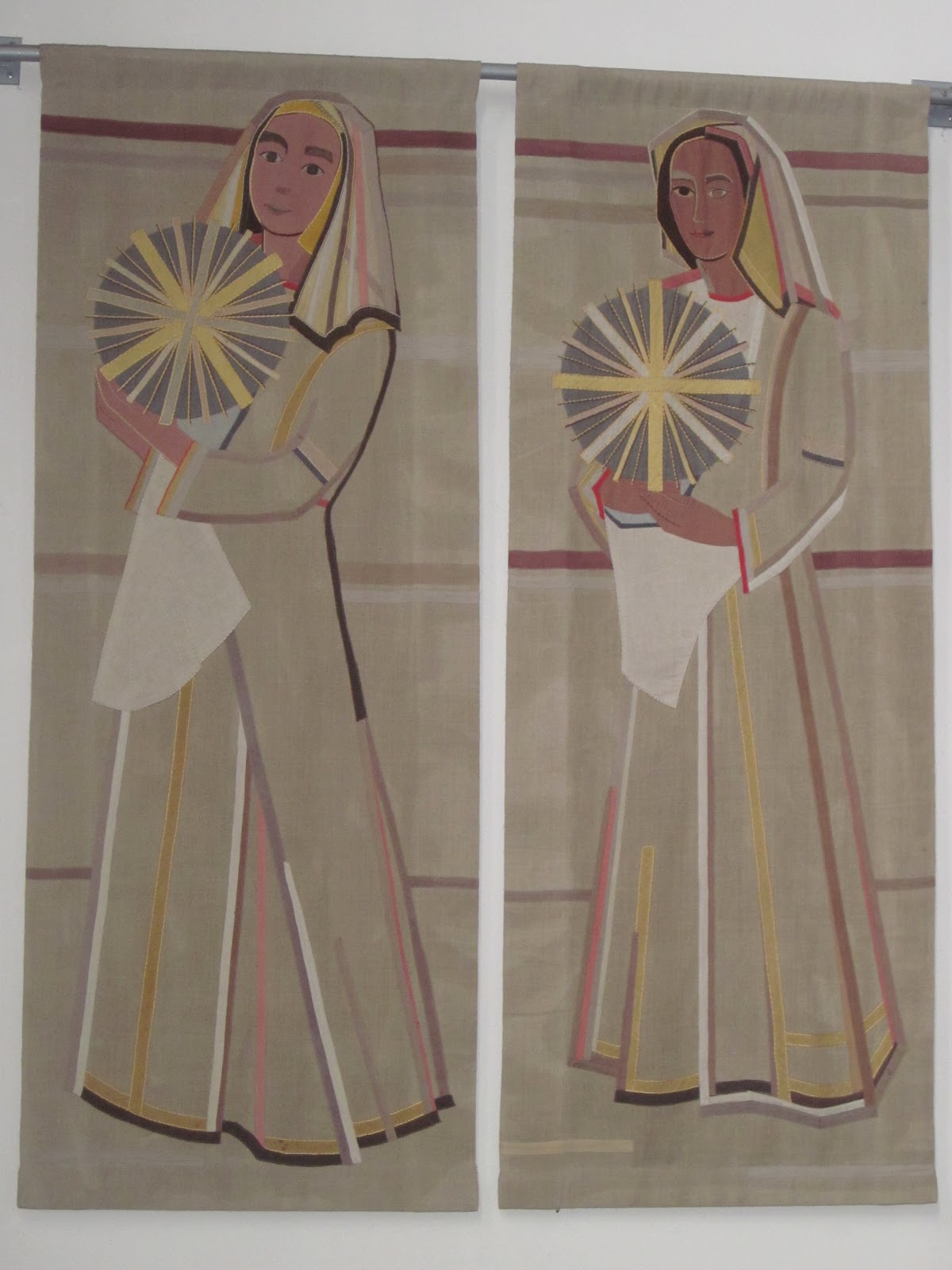
. . . with the ten virgins made of a linen applique:

Back outside, the church made a picturesque background for a family photo:

A dandelion-looking fountain added a bit of whimsy to the church courtyard:

All that walking made us hungry. Okay, so sitting made us hungry too, and so did sleeping, but that's beside the point. What did Vegan Bob find to eat at a GRILL?


He had them make him a surprisingly delicious kebab sans meat.

Chris and Dave didn't think much of Bob's snack, so they found something else to eat:

Bonnie and Stan come around just in time to save them from themselves. Well, maybe not. I think they were actually waiting in line.

Revived by our nutritious snack, we visited one more church before returning to our ship. St. John Nepomuk Church had perhaps the most beautiful grounds of any church we saw on this trip:


St. Andrew on the left with his x-shaped cross, and St. Peter on the right holding his keys:


My favorite work of art in St. John Nepomuk was the altar. I believe this depiction of Isaiah refers to the scripture in Isaiah 6:

5 ¶Then said I, Woe is me! for I am undone; because I am a man of unclean lips, and I dwell in the midst of a people of unclean lips: for mine eyes have seen the King, the Lord of hosts.
6 Then flew one of the seraphims unto me, having a live coal in his hand, which he had taken with the tongs from off the altar:
7 And he laid it upon my mouth, and said, Lo, this hath touched thy lips; and thine iniquity is taken away, and thy sin purged.
8 Also I heard the voice of the Lord, saying, Whom shall I send, and who will go for us? Then said I, Here am I; send me.
On our way back to our ship, we walked past a garden of sculptures lining the river. Among them was a memorial to the dead of World War I:


. . . a Jewish prayer shawl scarf, and a very sweet sculpture entitled Reconciliation:


Back on the boat, we continued on our journey north. As part of the entertainment on board, there was a cooking demonstration by our chef (on the right in the picture below):


Next: Beautiful Heidelberg


