Showing posts with label Ecuador. Show all posts

Thursday, July 28, 2022

ECUADOR: HACIENDA CACAO & MANGO AND CHURUTE MANGROVES ECOLOGICAL RESERVE

 March 28, 2022

After hours of winding roads and then dirt roads, which were hard on me but didn't seem to affect anyone else (I'm so wimpy), we finally made it to our last destination of the trip, the Charute Mangroves Ecological Reserve and Cocoa Farm. The Ecological Reserve covers about 220 square miles, and is about 25 miles from the city of Guayaquil.

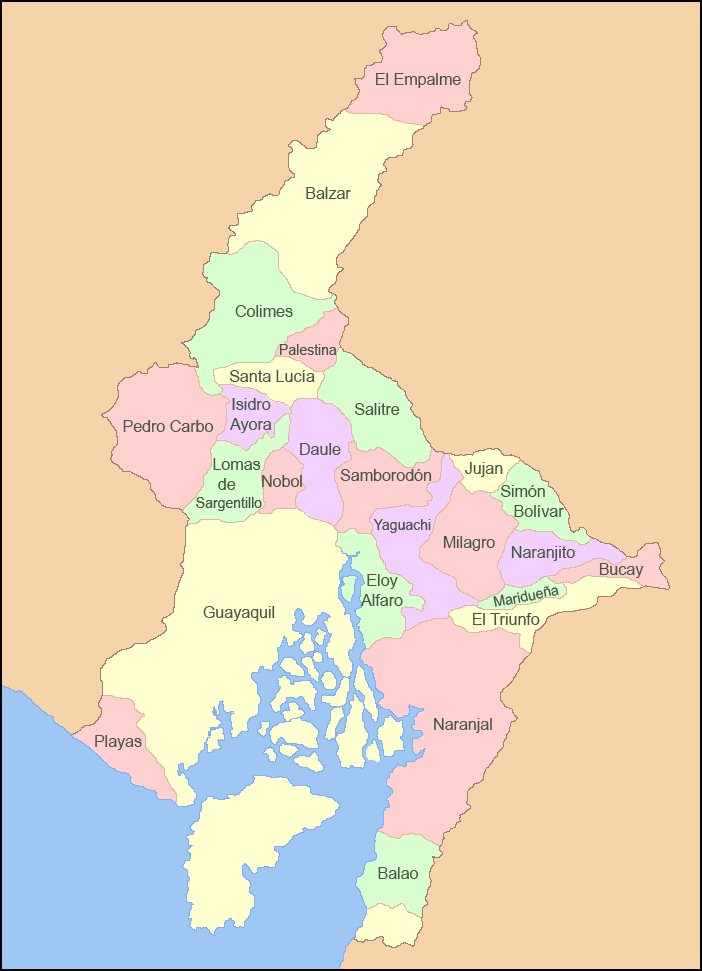
Map adapted from one found here

We stopped first at Hacienda Cacao & Mango, a farm focused on agritourism.


Our first item of business was a stop at the WC. I don't usually mention that in posts, but this one was extra cute.

Next up was lunch. All the food is grown locally and organically (or so they say). I loved the use of tree sections for placemats.

Wednesday, July 20, 2022

ECUADOR: CAJAS NATIONAL PARK AND THE CONTINENTAL DIVIDE

 March 27, 2022

I mentioned in a previous post that Cuenca means "basin" in Spanish. What makes Cuenca a basin are the tall Andes Mountains that surround it. Our guide Javier took us on a drive high into the Andes to visit Cajas National Park and the Continental Divide. The name Cajas is derived from the Quichua word cassa, meaning "gateway to the snowy mountains." An alternate meaning is "cold." The average temperature is about 55° F (not that cold), and the average rainfall is about 42 inches. That's pretty warm for the elevation, but Javier reminded us that we were pretty close to the equator, and the snow level is 16,000 feet!

Buenos días, Señor. Como está usted?

The park covers about 110 square miles and is between 10,170 and 14,600 feet above sea level. We stopped at an area called Toreadora, or "bullfighter." 

I suppose this serene, stunningly beautiful lake somewhat resembles a bullring--it is round and has sloping slides that somewhat resemble bleachers. 

Saturday, July 16, 2022

ECUADOR, CUENCA: OLD TOWN

 March 27, 2022

The historical center of the city of Cuenca has been listed as a UNESCO World Heritage Site. 

The official name of the city is Santa Ana de los Ríos de Cuenca. The name Cuenca, which means "basin" in Spanish, refers to its position in a broad valley in the Andes. Cuenca was built by the Spaniards atop the ruins of Tumebamba, an Incan city destroyed in a civil war just before the arrival of the Spanish conquistadors.

The city's coat of arms includes the words Primero Dios y Despues Vos, which translates as "First God and then you." 

There are many beautiful buildings in the older part of town, and some date to the colonial era. Others are more recent. Our first stop was the San Francisco Church, largely constructed in the 19th century. The clock tower was added in 1930 and includes the Latin phrase Ora Pro Nobis ("Pray for us") just above the clock.


Tuesday, July 12, 2022

ECUADOR: FAREWELL GALAPAGOS ISLANDS, HELLO CUENCA (A WALK THROUGH THE UPPER CITY AND A VISIT TO THE MARKET)

 March 26-27, 2022

The Alya crew had one more wet landing on Bachas Beach (Santa Cruz Island) planned for the morning, but I was hesitant to get wet just before leaving so I didn't go. I wish I had as Bob said it was one of the best walks of the trip. He was most excited by the fact that they actually saw a flamingo--just one, but what a setting!

I should know better than to miss an opportunity. 

After they got back, we were returned to the tiny Galapagos Airport, where we waited for several hours for our flight to Guayaquil. We were reminded not to neglect wearing a face mask, maintaining social distance, and washing our hands because "The pandemic is not over."  Darn. We had hoped it had disappeared while we were in the wild.


Our group of four couples split up at the Guayaquil Airport, with two couples continuing to Quito and then home, and Bob, Terry, Geneil, and I continuing our adventure. We were picked up by a driver who didn't speak English and who was not terribly interested in trying to understand my attempts at Spanish. He drove us to Cuenca, a drive we thought would take 2.5 to 3 hours, but that he said would take 5, and that actually took 5.5 hours. Terry looked up the route on his phone and saw a long way and a short way to Cuenca, the shorter way having tolls. I tried to clarify with the driver that we wanted the shorter one and would pay the tolls, but he said there was only one road. That really bugged us. (We later learned that the shorter way had been closed since the previous August because of a  massive landslide, so there WAS only one road!)

Friday, July 8, 2022

ECUADOR, GALAPAGOS ISLANDS: SANTIAGO ISLAND, Part 2

 March 25, 2022 - Afternoon

We had one final snorkeling adventure planned on the afternoon of our last full day in the Galapagos Islands off Espumilla Beach on Santiago Island. This last snorkeling trip was, in my opinion, the best of the many snorkeling opportunities we had. I wish we'd had a better underwater camera, but these posters at least illustrate the wide variety of fish in the Galapagos ocean.


Monday, July 4, 2022

ECUADOR, GALAPAGOS ISLANDS: SANTIAGO ISLAND, Part 1

 March 25, 2022 - Morning  

We were feeling a bit waterlogged after a lot of snorkeling on this trip and decided to opt out of the morning snorkeling trip in anticipation of another snorkeling trip planned for the afternoon. We planned to just stay in our room and get caught up on reading, journaling, etc. 

However, one of the employees came to our cabin to tell us Fernanda had called and asked him to see if we wanted to go exploring in a panga. That sounded like fun, so off we went.

The panga traced a path along the shoreline, and we saw all kinds of animals--boobies, sea lions, pelicans, diving birds, and more.


I had fun taking pictures of Bob taking pictures.

Thursday, June 30, 2022

ECUADOR, GALAPAGOS ISLANDS: CROSSING THE EQUATOR

 March 24, 2022, Late afternoon and evening

The first time Bob and I crossed the equator was in 2009 when we flew over it on our way to Peru. The first time we crossed the equator at ground level was on our trip to Kenya in 2014. We crossed the equator by air several more times before this trip, and we crossed it on foot and by car in Quito, but our trip to the Galapagos was the first time we crossed the equator on the water.

We were not quite prepared for what it means to cross the equator on a boat.

First, we all gathered in the wheelhouse with the captain to take a look at the instruments that indicated exactly where we were on the earth's surface.

Somewhere out there was the equator, but we couldn't see it.

In days past, a sextant was used to determine latitude, but these days a sophisticated, digital instrument panel makes it much easier. We all crowded in and got our cameras ready to take a picture of the GPS display when we crossed the equator.

The equator is at 0*00.000, but I missed it by .003. (We were traveling south to north, so this is just after crossing.)

Sunday, June 26, 2022

ECUADOR, GALAPAGOS ISLANDS: ISABELA ISLAND - TAGUS COVE PANGA RIDE AND EQUATOR CROSSING

 March 24, 2022, Afternoon and Evening

In the afternoon we took a panga trip to Vincente Roca Point, the northernmost site on Isabela Island. It is supposed to be a fantastic area for snorkeling, but the water was very murky.


I could see the great swaths of bubbles that Bob said had a soapy taste.


Close up, it didn't look like bubbles at all--more like DNA chains.


Wednesday, June 22, 2022

ECUADOR, GALAPAGOS ISLANDS: ISABELA ISLAND - TAGUS COVE HIKE

March 24, 2022, Morning and Lunch

During the night our catamaran left Fernandina Island and returned to Isabela Island, dropping anchor just off Tagus Cove on the northwestern coast of the island.

We got up early for a 6:00 AM breakfast, and by 7:00 we were in pangas on our way to a dry landing at Tagus Cove.

Tagus Cove was visited by Charles Darwin in 1835 and has always been a hideout for pirates, whalers, and other sea voyagers. The cove gets its name from a British ship, the Tagus, that anchored there in 1814 looking for some of the giant tortoises to replenish their food supply.

Starting in the early 19th century, visitors to this site began carving their name and the year into the cliff. (It just takes one to start a trend.) 

The oldest is this one: 1836.

The practice was outlawed when the Galapagos National Park was established in 1959-1960, although I see "Feb 1974 Oceana" on the right. Clearly this was before tourists had to be accompanied by a naturalist!

Saturday, June 18, 2022

ECUADOR, GALAPAGOS ISLANDS: FERNANDINA ISLAND - ESPINOZA POINT

 March 23, 2022, Afternoon

The last expedition of the day was a walking excursion on Fernandina Island, an island next to Isabela Island, where we had spent the morning and the previous day. Our naturalist guide Fernanda told us Fernandina is her favorite island in the Galapagos, and not just because of the similarity to her name. She was excited to show it to us.

With the good omen of a rainbow behind us, we set out in the pangas for a dry docking on Fernandina Island. Our two-hour visit there may be our favorite experience of the entire Galapagos trip, and possibly one of our favorite travel experiences of all time.


We disembarked directly from the panga onto a short length of concrete that acted like a pier. We were the second panga in, and we wondered what everyone from the first panga was taking pictures of. When we got to that spot, we saw this green marine iguana crawling out of the water.

When we were only about 10 yards farther down the trail, we started hearing gasps from those in front of us, and when we could  see what they were looking at, we gasped too. A clearing was jam-packed with completely motionless marine iguanas--hundreds of them--some unceremoniously stacked on top of others, and they didn't even bother to acknowledge our presence. 

Tuesday, June 14, 2022

ECUADOR, GALAPAGOS ISLANDS: ISABELA ISLAND - URBINA BAY

 Wednesday, March 23, 2022, Morning

Every night after dinner, the crew would put the next day's itinerary on a giant TV screen so we could plan clothing, etc. Our second day would include two landings: one wet and one dry.


When we woke up the next morning, we had this view from our cabin window. 

After breakfast, we motored to Urbina Bay on Isabela Island. Bob took this photo of the Bay later in the day:

Our morning excursion required us to get out of the panga in knee-deep water (a "wet" landing).  The coarse volcanic sand of the beach wasn't very hospitable, and neither was the skull. Was it a warning of some kind? It was also already quite hot and very humid.  


Friday, June 10, 2022

ECUADOR, GALAPAGOS ISLANDS: ISABELA ISLAND - PUNTA MORENO AND ELIZABETH BAY

 March 22, 2022

During the night we sailed from Puerto Ayora to Punta Moreno, located on the largest of the Galapagos Islands, Isla Isabela. We spent the morning boating around Punta Moreno, and in the afternoon we traveled a little further up the coastline to Elizabeth Bay, shown below.

We had thought that being on a triple-hulled boat meant more stability in the water, but that was not the case, and during my first night on the Alya I did serious battle with my nemesis, motion sickness. Thank goodness we had a private bathroom. In spite of scopolamine patches and Dramamine, I felt queasy to some degree the entire trip, which was a bummer.

However, the next morning I was able to keep my breakfast down and join the others on an inflatable motorized raft, which I learned is called a panga, for an expedition to explore the coastline of Punta Moreno on the island of Isabela. There it is in the distance, as seen from our catamaran:


The Alya had two pangas, and every time we left the catamaran, we split our group of 19 (8 couples, 1 naturalist, 2 panga skippers) between the two.

We were not allowed to actually land and disembark on this day, but we still had some amazing experiences.

First, we pulled up alongside a coastline covered with a dense mangrove thicket.

As we got close, we saw that the trees were full of pelican nests.

Pelicans are huge, clumsy-looking birds with what looks like a toupee instead of feathers on their wings--at least from this angle.