
We had a rather loquacious Finnish guide, but I loved her. I was particularly interested in what she had to say about education, because Finland has one of the best school systems in the world. Finnish children go to preschool at age 6 and start public school at age 7. (I think the United States is making a huge mistake pushing reading to five-year-olds in kindergarten, but that is a topic for another post.) They start learning a foreign language at age 9, which is usually English first and then Swedish a few years later. At age 16 students decide whether or not to continue in a college prep program, and about half do and the other half start learning a trade or working. Most Finns graduate from high school at age 19. All Finnish men then have compulsory military service at age 20, and Finnish women may volunteer if they so choose.
Finnish living standards are high, with an average salary of about $4,000/month. They pay a LOT in income taxes (a minimum of 1/3 of their income up to the highest tax rate of 62 or 63% according to our guide, but which I was unable to verify in my own research), and there is a 13% tax on groceries as well. However, they have fabulous retirement and medical care, and all schooling is free, including the universities.
One of our stops was a monument to Jean Sibelius (1865-1957), the Finnish national composer. Our guide spent quite a bit of time telling us about him. Here is what I learned:
* He grew up in a Swedish-speaking family, and his father died when he was quite young. His father had wanted Jean to be a lawyer, so that is what Jean studied at the university, but he ultimately gave up law to study music.
* He is known for his seven symphonies and numerous shorter pieces.
* Almost all of the music we associate with him came from his early years of composing. He became very critical of his later works. He was also bashed by music critics--perhaps in response to his own self-criticism.
*He had to have absolute silence to compose.
*He smoked cigars (and still lived to be 92).
* His composition, "Finlandia," is the UNofficial national anthem. It was written in 1899 as a subtle protest against Czarist Russia domination and censorship and was originally played against a background of scenes from Finnish history. See a great video about the music here. The part we Americans are most familiar with (the section used for the hymn "Be Still My Soul") begins at about 5:20.
The Sibelius monument was unveiled in 1967 and is composed of 600 hollow steel pipes and a separate bust of the composer. The pipes could represent an organ, although Sibelius did not compose for organ, or perhaps they are symbols of music in general. Some believe the pipes represent the Finnish forests.

Detail of one of the pipes:
 The monument was rather controversial, and so a more "traditional" bust of the composer was added. However, note that poor Jean does not have ears. There is some argument about the metal shape surrounding Sibelius's head, but most believe it represents his very unique way of hearing music. After all, he did not compose on a piano; he did not even have one until he was 50, which was after the bulk of his composing was done.
Our final stop in Helsinki was one of the most unique churches I've ever seen: Temppeliaukio Church, a Lutheran church built in 1968-1969 inside a small mountain of rock. The rock walls are left exposed, and the ceiling is a glazed dome.

 If you can believe it, this is one of Helsinki's most popular tourist destinations:
 I got a kick out of this sight of two men "kneeling at the altar" to snap their photos:
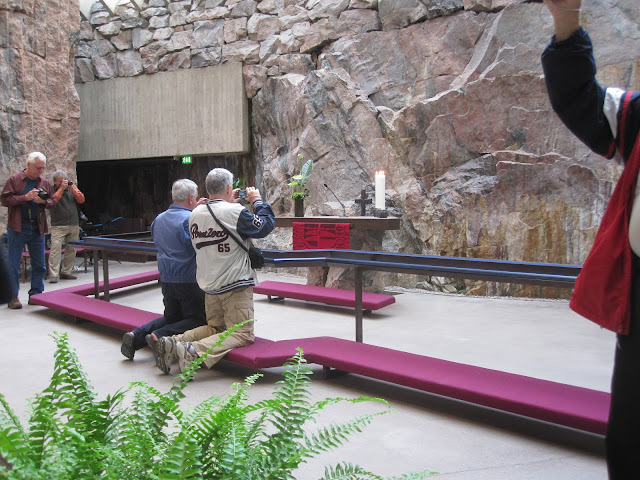 We did have to wait a bit to get in as there was a wedding in progress. This church is a very popular place to get married, and couples have to reserve their date a full year in advance.
 Set up for the next wedding was happening during the time we were inside. Crazy.
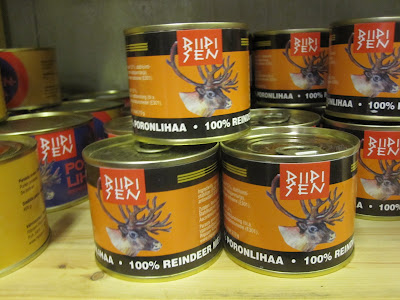
Finally, no country post is complete without a few food photos. I include what Bob drooled after but figured he couldn't sneak through customs:



Finnish living standards are high, with an average salary of about $4,000/month. They pay a LOT in income taxes (a minimum of 1/3 of their income up to the highest tax rate of 62 or 63% according to our guide, but which I was unable to verify in my own research), and there is a 13% tax on groceries as well. However, they have fabulous retirement and medical care, and all schooling is free, including the universities.
 |
| Photo from Wikipedia |
One of our stops was a monument to Jean Sibelius (1865-1957), the Finnish national composer. Our guide spent quite a bit of time telling us about him. Here is what I learned:
* He grew up in a Swedish-speaking family, and his father died when he was quite young. His father had wanted Jean to be a lawyer, so that is what Jean studied at the university, but he ultimately gave up law to study music.
* He is known for his seven symphonies and numerous shorter pieces.
* Almost all of the music we associate with him came from his early years of composing. He became very critical of his later works. He was also bashed by music critics--perhaps in response to his own self-criticism.
*He had to have absolute silence to compose.
*He smoked cigars (and still lived to be 92).
* His composition, "Finlandia," is the UNofficial national anthem. It was written in 1899 as a subtle protest against Czarist Russia domination and censorship and was originally played against a background of scenes from Finnish history. See a great video about the music here. The part we Americans are most familiar with (the section used for the hymn "Be Still My Soul") begins at about 5:20.
The Sibelius monument was unveiled in 1967 and is composed of 600 hollow steel pipes and a separate bust of the composer. The pipes could represent an organ, although Sibelius did not compose for organ, or perhaps they are symbols of music in general. Some believe the pipes represent the Finnish forests.

Detail of one of the pipes:

 |
| I think he rather looks like Dr. Zhivago here, don't you? |


Finally, no country post is complete without a few food photos. I include what Bob drooled after but figured he couldn't sneak through customs:


I'm so glad I didn't have to eat Rudolph and Smokey.


