Traveling often raises a lot of questions. I have learned that there is nothing like going somewhere new to realize that I really know very little about the world. Then it is fun to come home and do some research to give context to what I've seen.
Hungary was that way for me. I knew that it had been part of the Austro-Hungarian Empire prior to World War I, and because I had read Michael Meyer's book
The Year That Changed the World, I knew about it starting the chain of events that led to the collapse of the Iron Curtain, but that's about it. The years in between were pretty unknown to me. Since coming home, I have learned that after World War I, Hungary lost 70% of its territory, all of its seaports, two-thirds of its total population, and a third of its ethnically Hungarian population. No surprise, then, that it joined the Axis powers in 1940.
In 1941 Hungary invaded Russia, doing well at first but then suffering growing losses until finally trying to negotiate surrender to the Allies in 1943. However, this ticked off Hitler (
not a good thing) and he sent Nazi troops to occupy Hungary to prevent the surrender. Unfortunately, once the Nazis were there, they immediately began identifying and collecting the Jews, and in May and June of 1944, the Nazis deported 444,000 Hungarian Jews, mostly to Auschwitz. Because it was so late in the war, many of these Jews suvived, but at least 200,000 died. There was a very strong underground movement that saved a number of Jews, particularly in Budapest, and ultimately about half of the city's Jews survived the Holocaust. (By comparison, only 10% of Poland's 3,000,000 Jews survived.)
 |
| Arrow Cross flag |
In November 1944, just six months before the end of the War, the Arrow Cross government, the Hungarian branch of the Nazi party, ordered all remaining Jews into the Ghetto. During the next two months, the ruthless Arrow Cross took as many as 20,000 Jews from the Ghetto to the banks of the Danube. They had them remove their shoes so that they could be passed on to others, and then they shot them and let their bodies fall into the river.
Which brings me to our visit to Budapest.
Sixty years later, two Hungarian artists created a stirring remembrance of the atrocity, and they called it "Shoes on the Danube Bank." Sixty iron pairs of 1940s-style shoes--men's, women's, and children's--are attached to the stone at the edge of the Danube, forming a border that runs about forty-three yards.
The memorial plaque is written in three languages, including English:

Moving in its simplicity, this memorial is a must-see for any visitor to Budapest.
The other significant Jewish site we visited was the Dohany Street Synagogue, the largest synagogue in Europe and the fifth largest in the world:
Completed in 1859, it has an interesting Moorish style that reminded me of the
Spanish Synagogue we had seen in Prague. Our guide pointed out that it has two towers "like Solomon's Temple."
It was bombed and seriously damaged at the beginning of the War, then the Nazis used it as a radio station and a barn, and finally it was further damaged during the Soviet invasion at the end of the War. During the Soviet occupation, the government allowed it to be used as a prayer house, which at least kept it from being torn down. A seven-year restoration project began in 1991 after Hungary's return to democracy, funded in part by Tony Curtis and Estee Lauder, both descendants of Hungarian Jews.
These t-shirts sold in the synagogue gift shop made me chuckle. That one on the right says "Winnie the Jooh."
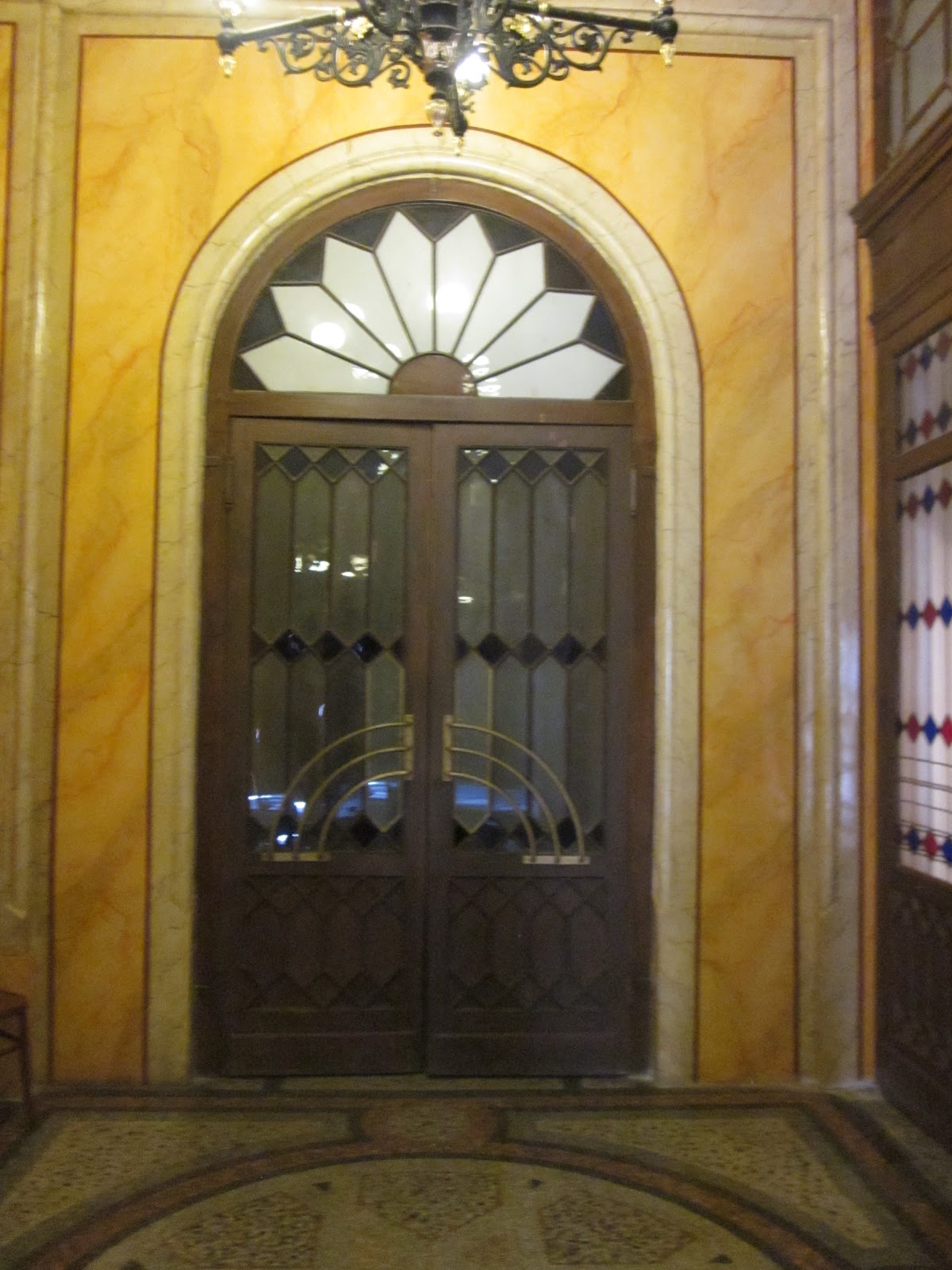
I really developed a thing for interesting/beautiful doors on this trip.
I also loved the geometric windows, and I got a kick out of Stan in his cap. Bob was always wearing a hat he purchased in Prague, so he didn't have to don one of these. Too bad.
The very unorthodox interior is almost shocking in its gaudiness. Men's seats are on the ground level, and women are seated in the balconies. In 1944, the evil Nazi Adolf Eichmann had an office on one of these balconies:
More Moorish touches in the inside:
The aisle floor looks like a quilt: Fresh flowers tied to the end of the pews:
There were also some interesting touches not usually seen in synagogues: an organ and a central pulpit. As our guide put it, "This is the most beautiful Catholic synagogue in the world," and it was "built to impress Gentiles."
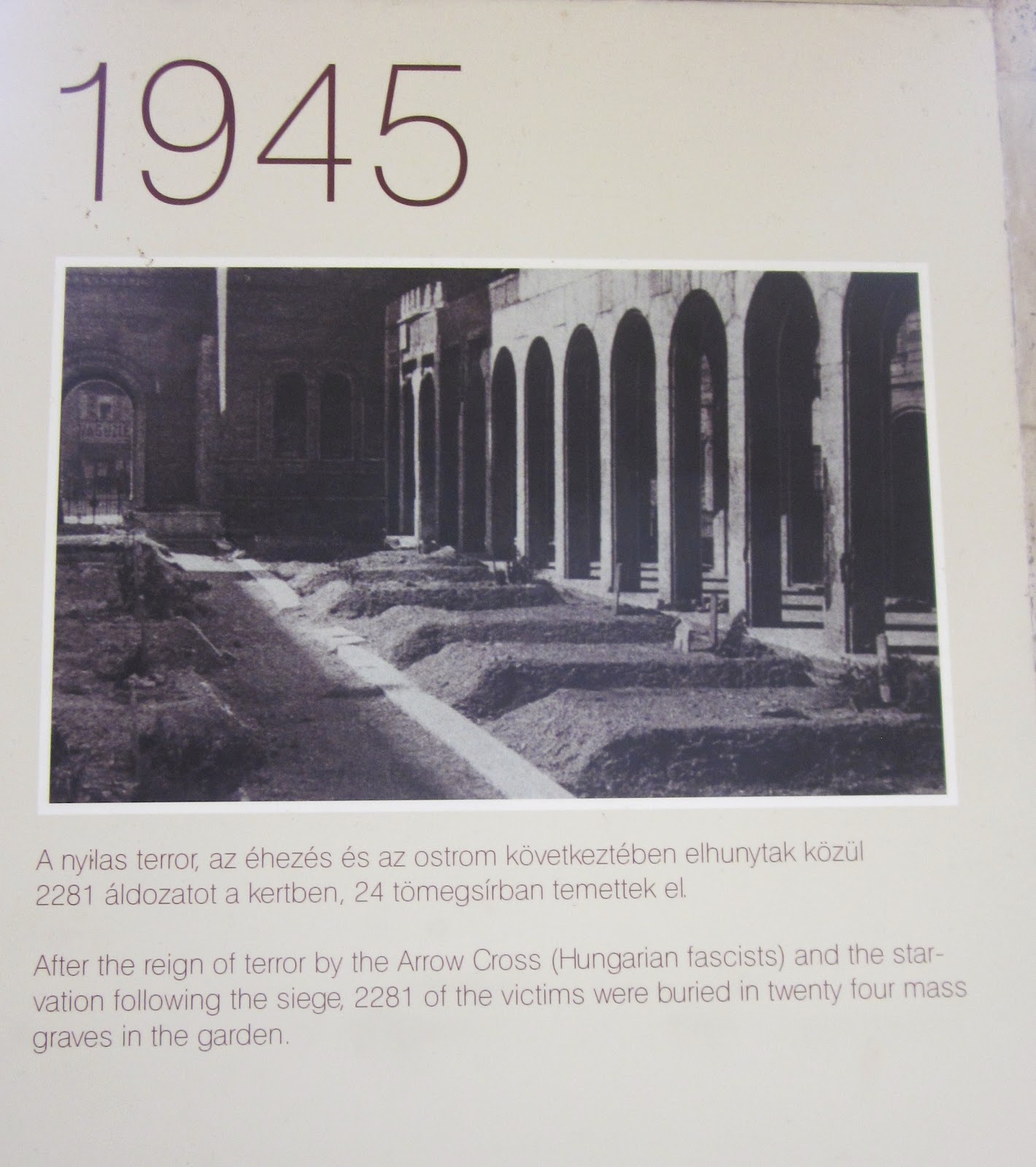
As in so many Jewish sites, there are many references to the Holocaust. Behind the synagogue is a beautiful courtyard with a sad history. In the winter of 1944-1945, thousands of Jews were kept in inhumane conditions in a ghetto that included this area. When the ghetto was liberated, thousands of bodies of Jews who had frozen, starved to death, or been brutalized by the Arrow Cross were found in the streets. More than 2,000 of those Jews were buried in twenty-four mass graves here, behind the synagogue:
It is called "The Garden of Remembrance," and a sign says it is "a memorial to an era when all human feeling was lost."
Just beyond the garden is an unusual weeping willow tree made of steel:
On closer examination, we saw that it was a broken-looking upside-down menorah,
The Memorial of the Hungarian Jewish Martyrs.

On the leaves are engraved the names of Hungarian Jews known to have died in the Holocaust: a number that ranges from 400,000 to 600,000, depending on the source.
An inscription at the base of the statue in Hungarian is translated as "Whose agony is greater than mine?"
Facing the willow from across the courtyard is this dramatic stained glass window. The swirling flames are the perfect symbol of the Holocaust; the snake coiling upward out of the flames represents the evil of Fascism.
The word on this grave marker is the Hungarian word for "Remember."
There is also a memorial to the non-Jews who risked their lives to save the Jews. As I mentioned at the beginning of this post, they were particularly active and successful in Budapest. The first name on this marker is that of Raoul Wallenberg, Sweden's special envoy in Budapest in 1944, who issued protective passports to thousands of Jews and hid thousands more in safe houses designated as Swedish territory, saving tens of thousands of Jews
all by himself. In 1945 he was accused of spying by the Soviets and shipped off to a KGB prison in Moscow, where it is thought he died in 1947. Among those he saved was Tom Lantos, who went on to become a United States Senator from California.
While Wallenberg is not actually buried here, this symbolic grave is a reminder that a single person can have a great impact in the war against evil.
ANOTHER BOOK TO READ:
The Seamstress, by Sara Tuvel Bernstein, is the memoir of a very feisty Romanian Jew who lived and worked in Budapest in the days leading up to the Holocaust. She recounts the growing tension in Budapest as fascism gains power, the increasing number of anti-Semitic laws, and finally the open persecution of Jews that led to the establishment of the Jewish ghetto. This first half of the book provides poignant insight into the Jewish venues in Budapest.
Sara, her sister Esther, and two friends end up in Ravensbruck, a brutal women's concentration camp about 60 miles north of Berlin, where 19 out of 20 prisoners eventually died because of the horrible conditions. Although one of Sara's group dies, Sara, her sister, and one of the friends miraculously manage to survive, due in large part to Sara's street-smarts and courage.
Time to move on for some gelato.