Showing posts with label Lech Walesa. Show all posts

Saturday, February 29, 2020

POLAND, WARSAW: ROYAL PALACE

June 27, 2019

Old Town Market Square, where we were staying in Warsaw, is only a block from the beginning of Castle Square, which is the starting point for the Royal Route, a 7-mile road that leads from the Royal Castle to King Jan III Sobieski's 17th-century personal residence. A main artery of the city, it is chock-full of things to see. 

The first thing we noticed when we entered Castle Square was a 72-foot-tall column topped by a statue of King Sigismund II of Vasa, who moved Poland's capital from Krakow to Warsaw in 1596. The column was erected in 1664 and has the distinction of being the first secular monument in column form in modern history. You'll notice, however, that although the king has a sword in one hand, he is carrying a cross in the other hand. Not much separation between church and state in those days.

Sigismund made it through the 1939 Nazi invasion of Poland, but on September 1, 1944, during the Warsaw Uprising, the column was demolished in bombing raids. Miraculously, the figure of Sigismund more or less survived. 
Photo from Wikipedia
Sigismund had some reconstructive surgery after the war and was re-elevated to the top of a new granite column in 1949. Today the column is a popular gathering site. Every time we were near it, there was a busker of some sort playing on the steps and dozens of people languishing on or near its base.

To the right of the column is a huge red brick building. This is the Royal Castle, once the home of Polish monarchs (including Sigismund, the dude on the column) and now a Polish art and history museum. It is a UNESCO World Heritage Site.

The castle's clock tower is almost 200 feet tall, and its base dates to the mid-14th century. The castle was hit by bombs during the initial invasion of Warsaw in September 1939, which destroyed the roof and turrets. Immediately after the Germans seized the city, they cleaned out everything that was valuable from the building, sending some items to Germany and giving others to Nazi officials living in Warsaw.  However, some of the art was secretly smuggled out by Polish museum staff at great risk to their lives. The Nazis dynamited what was left of the 600-year-old building in 1944 in retribution for the Warsaw Uprising.

Friday, November 29, 2019

POLAND: WALKING TOUR OF GDANSK

June 21, 2019

There is a lot to see in Gdansk, and a good way to see it is by hiring a private tour guide. Our guide, Klaudia, was excellent. 

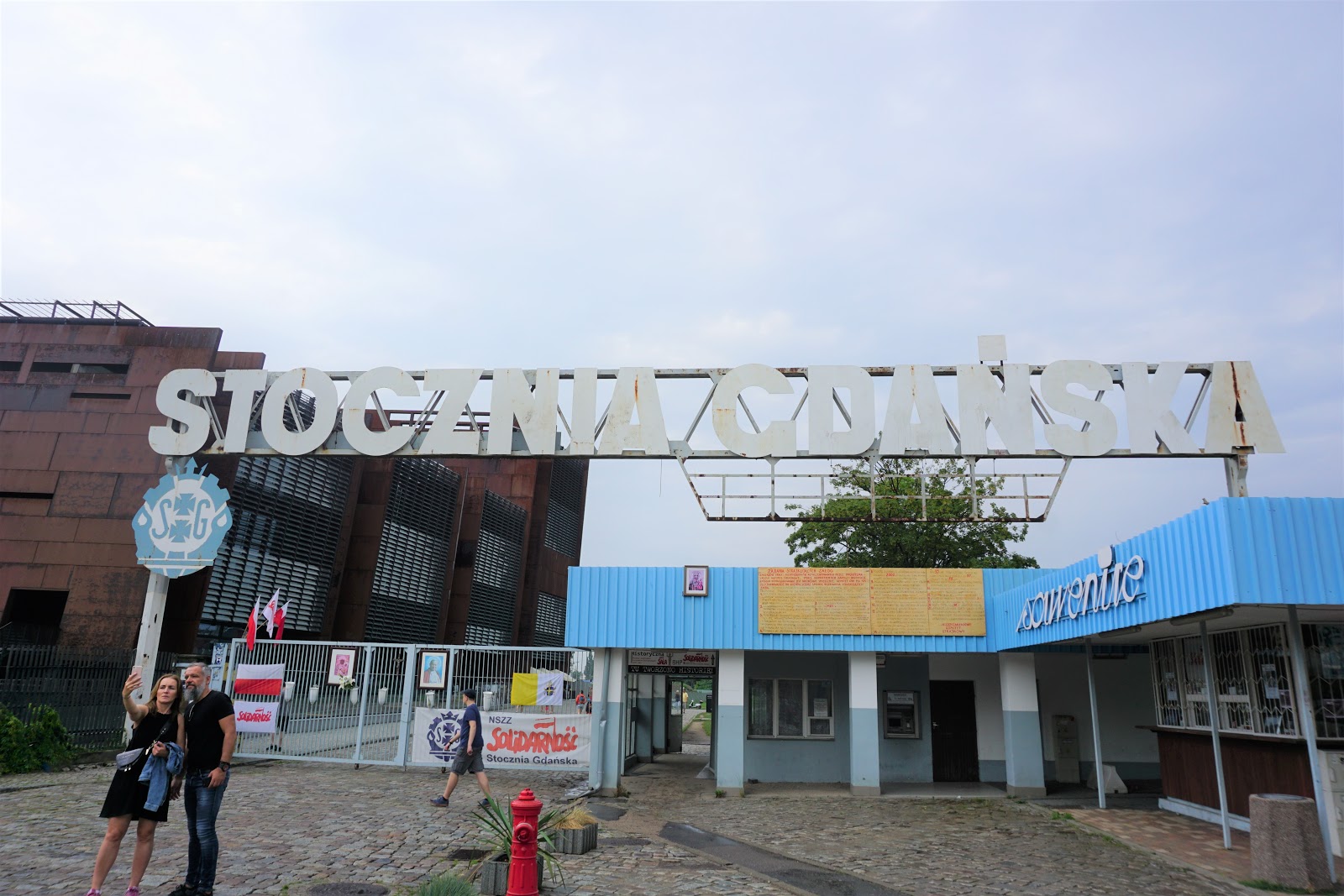
The first place she took us was to Solidarity Square, the site where 45 striking shipyard workers who were protesting the communist regime were killed in 1970. At the center of the square is the Monument to the Fallen Shipyard Workers of 1970, also known as the Three Crosses Monument, which was erected 1980 next to entrance of what was then called the Lenin Shipyard. It was the first monument in the world erected in a Communist country to recognize victims of Communist oppression.

Three 138-foot steel crosses, each weighing 36 tons, stand on the spot where the first three victims of the riots were killed. The crosses represent the suffering and sacrifice of those first three victims, subsequent victims, and all of the protestors. The crosses are topped by anchors, symbols of the shipping industry. Bas reliefs of the dock workers adorn the bottom of the shafts.

Stockznia Gdankska = Gdansk shipyard:

Sunday, October 27, 2019

WELCOME TO POLAND: INTRODUCTION

June 20, 2019

Poland has been at the top of my travel list for more than a decade. Our son served an LDS mission there in 2004-2006. During and since that time I read book after book about Poland, some of which I will include in future posts. I was moved by the stories of modern Poles that our son shared with us, and I was captivated by the resilience and courage I read about.

On the other hand, my mother was not so big on Poland. She was German, and the Germans look down their noses at the Poles. She told me they used to have a saying in Germany, "If your car is missing, look for it in Poland," implying that all car thieves are Poles. However, she too was moved by our son's letters and stories from his mission, and I think her heart was softened somewhat during those two years. I wish she were still alive and that I could share some of our experiences with her now.

As it turns out, Poland is now one of my most favorite tourist destinations in the world. I would return in a heartbeat. There is so much history, anguish, and triumph there. Situated between two super powers, Germany on the west and Russia on the east, Poland has been subject to a constant game of tug-of-war, and yet the Poles have managed to retain a national identify separate from either country. 

World War II was especially hard on Poland, partly because of its location, partly because its large Jewish population was annihilated by the Nazis, and partly because no one came to its aid. Poland, of course, was the first country invaded by Hitler in September 1939 (more on that in later posts).

Of all the countries that fought in World War II, Poland lost the highest percentage of its population--almost 20%. Six million Poles died, half of whom were Jews. Less than 10% of the total fatalities were caused by combat. Rather, people died in concentration camps, at the hands of brutal invaders, and of starvation and disease. It took almost 30 years after the war for Poland to recover the population it had at the beginning of the war.
Graph from here