Showing posts with label Wisconsin. Show all posts

Wednesday, March 22, 2017

DOOR PENINSULA, WISCONSIN: CAVE POINT COUNTY PARK

Before I get into this last post in my Wisconsin series, I have to say a few words about Wisconsin cheese: There's a lot of it.

Wisconsin produces more cheese than any other state in the Union. In 2014, it produced 2.9 billion pounds of cheese, or just over 25% of all the cheese produced in the United States. In a 2006 article, the New York Times noted, "Cheese is the state's history, its pride, its self-deprecating, sometimes goofy, cheesehead approach to life." On our way north to the nethermost regions of Wisconsin, we stopped at a remarkable cheese shop with so many delicious options that it made my head hurt:

Player Shaped Cheese, Football Shaped Cheese, State Shaped Cheese, Cow Shaped Cheese (in both black & white and yellow)--they have cheese I never knew I wanted but did as soon as I saw them (never mind the lack of hyphens in the names):

They have more kinds of cheese than Germany has brats or France has breads:

What does a bear have to do with cheese? I have no idea, but he is cute, isn't he?

Tuesday, March 21, 2017

TREATS IN WISCONSIN: CEDARBURG AND GREEN BAY

Traveling as a couple requires some give and take. In spite of having been married over 37 years, we have our differences. (Surprising, I know. I'm sure this isn't true for any other oldy-weds, right?)  Bob humors me by detouring for chocolate, art museums, and all things quaint, and I humor him by detouring for anything animal related and college football stadiums.

On our Wisconsin trip, we had some of that give-and-take that ended up being a win-win. We both got something out of the other person's passion.  

MY STOP was "historic" Cedarburg, a borough founded in 1845 by Irish and German immigrants. (How Germans and Irish could live in the same place is a mystery to me.) Together they built five dams, five mills, and a thriving community. Cedarburg has done a great job preserving their 19th century buildings, and coupled with a resort-ish main street shopping area, the town has become a tourist destination.

The St. Francis Borgia Catholic Church of Cedarburg was built in 1842 and is still going strong.

I was touched by several things in the St. Francis Borgia churchyard, including this plaque that reads, "In Memorium. Leona Lesage Grant & Rose Weber. Born to eternal life, November 9, 1999. Killed when struck by a car when they crossed the street after attending morning mass. Safe in the arms of Jesus." 

I was also intrigued by this statue of a woman holding what looks like an empty blanket:

This is the plaque on the base:

Tuesday, March 7, 2017

WISCONSIN: MILWAUKEE ART MUSEUM

Warning! This is a L-O-N-G post, but do not be deterred by length. It is another cataloging of art that I've seen and loved. It's mostly pictures with just a little text.

Coming upon the Milwaukee Art Museum is a lot like driving past the Disney Concert Hall in Los Angeles or the Space Needle in Seattle. The drama of the structure stops you in your tracks and makes you whip out your camera.

The building was designed by internationally renowned architect Santiago Calatrava and was completed in 2001. The triangle "wings" span 217 feet and can be folded in at night or during storms. To me, the design looks like a cross between a ship and an airplane or spaceship.

This bridge provides safe passage over a busy street in front of the museum and connects the museum to downtown Milwaukee:

The very long lines of the fountain echo the rigging cables seen the in photo above:

The inside architecture is just as spectacular as the exterior:

Saturday, February 25, 2017

WISCONSIN: TWO FRANK LLOYD WRIGHT CHURCHES

We had the good fortune to visit two churches in Wisconsin that were designed by Frank Lloyd Wright. Wright was born in 1867 (yeah, that surprised me too) in Richland, Wisconsin, a small town about 60 miles northwest of Madison. For a mid-westerner, he really got around. He designed over 1,000 structures, 532 of which were actually built. There are 25 structures designed by him in my home state of California, including the famous Hollyhock House.                                                                                                                           Wright lived a very colorful and often controversial life and died in 1959.  In 1991 he was deemed "the greatest American architect of all time" by the American Institute of Architects.  
We visited the Annunciation Greek Orthodox Church in Milwaukee. Wright was 89 years old when he designed this church in 1956 (two years after the above photo of him was taken and three years before he died), and the church was completed in 1961, two years after his death. He drew from Byzantine architectural styles (particularly the Hagia Sophia in Istanbul) for his design. I love the reflecting pond out front that presents a shimmering, ephemeral version of the church:

We were so disappointed that it was locked up tight with no one around. Photos of the inside show it to be quite a spectacular church:
Picture from here.  Go to the site for other gorgeous photos.

I would have loved to see this window from the inside:

Friday, February 24, 2017

MILWAUKEE, WISCONSIN: ST. JOSAPHAT'S BASILICA

I used to think that Europe had cornered the market on stunning church architecture and decor, but the more we travel around the United States, the more treasures we discover in our own country. The Basilica of St. Josaphat in Milwaukee is certainly one of the most beautiful churches we've seen in the U.S.
I must confess, however, that initially I had a hard time getting the phrase "Jumpin' Jehoshaphat!" out of my head. (For the origin of that phrase, go here.)  This isn't THAT Jehoshaphat. 

St. Josaphat was born John Kuncevic in 1580 in Lithuania, which was part of the Polish kingdom at that time. He became a monk and archbishop of the Ukrainian Greek Catholic Church and was killed in what is now Belarus in 1623 for the part he played in reuniting a segment of the Eastern Orthodox Church with the Roman Catholic church. He was canonized in 1867.

In 1880 there were 30,000 Polish immigrants living in the Milwaukee area, and they wanted a church. They modeled their church after St. Peter's Basilica in the Vatican and dedicated it to St. Josaphat. Ground was broken in 1896, and much of the work was done by the poor immigrant parishioners, who had little money to donate to the building fund. When  the structure was completed in 1901, it was the city's biggest church. The interior was completed in 1926, and in 1929 it was designated a Minor Basilica by Pope Pius XI, only the third church in the United States to be so honored. In the Catholic Church, basilica status is given only to the largest, most beautiful and historically important churches. Today Wikipedia says there are eighty-two basilicas in the United States, and those churches are the closest we get to European cathedrals.

This giant church, which can seat over 1,000 on the main floor and hundreds more in the galleries, is nestled among well-kept homes that reminded me of giant dollhouses:

Friday, February 17, 2017

MILWAUKEE, WISCONSIN: MILWAUKEE COUNTY ZOO

Years ago, my husband Bob would take off for continuing education programs and leave me stranded at home with three little children.  I was always very jealous that a) he got to get away without kids, and b) he could keep learning in his field. As an English major, I guess I could also "keep learning in my field," as long as I could find time to read with those three little kids around.

Anyway, one of the places he went several times was to a tax planning seminar at the University of Wisconsin in Madison.  Until we spent a few hours in Wisconsin while on a trip to visit my sister in Minnesota in fall 2015, I had never been to Wisconsin. Well, last July, after years of not attending that seminar, Bob decided it was time to go again, and this time, I got to go along!

Bob flew to Wisconsin several days ahead of me, and I flew in shortly before his week-long seminar ended. I wandered around Madison during his final day or two of the seminar, and then we headed east to Milwaukee.
Here is the sum total of what I knew about Milwaukee: "Schlitz, the beer that made Milwaukee famous" was a popular slogan when I was a kid, and had it not been for that slogan I probably never would have heard of Milwaukee.  Oh yeah, and I had also heard of the Milwaukee Brewers baseball team, which I've always related to the Schlitz slogan.

Well, Milwaukee has a few things other than their beer (which we don't drink anyway) that are worth noting. I'll start with the Milwaukee Zoo, a 200-acre spread that boasts over 3,300 mammals, birds, fish, amphibians, and reptiles that comprise 377 species. It began in 1892 as a mammal and bird display in the city park, and within a few years it grew to 800 animals housed on 23 acres of land. Over the next 100 or so years, it grew and grew and GREW until it reached the size it is today. In acreage, it is twice as large as the famous (at least to us Californians) San Diego Zoo, but it has only 10% of the animals and half the number of species that the San Diego Zoo boasts of.

Fewer animals on more land--that's what we liked about this zoo.

The sleek impala looked happy on this lot:

Thursday, March 31, 2016

WISCONSIN: CADDIE WOODLAWN HISTORICAL PARK

As of 2015, I had never been to Wisconsin. Bob had been there several times for a continuing education seminar that he really liked, but those were the years when we had children at home, and I never got to go along. We decided that our trip to Minnesota in October 2015 was a great time to slip across the stateline so I could check Wisconsin off my list. After a bit of research, I determined that a visit to the Caddie Woodlawn Historical Park would be perfect.

On our way, we stopped for a few photos of the St. Paul Minnesota Temple. (Or was that on the drive to somewhere else? Hmmm.)
This temple was dedicated on January 9, 2000. I'll bet it was freezing that day. When we were there, however, it couldn't have been more beautiful.

We got back on the road and headed east on the 94 Freeway towards Menomonie, where we turned south on Highway 25. I added the green line to the map below to show what I think is the approximate location of the Minnesota-Wisconsin stateline and to prove that I did more than just put my big toe in Wisconsin:

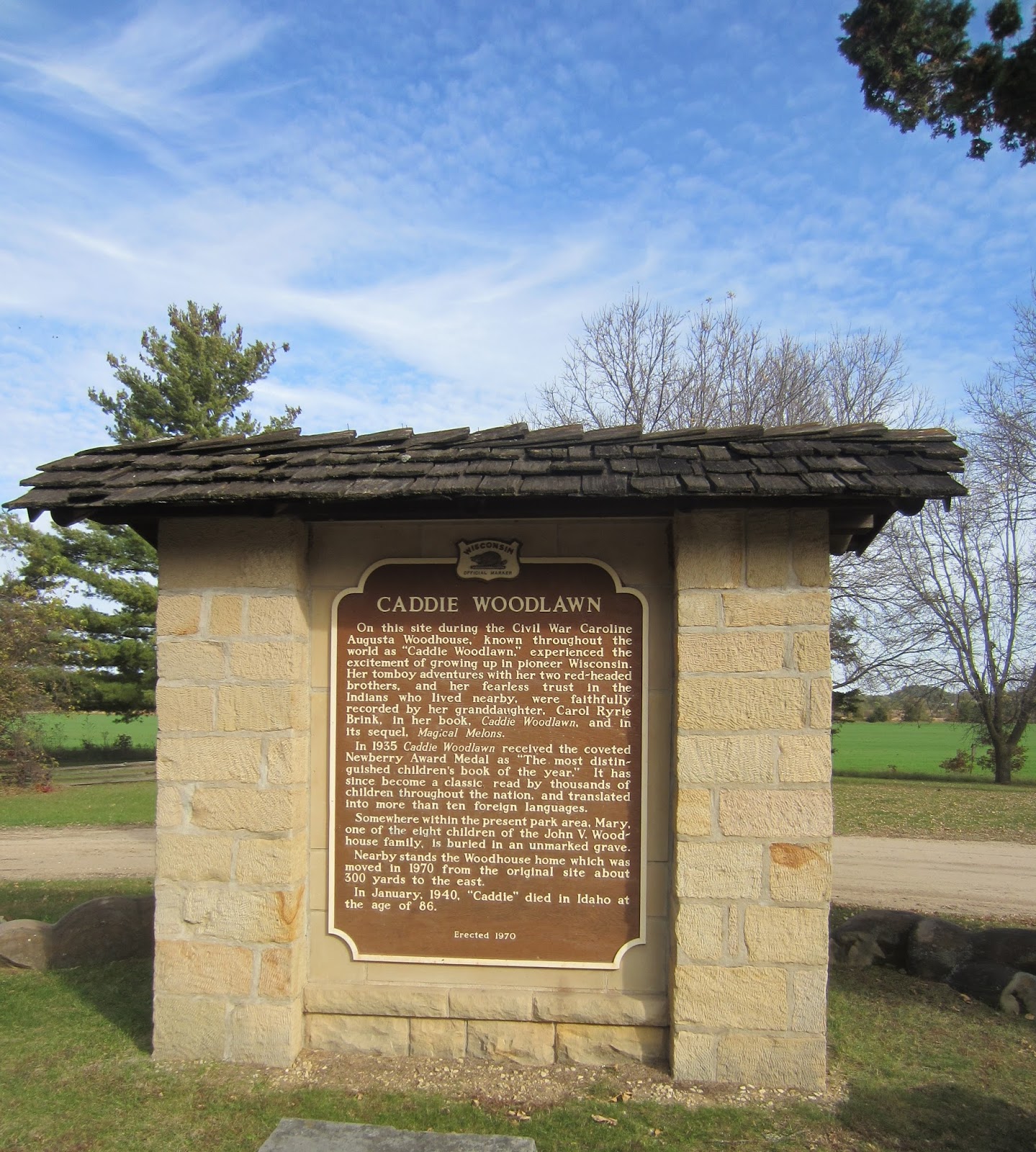
Caddie Woodlawn is a historical fiction children's book written by Carol Ryrie Brink that I read and loved when I was nine or ten years old. Published in 1936, it received the Newbery Medal for Children's Literature that year. (The sign on the property erroneously lists the medal as being awarded in 1935.) Caddie Woodlawn was not actually a real person, but she was based on the author's grandmother, Caddie Woodhouse Watkins, who grew up in Wisconsin and whose home is now the anchor of this historical park.