Showing posts with label propaganda. Show all posts

Thursday, January 1, 2026

GERMANY: DACHAU

 May 25, 2025

We visited Mauthausen Concentration Camp in Austria in 2012 and Auschwitz-Birkenau Concentration Camp and Treblinka Concentration Camp in Poland in 2019, so we assumed we were more or less prepared for a visit to Dachau. However, I learned that you can't actually be "prepared" to face horror on the scale of a concentration camp.

Historians believe over 1.1 million people perished in Auschwitz during its less than five years of existence, 800,00 to 925,000 Jews were gassed in Treblinka in just over a year, and 90,000 to 120,000 people were killed or died from the horrific conditions at Mauthausen during its seven years of operation. In contrast, "only" 41,500 or so people died in the Dachau concentration camp and its extensive subcamp system, and that was over a period of twelve years. Auschwitz-Birkenau and Treblinka existed primarily as extermination centers--the "final solution to the Jewish problem." Mauthausen started as a labor camp, but eventually became an extermination center as well. Dachau was a prison camp--a place in the beginning for the Nazis to intern their political opponents; then groups regarded as criminals such as Jews, Romani, homosexuals, and Jehovah's Witnesses; and finally, foreign nationals from countries that Germany occupied or invaded.

We arrived in the city of Dachau by train, and I was kind of surprised that there was a city--I had only heard of the camp. A map at the station highlights "Historic Old Town," "Dachau Palace," and  ways to experience nature near the town of 50,000. The last thing on the list is a "Place of Learning and Commemoration"--the concentration camp.


We had a private guide who showed us a map of the major concentration camps in Germany itself--most of which I hadn't heard of--along with the subcamps and Aktion T-4 centers. There are so many.

Grafeneck, where our grandfather was murdered on May 21, 1940, is on the map.

It was gloomy and rainy at Dachau, appropriate weather for the experience.

The Dachau concentration camp was opened by Heinrich Himmler in 1933, the first concentration camp established by the Nazi Party and the longest to be in operation, from March 1933 to April 1945 when it was liberated by American forces.

Wednesday, October 15, 2025

GERMANY: GRAFENECK

 May 21, 2025

This post is one of the hardest ones I think I have ever written. The subject matter is difficult, and six months out, I find I am still trying to process this day's events, both those that happened in 2025 and those that occurred exactly 85 years earlier in 1940.

Everyone has heard of Auschwitz-Birkenau, Dachau, Sobibor, and other concentration camps, but I am guessing that very few Americans are familiar with Bernberg, Hadamar, Brandenburg, Hartheim, Sonnenstein, and--the one that matters most to me and my siblings--Grafeneck. Each of these were "extermination centers" that were part of the Nazi Aktion T4 program. 

Aktion T4 preceded the concentration camps extermination program, and in fact was a foundation for the killing methods used in the camps and the beginning of the systematic mass murder system that led to the Holocaust. Its goal was to rid Germany of "life unworthy of life," the mentally ill and disabled. 

A propaganda poster in the Grafeneck Memorial
Documentation Center showing a strong German trying
to "support" two mentally ill creatures and noting that
supporting a handicapped person until the age of 60
costs 50,000 Reichsmarks.

Victims were brought against their will and generally without the knowledge of their families to one of the six facilities I listed above. There they were gassed using carbon monoxide, which took about 20 minutes--a much slower process than the Zyklon B (hydrogen cyanide) gas later used in the concentration camps--and their bodies were cremated. The Nazis called these "mercy deaths." Families were notified that their relative died of some randomly chosen but plausible cause, and often a container of indiscriminate ashes was sent to the family. 

Wednesday, February 14, 2024

NORTH CAROLINA: RALEIGH

 October 2022

On my last day I had several hours to kill after my son went to work and before I had to head to the airport, so I decided to take a look at North Carolina's capital city, Raleigh, named after Sir Walter Raleigh of Roanoke Colony fame. With a population of about 475,000, it is the 41st largest city in the United States, the 2nd most populous city in North Carolina after Charlotte, and one of the fastest growing cities in the country. In 2011 was ranked by Time as the third most-educated city in the US. 

Andrew Johnson, the 17th President of the US, was born here in 1808. Other notables include Olympic figure skater Kristi Yamaguchi, American Idol star Clay Aiken, and writer David Sedaris.

I was headed for the capitol building, but I detoured when I saw Christ Episcopal Church, built in 1848 to 1853. I love this sculpture entitled Peaceable Francis.


Down the street and around the corner is the First Baptist Church, completed in 1859.

Thursday, September 30, 2021

TEXAS, EL PASO: MUSEUM OF ART

 July 3, 2021

We ended our nine-day trip to New Mexico back where we started - in El Paso, Texas, where we had time to visit the El Paso Museum of Art, get some dinner, and get a bird's-eye view of the city.

Art first. 

The museum is located in the heart of downtown. The current location was built in 1998, and I liked it even before we went inside because of this fun mural on the side of the building.


People and animals have a lot in common, don't they?

The museum lobby had this work on one wall. Created by Andrea Bowers in 2019, it refers to the separation of migrant families at the border. The changing colors of the letters suggests the random divisions going on there.


Tuesday, November 17, 2020

LOUISIANA: NEW ORLEANS, Part 2 - National World War II Museum and New Orleans Museum of Art

November 6-10, 2019 

I visited two really good museums while I was in New Orleans: The National World War II Museum and the New Orleans Museum of Art.

1. The National World War II Museum

At the end of a long day of conferencing, I grabbed a taxi (Uber was SUPER slow in New Orleans, but a cab was always waiting at the hotel) and headed to what Congress designated in 2003 as America's official National World War II Museum. The museum's website states, "The National WWII Museum tells the story of the American experience in the war that changed the world--why it was fought, how it was won, and what it means today--so that all generations will understand the price of freedom and be inspired by what they learn."


Originally called the D-Day Museum, the museum opened (appropriately) on June 6, 2000. It is affiliated with the Smithsonian Institution and is worth much more time than I was able to give to it. Since its opening it has had many expansions and added many new exhibits. It is a must-see museum, whether your are a war buff or history aficionado or neither. Just go.

I started in the European theater section, and was reminded that the United States lost far fewer of its service members than its enemies did.

The war was also NOT a popular cause in the early years.

Sunday, July 23, 2017

WASHINGTON, D.C.: LIBRARY OF CONGRESS

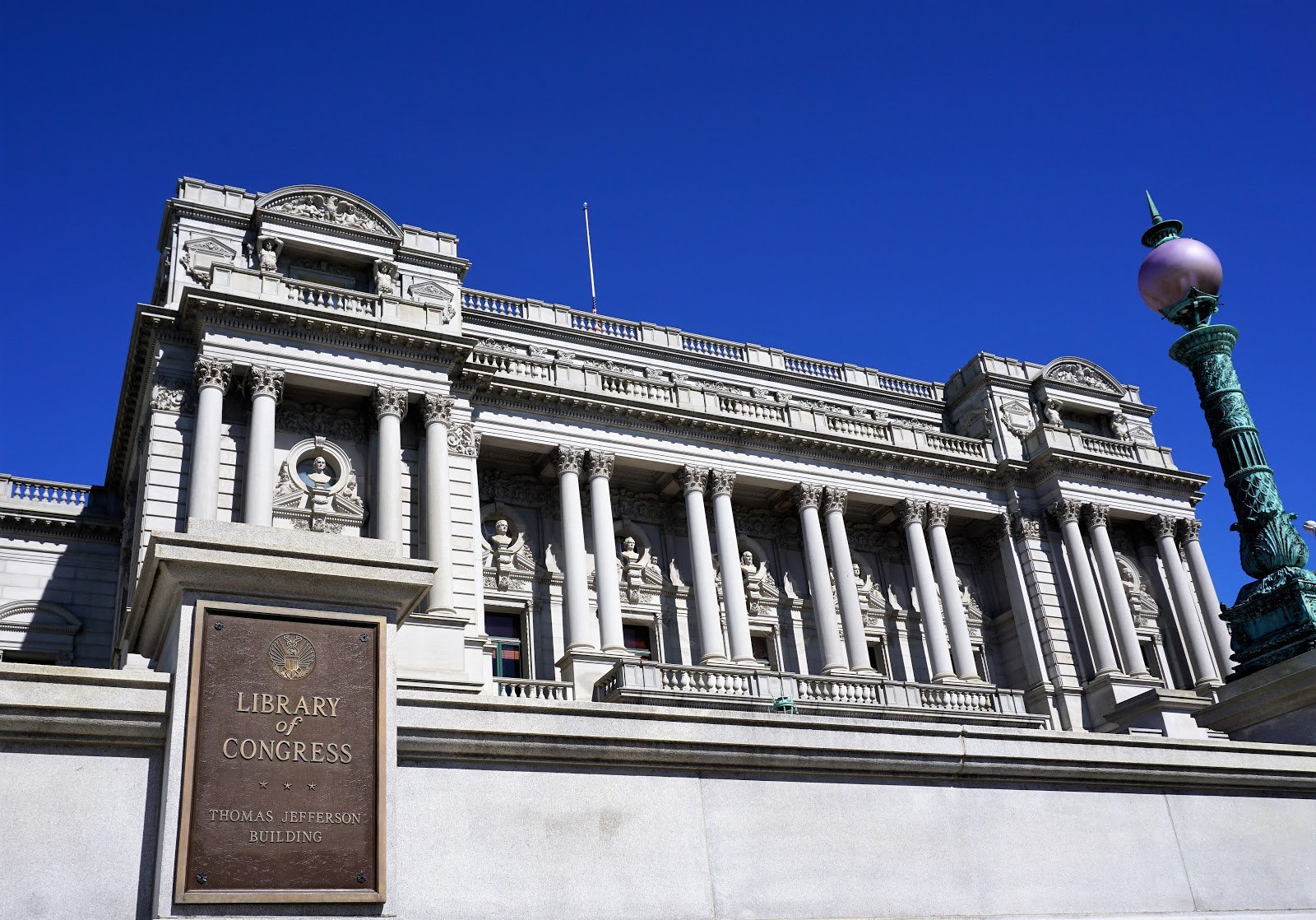
Just across the street from the U.S. Capitol is a building whose name I've always been familiar with, but which I knew little to nothing about: the Library of Congress.
U.S. Capitol as seen from the steps of the Library
The main building of the Library of Congress
The Library has an interesting history of stops and starts:

1783:  James Madison suggests creating a congressional library.

1800:  The Library of Congress is signed into existence by President John Adams when the capital moves from New York to Washington, D.C. A total of 740 books and 3 maps ordered from Europe constitute the first collection, which is housed in the capitol building and is meant to service the reference needs of Congress. 

1814:  Invading British troops destroy the Library of Congress and its collection, which has grown to 3,000 volumes. Thomas Jefferson almost immediately offers to sell Congress his personal library as the base for a new collection. (Why didn't he just give it to them?)

1815:  Congress designates $23,950 to purchase his 6,487 books. ($3.69/book is a pretty good deal for Jefferson in 1815.) The library continues to grow.

1851:  A disastrous fire destroys 35,000  of the library's 60,000 or so books, among which are two-thirds of Jefferson's collection. Congress replaces the number of lost books.

1865:  By the end of the Civil War, there are about 80,000 volumes in the library. The next decade sees tremendous growth, both in the number of books in the library and in the power of the organization itself when the library is given jurisdiction over all copyright registration.

1876:  The Library of Congress has over 300,000 volumes and begins construction of the present main library building. 

1897: With a collection of over 840,000 volumes, the Library moves into the Beaux Arts style Thomas Jefferson Building.

Sunday, December 13, 2015

INDEPENDENCE, MISSOURI: TRUMAN PRESIDENTIAL LIBRARY AND MUSEUM

On this trip to the Midwest, Bob and I visited three Presidential Library and Museum (PLM) sites, bringing our total to eleven of the thirteen official sites. (We still need to visit Gerald Ford's in Michigan and Teddy Roosevelt's in New York.)
The Truman PLM was the first library created under the 1955 Presidential Libraries Act, which established a system of privately built but federally maintained libraries. The dedication in 1957 was attended by previous President Herbert Hoover, Chief Justice Earl Warren, and former First Lady Eleanor Roosevelt. In 1972, funeral services for President Truman were held here before he was interred in the back courtyard, and ten years later his wife was buried by his side.

A mural by Thomas Hart Benton covers 495 square feet of the lobby walls, its swirling clouds, rolling landscape, and busy figures almost jumping off the surface:

Detail of area above the door
Detail of left panel below main painting
Detail of right panel below main painting
Truman and Benton became good friends during the painting of Independence and the Opening of the West. Truman himself even applied a few brushstrokes to this mural.