Showing posts with label mausoleum. Show all posts

Friday, July 18, 2025

INDIA, AGRA: THE TAJ MAHAL AND A STONE FACTORY

 December 28, 2024

Before our trip, when we told anyone we were going to India, their first question was, "Are you going to see the Taj Mahal?" Yes, of course! This UNESCO World Heritage Site is the #1 tourist attraction in India (although it is being overtaken by a city I haven't heard of--Ayodhya--308 miles to the east). UNESCO declared it "the jewel of Islamic art in India and one of the universally recognized masterpieces of the world's heritage." It was also named one of the "New 7 Wonders of the World" in 2001. Taj Mahal is Hindi for "Crown Palace." It is interesting to note that out of the 7 to 8 million visitors it hosted in 2024, less than 1 million were international tourists and the rest were domestic.

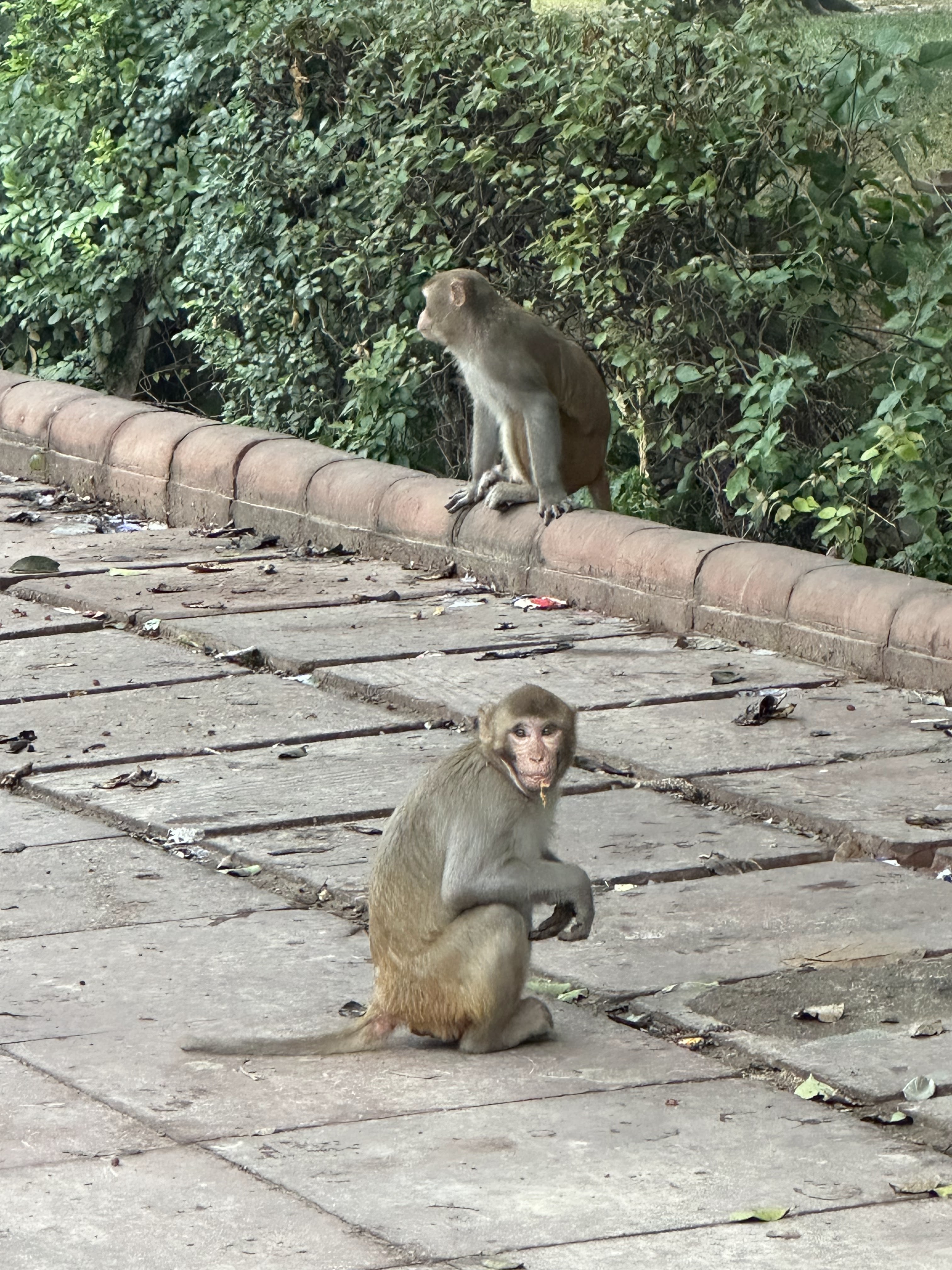
To get to "the Taj," as it is fondly called, you first have to pass through the Monkey Guard, a long walk from the parking area to the Taj itself that is guarded by aggressive macaque monkeys.


There are a lot of them, both underfoot . . . 

. . . and overhead.

Tourists are given plenty of warning to use caution around the monkeys. The sign at right has five bullet points of advice. I should have paid more attention to the one that says "Don't make direct eye contact with monkeys." More on that at the end of this post.

Monday, July 14, 2025

INDIA, AGRA: THE ITIMAD-UD-DAULAH OR "BABY TAJ"

 December 27, 2024

Between the Agra Fort and our next destination, we passed a few interesting things on the street, including this man on horse back (left) who I think is Shivaji I, a 17th century Indidan ruler. The guy in the right peering in our van window is a bit scary, don't you think?

I think that is a mechanic's shop on the left with it's very own domed verandah. It's hard to believe that the "Hotel Alleviate" (right) could offer anything better.

This little roadside stand selling water and cigarettes had a sign that said "Try unmatched quality." It also had monkeys on the roof.

We saw more monkeys on a roof and in a tree when we got to our destination the Itimad-ud-Daulah, locally known as the "Baby Taj."

Wednesday, June 4, 2025

INDIA, DELHI: QUTB MINAR COMPLEX AND FUN TIMES IN THE IMPERIAL HOTEL

 December 22, 2025

I admit that I am obsessed with the traffic in India. Here's yet another post beginning with traffic footage. This one shows us trying to cross the street on foot. DO NOT ATTEMPT THIS ON YOUR OWN. You should be with a guide who can, well, guide you across.


Pay attention to the signage, which is often good for a laugh or at least a smile.

And watch out for the traffic cops. Some don't look so friendly. And the trees have eyes (eyeglasses?)!

Our next stop was the Qutb Minar Complex, a UNESCO World Heritage Site. I'm not sure how to pronounce it, but it sounds like a disease.

Saturday, May 31, 2025

INDIA, DELHI: HUMAYUN'S TOMB

 December 22, 2024

After church we got on the road for a city tour of New Delhi. I can't say this enough, but the traffic is CRAZY in the city. There is no respect for lanes, and there is lots of honking. Tourists should not drive.


Our first stop was Humayun's Tomb, built for the Mughal emperor Mirza Nasir al-Din Muhammad (aka "Humayun," and I have no idea how the names relate to each other) by his first wife and chief consort, Empress Bega Begum and with the patronage of Humayun's son, the great Emperor Akbar, in the 1570s. The Empress was so devastated by her husband's death that she dedicated the remainder of her life to the construction of the most magnificent mausoleum up to that time in the Empire. It was the first monumental Islamic mausoleum in India as well as the first garden tomb, and it greatly influenced that design of the Taj Mahal 80 years later.

The tomb and surrounding property was declared a UNESCO World Heritage Site in 1993, which enabled it to undergo extensive restoration. It didn't take long for us to discover what an excellent guide we had. His name was Sajeet, and Bob found him online. I wish I had more info to share because he was one of the best guides we have ever had. 

The tomb complex has an impressive 67-acre footprint and includes over 100 tombs in addition to Humayan's Tomb, as well as several ponds and  gardens.

It was pretty busy the day we were there.


Wednesday, July 24, 2024

TUNISIA, DAY 2 CONT.: KAIROUAN - MAUSOLEAM SIDI ABID AL-GHARIANI, ZAWIYA OF SIDI SAHIB, THE EL JEM AMPHITHEATER, COUNTRY ROADS, THE MEDINA, AND A PARTY AT OUR HOTEL

March 21, 2024

As we walked deeper into the old town section of Kairouan, we came to the Mausoleum of Sidi Abid Al-Ghariani.

This building was built as a madrasa (school for studying the Quran) in the 14th century by a Kairawani scholar known as Al-Jadidi. After he died while on a pilgrimage to Mecca in 1384 AD, his disciple Sidi Abid Al-Ghariani carried on his work. When Sidi Abid died in 1402 AD, he was buried here, and ever since the school has borne his name. 

It is a spectacular example of the local architectural style.


Check out this amazing craftsmanship:


I think this must be the tomb, but we were not allowed to go into the room itself and this photo was taken from the door.

Monday, July 30, 2018

BAKU, AZERBAIJAN: SITES AROUND TOWN

Warning. Long post, but LOTS of pictures, not so much text.

1. THE WORLD'S FIRST INDUSTRIALLY DRILLED OIL WELL

. . . is in Baku, the capital of Azerbaijan. Who knew??
This well hit oil at only 21 meters deep. By 1901, Baku was producing 11 million tons (212,000 barrels) of oil per day, more than 50% of what was being produced worldwide. During the first year of the World War, Azerbaijan produced a record 25.4 million tons of oil. Hitler aimed to capture Baku so as to control this vast resource, but the Nazi defeat at Stalingrad in 1942 forced a retreat from the area, and Hitler never realized his goal. 

Production declined after the war, but oil production is back up now, and crude oil is pumped to Europe in the second-longest oil pipeline in the world, which has the capacity to transport 1 million barrels/day.  These days they are producing about 875,000 barrels of oil/day. That doesn't touch the 10 million barrels/day produced by the US in 2107, but remember, it's a country the size of South Carolina. 

Considering all the natural gas leaking out of cracks in the rocks in the area, it shouldn't be a surprise that there is plenty of petroleum down there as well.

Marco Polo wrote: "Near the Georgian border [somewhere in Azerbaijan] there is a spring from which gushes a stream of oil, in such abundance that a hundred ships may load there at once. This oil is not good to eat; but it is good for burning and as a salve for men and camels affected with itch or scab. Men come from a long distance to fetch this oil . . . ."

Tuesday, July 10, 2018

ASHGABAT, TURKMENISTAN: TWO MOSQUES

Turkmenbashi Ruhy Mosque (aka Gypjak Mosque) is the largest mosque in Central Asia and the main mosque of Turkmenistan. "Turkmenbashi" means "head of the Turkmen" and was the title the first president, Saparmurat Niyazov, gave to himself. In fact, it was he who ordered this mosque to be built and who chose the village of Gypjak for its location, about 5 miles outside of Ashgabat and "coincidentally" his birthplace.

The gold-covered dome is 164 feet wide. By way of comparison, the dome on the U.S. Capitol is 135 feet wide.

Monday, July 2, 2018

MARY AND MERV, TURKMENISTAN

Our first of two stops in Turkmenistan, the fifth and final "Stan" on our itinerary, was the city of Mary. "Mary" is quite an unusual name for a city deep in Islamic territory, and as it turns out, Mary has an unusual history.

In the 11th century, one of the local tribes converted to the Eastern Christian Church. According to their tradition, Mary the Mother of Jesus is buried here. (There are several other groups that dispute this.)

Clearly, however, Islam has a strong presence here now. I wish we could have stopped to visit this beautiful building, the Gurbanguly Hajji Mosque:

Construction began in 2001 but was halted due to lack of funds. Eventually the president of Turkmenistan (more about him in a future post) donated enough money from "the President's Charity Fund" to complete construction, and in appreciation, the mosque was named for him.

The modern city of Mary is built near the ruins of the ancient city of Merv, one of the oldest oasis cities on the Silk Road and a UNESCO World Heritage site. It shimmers like a mirage on the edge of the horizon:

Sunday, June 24, 2018

BUKHARA, UZBEKISTAN: THE ROYAL PALACE, A SUFI TEMPLE AND MAUSOLEUM, AND LEAVING UZBEKISTAN

On our way out of Bukhara, we stopped at two historical sites: a royal summer palace and a Sufi mausoleum.

In the mid-19th century, the Emir of Bukhara (a descendant of Genghis Khan) decided he needed a place to escape the heat, to he asked his wise men where to build. They told him to kill and quarter a lamb, and then to put each quarter in a different location. Build where the meat stays fresh the longest. He did exactly that.

While his summer palace did not survive, a second one was built on the same site later in the 19th century. The Emir at the time had a beloved wife Sitora who died, so he named the palace after her: Sitorai Mokhi Khosa, translated as "Star, like the Moon."  The front gate, a fusion of central Asian and Russian design, still stands:


Apparently it wasn't fancy enough for the grandson of that emir, because when he inherited the throne, he built a third palace next to the old one. It was finished in 1917. Unfortunately, Russia took over Bukhara in 1920, and the emir fled to Afghanistan, where he lived out the rest of his life and died in 1944.

These days the palace serves as a museum of fine arts. As in days past, peacocks roam freely around the grounds:

There were many handmade items on display and for sale, including the ubiquitous suzanis, or embroidered tablecloths/wall hangings. In fact, there were quite a number of desperate artisans there, trying to sell their creations, but there were few if any buyers. We had been exposed to these products for days and had already filled our luggage with similar items. However, I think the quality and prices at the palace were as good and probably better than in the city.


Friday, April 27, 2018

SAMARAKAND, UZBEKISTAN: ST. DANIEL'S MAUSOLEUM

I have one final post about Samarkand, one of the most amazing cities we have ever visited. The last place we stopped on our way out of town was St. Daniel's Mausoleum--yes, THAT St. Daniel, he of lion den fame and a prophet recognized by Muslims, Jews, and Christians alike.  However, eight other places around the world also claim to be Daniel's mausoleum. Wikipedia, for example, places Daniel's burial site in Susa, Iran.

On the other hand, the Uzbeks have a pretty good story, and guess who is involved in it? None other than Amir Timur, World Conqueror. The story goes that Timur, frustrated by his failed attempts to conquer a small city in Asia Minor (now known as *ta-da!* Susa, located in Iran), heard from one of his ministers that Daniel, a figure from the Bible who lived about 2500 years ago, was buried there and protected the land. Aha! Problem solved! One version says Timur sent an army to Daniel's burial place, disinterred the body after a fiery battle, and brought at least some of the remains back to Samarkand. Another version says he negotiated for part of the relics, and that is what was brought back to Samarkand. A third version says he brought back some dirt from Daniel's grave. (Now, does that sound like Timur to you?) Then he went on to win the battle, or maybe he did all this after he won the battle. No one knows.

In any case the remains/relics/dirt were re-interred on the shore of Siab, a small tributary of the Zerafshan River, which is one of the major rivers in Uzbekistan:

Another version of the story says that these are not the relics of that Daniel, but rather of Daniyor (or Danier), an associate of the prophet Muhammad's cousin Kussama ibn Abbas. Yet another version says the remains were brought here by early Christians. Even what is contained inside the tomb is contested. Some say it is the body, others say an arm, and yet others say it is only soil from the actual grave in Susa. No one seems to be bothered with the ambiguity, and the site attracts Jewish, Muslim, and Christian pilgrims.

In the 19th century, a large mausoleum was built on the top of a sandy mesa, but visiting this site is not all about the mausoleum.

Saturday, April 21, 2018

SAMARKAND, UZBEKISTAN: GUR-E-AMIR, AKA THE AMIR TIMUR MAUSOLEUM

By the time we got to the Gur-e-Amir, which is Persian for "Tomb of the King" (and which is also known as the Amir Timur Mausoleum), we had seen dozens of gasp-inducing, mind-bending, pinch-me-am-I-really-seeing-this edifices. You'd think we would have been jaded after all we had already seen. Judging by the number of photos I have of this Mausoleum, however, I still had room for a little more awe.

Some of this architecture was, by this time in the trip, very familiar--the huge vertical slabs used as portals to courtyards, the wide towers topped by azure domes, the unbelievably intricate details--but this mausoleum of the most powerful conqueror of Middle Asia was truly over the top, adding even more design features and ostentatious bling to architecture that I had thought could not be made any more elegant.

For example, take a look at the picture below. See that sidewalk leading up to the main entrance?

Here are two better views. Absolutely stunning.


Here is a better look of that vertical panel that frames the portal. Even a close-up shot can't really capture how magnificent this is. Let me remind you that we are talking TILES, not paint.