Showing posts with label monkeys. Show all posts

Tuesday, May 26, 2026

INDIA 2025: RATHAMBORE NATIONAL PARK DAY 2, RANTHAMBORE FORT

   November 29, 2026

Bob's primary interests on this trip were birds and tigers. That got a little tiresome for me, and I needed a break from it and from bumpy jeep rides. Luckily, Ranthambore National Park has a great fort that four of us decided to explore while Dave and Stan went on yet another safari drive. 

An engraved sign at the fort shares some interesting details:

  • It is one of the strongest forts in India.
  • It dates to the fifth century A.D. (!)
  • It changed hands according to who was in power, which included Sultans and Mughals.
  • It has seven gates.
  • There are two palaces, a mosque, a Jain temple, and several Hindu temples within the walls.
Another embossed brass plaque notes that the fort is a UNESCO World Heritage Monument.


We joined a small crowd of people at the fort entrance. It seemed to me that about 95% were Indians.

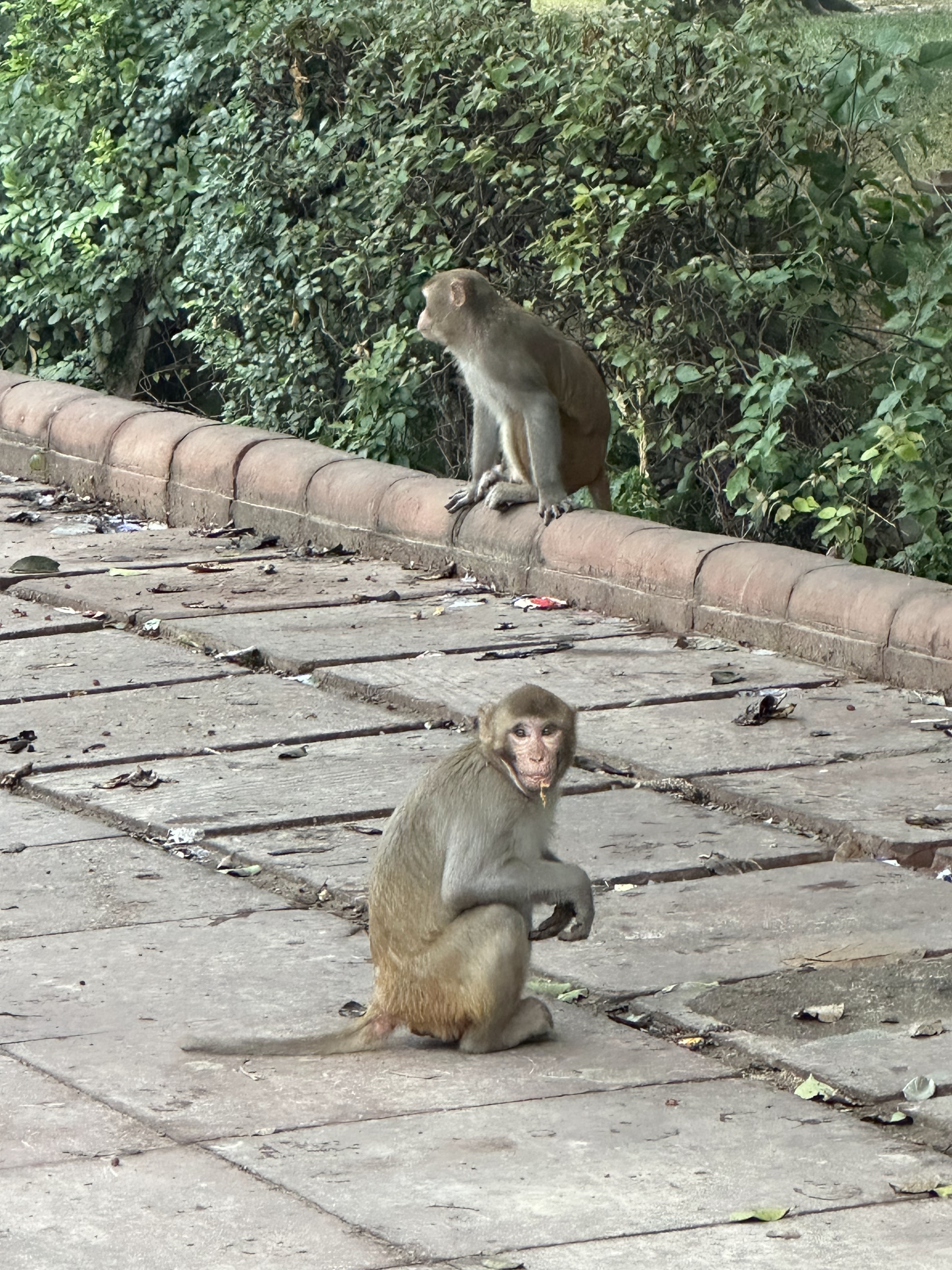
There were plenty of other locals hanging out at the fort.

Friday, May 22, 2026

INDIA 2025: RATHAMBORE NATIONAL PARK DAY 2, MORNING SAFARI

 November 28, 2025

On Day 2 in Ranthambore National Park, we again rose early and battled the crowds at the entrance gate. Paperwork for every passenger must be checked before a vehicle is allowed to enter, and that takes time. You can tell how cold is was by looking at the photo of Bonnie and Dave that I took from the back seat.


As much as I complain, I still prefer the bumpy, crowded ride to a long walk in tiger territory.

We were assigned to Zone 5 and started off (again) with a great sighting of wild boars dipping their snouts in a watering hole. The pigeons look ready to dive in as soon as the boars finish up.

Monday, May 18, 2026

INDIA 2025: RATHAMBORE NATIONAL PARK DAY 1- KHEM VILLAS AND OUR FIRST TWO SAFARI DRIVES

 November 26-27 (Thanksgiving Day in the United States), 2025

Five or six hours after we left Keoledeo National Park, located approximately mid-way between Jaipur and Agra, we finally arrived at Rathambore National Park, It looks like a short distance on the map below, and it is--just a little over 150 miles--but we were driving through lots of small villages and the pace was agonizingly slow.

Ranthambore NP is large--515 square miles--and was established first as a game sanctuary in 1955 at about 1/5 of its current size, but then was declared as a Project Tiger reserve as part of a wildlife conservation program in 1974. In 1980 it was named a national park.

The tiger population in India has doubled since the early 1970s, but at about 3,700 tigers, it is still woefully short of the estimated 40,000 tigers that roamed the country at the end of the 19th century. Without Project Tiger, tigers would likely be extinct, at least in India, which has almost 75% of the world's wild tiger population.  Today there are 57 protected areas in India that have been designated as tiger preserves.

It was getting to be late, so our driver took us directly to our place of residence for the next few days, the Khem Villas, located ten minutes from the reserve. The place consists of eight luxury cottages, ten tents, and four double rooms. Our group of three couples had tents, but not exactly the kind of tents you think of when you hear that word.

The approach to the Villas is a long, private drive flanked by the property's gardens where they grow much of the food they serve to guests in the all-vegetarian meals. There is a lot of fencing around the gardens, which I assume is to keep wildlife scavengers out.


And here is the local bakery--but I don't think you want what they are baking . . . 

Cow dung cakes, stacked five high after they are dried out and sold as fuel for cooking and heating.

Monday, May 11, 2026

INDIA 2025: KEOLADEO NATIONAL PARK

 November 25-26, 2025

After arriving in Delhi, we spent the next five or six hours on the road to Bharatpur, a city of about a quarter million people in the Indian state of Rajasthan and popular with tourists because of its proximity to Keoladeo National Park, which was our ultimate destination.

We stayed in Pahersar, a small village 10 to 12 miles outside of Bharatpur. Our hotel, the Chandra Mahal Haveli, was built in 1840 in a Persian style--symmetrical, lots of tile work, large courtyards, plenty of landscaping, etc.


I can't remember what is important about that photo of Chris and Bonnie on the left. I think Chris couldn't get into her room or something. Our rooms opened onto this lovely courtyard.

In California, we see warning signs for rattlesnakes. It is a little different in India.

Tuesday, April 21, 2026

INDIA 2025 - DETOUR TO NEPAL: KATHMANDU'S MONKEY TEMPLE


 November 24, 2025

Our first stop of the day was the Swayambhunath complex in Kathmandu, widely known as "the Monkey Temple," probably because no one can pronounce "Swayambhunath," and also because hundreds of rhesus macaque monkeys live in and around the complex and roam freely about the site. Designated a UNESCO World Heritage Site in 1979, this complex of shrines, stupas, and statues has been sitting atop a hill and overlooking the valley for about 2,000 years, making it one of the oldest and most sacred Buddhist sites in Nepal, and one of the three most sacred Buddhist pilgrimage sites in the world. 

The complex is also know for its unique blend of Hindu and Buddhist culture. 


To get to the main stupa, we first walked through this garden of votive stupas, small shrines donated by pilgrims over the centuries to secure good karma or possibly to hold the ashes of the dead. It does look a lot like a cemetery.

Just past that garden/cemetery of votive stupas, we saw our first monkey, and then several more. Then dozens. They were everywhere--sacred site or not!

Sunday, April 12, 2026

INDIA 2026 - DETOUR TO NEPAL: THE PASHUPATINATH TEMPLE IN KATHMANDU

 November 23, 2025

Nepal is one of the countries that, like China and Russia and Botswana, I never thought in a million years I would visit. A landlocked country sandwiched between India and Tibet and home to the Himalayan mountain range and the King of All Mountains, Mt. Everest, it has always seemed about as foreign and unattainable as any place on earth.  

No longer!

We made our way from Amritsar to Kathmandu, Nepal, via Delhi's Indira Gandhi Airport, where we had a brief layover. There is always something new to discover at foreign airports:


This was actually pretty good!

Monday, January 26, 2026

UGANDA 2025: A LONG DRIVE AND THE ZIWA RHINO SANCTUARY

 July 20, 2025

We had told the camp folks that we would be leaving at 9:00 a.m., but for some reason they saw fit to wake us up at 7:00 a.m. when we were all still asleep. We grumpily got out of bed, packed, and mad our way to breakfast where we met William, our guide for the next six days.

After our rude awakening, breakfast was maddingly slow, but there were a bunch of vervet monkeys on the grounds outside that entertained us. These are Ella's photos:


We finally got on the road at 9:30, which was what we had planned, so why get up at 7:00? The roads were ridiculously bad--mostly ungraded dirt roads full of potholes and gullies. It was very hot, and our 4-wheel-drive vehicle did not have AC.  My nemesis, motion sickness, hit me hard around 11:30 a.m. when I lost my breakfast. The irony is that just two blocks later we finally merged with a paved highway that took us the rest of the way.

After we had been on the road for four or five hours, we stopped for box lunches that William had called ahead to order. Bob and Ella had goat and rice; I had mashed potatoes and could only eat about half. An hour-and-a-half later, we arrived at Ziwa Rhino Sanctuary where we were welcomed by this statue.

Based on the order of my photos, this school must have been in the sanctuary:

Friday, August 1, 2025

INDIA, JAIPUR: CITY TOUR

  December 29, 2025

We don't usually believe in quitting while the sun is still shining, so we ended the day with a city tour of Jaipur, led by a new guide booked through Audley Travel. His day job is teaching high school, and he was great!

Jaipur, by the way, is the capital and largest city in the northwestern state of Rajasthan. With a population of over three million, it is also the 10th largest city in the entire country. It is known as the "Pink City" due to the dominant pink color of the buildings in the old city. Along with Delhi and Agra, it is part of what is known as the "Golden Triangle" tourist circuit.

Jaipur appears in popular western culture. Paul McCartney wrote a song entitled "Riding into Jaipur" that is mostly Indian-themed sitar music with just a few words: "Riding into Jaipur, Riding through the night, Riding with my baby, Oh what a delight."  The city is also the setting for the 2011 movie The Best Exotic Marigold Hotel and its 2015 sequel, The Second Best Exotic Marigold Hotel.

We began at the Hawa Mahal, or "Palace of Winds," built in 1799 from red and pink sandstone by the grandson of the founder of the city. The palace has 953 windows. The iconic view that we saw is actually the BACK of the palace!


It's always good to start off with a snack (or two), and our guide waited in line for this fried something  (I can't remember what), served to us on a used page from a child's workbook, and then another treat served on a leaf. 


Friday, July 18, 2025

INDIA, AGRA: THE TAJ MAHAL AND A STONE FACTORY

 December 28, 2024

Before our trip, when we told anyone we were going to India, their first question was, "Are you going to see the Taj Mahal?" Yes, of course! This UNESCO World Heritage Site is the #1 tourist attraction in India (although it is being overtaken by a city I haven't heard of--Ayodhya--308 miles to the east). UNESCO declared it "the jewel of Islamic art in India and one of the universally recognized masterpieces of the world's heritage." It was also named one of the "New 7 Wonders of the World" in 2001. Taj Mahal is Hindi for "Crown Palace." It is interesting to note that out of the 7 to 8 million visitors it hosted in 2024, less than 1 million were international tourists and the rest were domestic.

To get to "the Taj," as it is fondly called, you first have to pass through the Monkey Guard, a long walk from the parking area to the Taj itself that is guarded by aggressive macaque monkeys.


There are a lot of them, both underfoot . . . 

. . . and overhead.

Tourists are given plenty of warning to use caution around the monkeys. The sign at right has five bullet points of advice. I should have paid more attention to the one that says "Don't make direct eye contact with monkeys." More on that at the end of this post.

Monday, July 14, 2025

INDIA, AGRA: THE ITIMAD-UD-DAULAH OR "BABY TAJ"

 December 27, 2024

Between the Agra Fort and our next destination, we passed a few interesting things on the street, including this man on horse back (left) who I think is Shivaji I, a 17th century Indidan ruler. The guy in the right peering in our van window is a bit scary, don't you think?

I think that is a mechanic's shop on the left with it's very own domed verandah. It's hard to believe that the "Hotel Alleviate" (right) could offer anything better.

This little roadside stand selling water and cigarettes had a sign that said "Try unmatched quality." It also had monkeys on the roof.

We saw more monkeys on a roof and in a tree when we got to our destination the Itimad-ud-Daulah, locally known as the "Baby Taj."