Showing posts with label UNESCO World Heritage. Show all posts

Sunday, August 2, 2026

GUATEMALA 2026: ANTIGUA

 March 21, 2026

Our last full day in Guatemala was spent in Antigua, which served as the capital from 1543 to 1773 when the country was part of the Kingdom of Spain. As a result, it is full of Spanish Baroque architecture and Old World charm and has been designated a UNESCO World Heritage Site.

Actually, Bob left early in the morning for a birding expedition, but I figured I could explore the Old Town area around our hotel by myself while he was gone. While I was looking for breakfast, I wandered into this park a few blocks from our hotel.

The "Fountain of the Sirens" was added in 1738. The four bare-chested women that are part of the fountain are quite eye-popping. It is no suprise that today the park is still a hub of activity, and when I was there, it was full of vendors, musicians, and tourists.


I enjoyed some pastries and wandered back towards our hotel. Shops across the cobblestone street from our room were just beginning to open. The street vendors were just starting to set up as well. Check out this guy bringing in an assortment of hats!

Before long, there was plenty of commerce going on. Under that pile of textiles is a little Guatemalan grandma selling her wares.

Saturday, May 2, 2026

INDIA 2025 - DETOUR TO NEPAL: BHAKTAPUR TAUMADHI AND DURBAR SQUARES

 November 24, 2025

About eight miles from Kathmandu and in the same valley lies Bhaktapur ("City of Devotees"), a densely populated city and one of the seven monument zones that make up the Kathmandu Valley UNESCO World Heritage Site. Interestingly, you must pay an entrance fee to go into the ancient city--much like a national park. And note the final sentence on the welcome sign below. Gotta love bad translations.

There are brass shops everywhere.  I think most of the brass tchotchkes we buy in the United States come from India, but I sure saw a lot in Nepal. I could probably find some of these at Home Goods, but there were some very unique items as well.


Take the sword-like brass knives, for example. I haven't seen them in Home Goods. They are weapons used by gurkhas. What are "gurkhas"? They are members of an elite Nepali military group that fought against the British from 1814-1816, but then were recruited to serve in the British Army, where they still serve today. They are known for being fearless in combat, for their loyalty, and for their skills with the khukuri, the curved knife seen in the photo on the right. That's a pretty cool knife, but unfortunately I only had carry-on luggage and I'm pretty sure that it wouldn't get through security.

One of the important places in Bhaktapur is Taumadhi Square, which is the location of several important temples, including Bhairavnath Temple, which is dedicated to Lord Bhairav, the fierce manifestation of the Hindu god Shiva. It was originally built in the 13th century, then restored and redesigned several times. The triple roof was added in 1718, but then it collapsed in the 1934 earthquake, was rebuilt, and was severely damaged again in the earthquake of 2015, and was re-rebuilt. Nepalis are persistent.

Sunday, April 26, 2026

INDIA 2025 - DETOUR TO NEPAL: KATHMANDU DURBAR SQUARE

 November 24, 2025

The word Durbar comes from the Persian word for "court," and a "Durbar  Square" is an area in Nepal that includes a royal palace and the public areas around it. There are three main Durbar Squares in Nepal: Kathmandu, Patan, and Bhaktapur, all of which are UNESCO World Heritage sites. Each served as the royal seat of its own kingdom until Nepal was unified in the 18th century. 
We began at Kathmandu Durbar Square, the most important of the three Durbar Squares. Construction began in the 3rd century, but most of the major structures were built in later periods. There are dozens of temples in the complex, so it is a bit overwhelming.

My first impression was that wow, there are a LOT of pigeons. How do they keep the square clean?


The dogs don't appear to be chasing the birds away.

Tuesday, April 21, 2026

INDIA 2025 - DETOUR TO NEPAL: KATHMANDU'S MONKEY TEMPLE


 November 24, 2025

Our first stop of the day was the Swayambhunath complex in Kathmandu, widely known as "the Monkey Temple," probably because no one can pronounce "Swayambhunath," and also because hundreds of rhesus macaque monkeys live in and around the complex and roam freely about the site. Designated a UNESCO World Heritage Site in 1979, this complex of shrines, stupas, and statues has been sitting atop a hill and overlooking the valley for about 2,000 years, making it one of the oldest and most sacred Buddhist sites in Nepal, and one of the three most sacred Buddhist pilgrimage sites in the world. 

The complex is also know for its unique blend of Hindu and Buddhist culture. 


To get to the main stupa, we first walked through this garden of votive stupas, small shrines donated by pilgrims over the centuries to secure good karma or possibly to hold the ashes of the dead. It does look a lot like a cemetery.

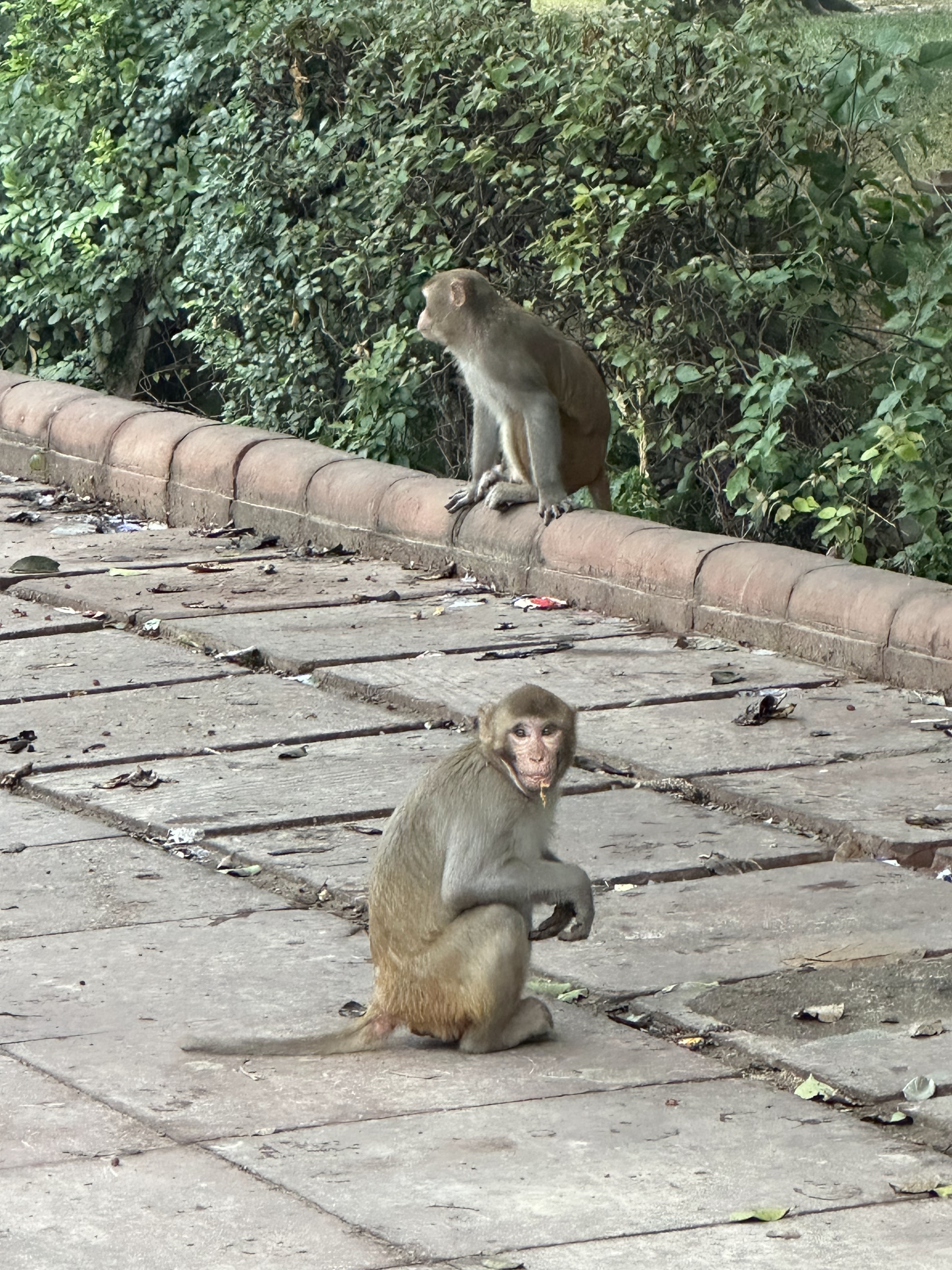
Just past that garden/cemetery of votive stupas, we saw our first monkey, and then several more. Then dozens. They were everywhere--sacred site or not!

Tuesday, August 12, 2025

GERMANY: TORGAU

 May 17, 2025

Torgau is a smallish town in eastern Germany on the Elbe River that today has a population of about 20,000 people. Probably its biggest claim to fame is that it is the place where the US and Soviet armies first met at the end of World War II on April 25, 1945. Eventually, Torgau became part of the region controlled by the Soviet Union and known in the United States as East Germany.

But that was not our interest in the city. We had planned a few days in this area of Germany--Saxony--to become better acquainted with the religious reformer Martin Luther, who established Torgau as a key center for the Protestant Reformation. Luther traveled here more than 60 times from his home in nearby Wittenburg to consult with princes and theologians, and Torgau was where he consecrated the first church intentionally built as a Protestant church.

Our first stop was at the Hartenfels Castle, which was built in the 15th century, making it the largest completely preserved early Renaissance castle in all of Germany. 

One of the most interesting things about the castle is that is has a moat surrounding it that is full of greenery and logs rather than water.

That is because the moat is home to two brown bears. This tradition dates back to the castle's origins. After a pause beginning in the 19th century, the bears were reinstanted in the 1950s with a gift from the Leipzig Zoo. Benno and Bea, who are brother and sister, are the latest residents, having lived here since 2013. We only saw one of them, but I can't tell you which one.


Monday, July 28, 2025

INDIA, JAIPUR: THE SAMODE HAVELI HERITAGE HOTEL AND THE AMBER FORT

 December 29, 2024

It is about 150 miles from Agra to Jaipur via Fatehpur Sikri, and altogether the drive took us almost five hours. Again, we were so glad we had a large van with AC and a very experienced driver. By the time we arrived at our hotel, we were worn out and the day was pretty much over.

Bob had booked rooms in a five-star hotel, the Samode Haveli, which was initially built in the 16th century as a fort but was converted into a palace in the early 19th century by Samode Haveli, the Prime Minister of Jaipur. In 1987 it was converted again, but this time into what is called a "Heritage Hotel," which is a building that has historical or architectural significance and has been made into a hotel. Heritage hotels are usually tied in some way to royalty, nobility, or prominent families.


It is gorgeous inside, but the hallways are a maze and we got lost a couple of times on our first day there. It was a little like wandering the back alleys of Delhi, but on a very grand scale!


Wednesday, July 23, 2025

INDIA, AGRA: FATEHPUR SIKRI

 December 28, 2025

On our way to our final destination, the city of Jaipur, we passed through some beautiful rural areas. This looks like a field of mustard, one of India's argricultural products.


We had time for a stop at Fatehpur Sikri, the capital of the Mughal Empire from 1571 to 1585 under Emperor Akbar. Fatehpur Sikri means "City of Victory."  However, the city was completely abandoned in the early 17th century. 

The East India Company took it over in the early 19th century and began some restoration projects. It was named a UNESCO World Heritage Site in 1986, which means it had additional funding for more restoration.

We were used to seeing cows roaming the streets in the big cities, and we had seen monkeys on the approach to the Taj Mahal, but this was our first experience with feral pigs foraging through the trash.

Friday, July 18, 2025

INDIA, AGRA: THE TAJ MAHAL AND A STONE FACTORY

 December 28, 2024

Before our trip, when we told anyone we were going to India, their first question was, "Are you going to see the Taj Mahal?" Yes, of course! This UNESCO World Heritage Site is the #1 tourist attraction in India (although it is being overtaken by a city I haven't heard of--Ayodhya--308 miles to the east). UNESCO declared it "the jewel of Islamic art in India and one of the universally recognized masterpieces of the world's heritage." It was also named one of the "New 7 Wonders of the World" in 2001. Taj Mahal is Hindi for "Crown Palace." It is interesting to note that out of the 7 to 8 million visitors it hosted in 2024, less than 1 million were international tourists and the rest were domestic.

To get to "the Taj," as it is fondly called, you first have to pass through the Monkey Guard, a long walk from the parking area to the Taj itself that is guarded by aggressive macaque monkeys.


There are a lot of them, both underfoot . . . 

. . . and overhead.

Tourists are given plenty of warning to use caution around the monkeys. The sign at right has five bullet points of advice. I should have paid more attention to the one that says "Don't make direct eye contact with monkeys." More on that at the end of this post.

Thursday, July 10, 2025

INDIA: BACK TO DELHI AND ON TO AGRA'S RED FORT

 December 26-27, 2024

Our next destination was Agra, home to the world-renowned Taj Majal, but to get there from Varanasi we had to fly to Delhi, spend the night, then sit four hours in a minivan to drive 150 miles, which gives you an idea of what the roads are like in India.

Fortunately, we had another luxury stay in Delhi in the Marriott Hotel. It wins the prize for the most beautiful lobby.


I was intrigued by this Christmas display with a griffin in the center, but I have since learned that the griffin is the Marriott Hotel's custom logo found in their hotels throughout the world.

Like almost all of our upper-end hotels, this one had a doorman in traditional dress. I don't know if this is a British colonial thing or a truly Indian culture thing. I suspect it is the former.

About half-way through the long drive we made a bathroom and snack stop.  I like how this bathrooms are labeled "Public Conveniences." 

KFC, Pizza Hut, and Subway are regular fast food places in India. No thanks. I grabbed something (I can't remember what) from the Indian fast food restaurant Vaango!

We arrived at the Agra Fort (aka Red Fort) in the early afternoon. I think it was the most spectacular thing we had seen up until this point in our trip. The initial stages of the fort were built in the early 1500s, and it was the main residence of the Mughal emperors from the time of its construction until 1638, which is when the capital was shifted from Agra to Delhi. It is where the most famous Mughal emperors, Humayun and Akbar, were crowned in 1565 and 1573, respectively. (It was Akbar's grandson who built the Taj Mahal just 1.6 miles from this site in 1648.) The Agra Fort was designated a UNESCO World Heritage Site in 1983.