Tuesday, July 19, 2011

MOSCOW PART 5: RED SQUARE

I had another rather startling insight on this trip:

Red Square is not red, and it isn't square.

However, there are three red buildings on one end of Red Square:
State Historical Museum, constructed in 1881
We never could figure out what this building is.  If you know, comment on this post!
Voskresensky (Resurrection) Gate, the main gate at one end through which visitors can enter Red Square.  It looks like it is straight out of a fairy tale, doesn't it?

And of course one side of Red Square is bordered by the RED Kremlin Wall:

But hey, the Russians say that all of these red buildings have nothing to do with this being "Red" Square, nor does "Red Square" refer in any way to communism.  Apparently the Russian word for "red" also means "beautiful."  While I have to question that the color red has no significance here, I can't argue that this is a very beautiful place.

As for its shape, rather than being square, Red Square is a very long rectangle.  Like me, you may have associated it with military parades, and it would be good for that (and was used for that).  It's really a very, very wide street.
View of Red Square from the end opposite the State Historical Museum and Resurrection Gate
Like the Kremlin, Red Square was absolutely NOT what we expected.  (How many times have I said that about Moscow so far?)  It is graceful and elegantly beautiful and decidedly non-military.

As mentioned previously, one long side of Red Square is bordered by part of the wall encircling the Kremlin complex. Another side is a huge, fancy, very expensive shopping mall known as the GUM Department Store
In front of GUM

GUM interior.  (Photo by fellow traveler Scott Zimmerman)

The week we were in Moscow, a stage was being set up in Red Square for a massive production in honor of Russia Day (which is what Russians consider their Independence Day), commemorating 20 years since the first free election.  By the way, that seems like a pretty significant anniversary, don't you think?  Did we hear anything about it in the US?


Rehearsal.  The production included 20,000 children and Russia's most popular pop stars.
I would have liked to see the square without all this stage material in it, but it was interesting to think of such a large, happy gathering in a place I have always associated with war.

There is one piece of communism still very present in Red Square: Vladimir Lenin.  Yes, he is still there, his body still on display in his own dark, creepy mausoleum:
Of all the places we visited in Russia, Lenin's Tomb was by far the most tightly controlled.  We queued up first thing in the morning about a half hour before the doors opened.  We couldn't take anything inside with us, so our tour guide gathered all of our bags, cameras, etc. and returned them to us after we exited the mausoleum.  The line wound past some outdoor crypts, including that of Yuri Gagarin, the world's first man in space and a huge national hero, and that of Josef Stalin, who used to lie in state next to Lenin but was moved to his crypt in 1961 as part of Khruschev's de-Stalinization program. At the door, visitors were checked over by armed guards.  Photography inside was strictly forbidden, as was talking.  Men had to remove their hats.  Bob was bothered by what he felt was reverence for this despot, but I felt it all added to the sense of evil I associate with Lenin.  To help preserve the body, the room is rather dimly lit.  Lenin himself is lying in a glass enclosure.  His body is small and unremarkable.  There are plenty of pictures of him on the Internet (I myself would never have had the courage to try to sneak a photo, even in the "new and improved" Russia), and if you are interested, take a look here. There has been a lot of controversy over this monument, and many are calling for Lenin to be buried in St. Petersburg next to his mother, which is what he wanted.  Yeltsin was ready to do that, but then Putin came to power and refused, saying it would undermine the 70 years of "Russian values" represented by Lenin.  Go figure.  In any case, it is getting increasingly difficult to preserve the body (he died in 1924), if in fact that IS his body. Supposedly they have a hard time controlling the mold on his skin.  (They actually change his clothes periodically.  Now that would be a creepy job.)  Biology + public sentiment may force Lenin to finally be buried.

In contrast to that dark and dreary tomb are the two churches in Red Square.  The first is Kazan Cathedral:
The shapes and layers and colors are fantastic.  It looks a lot like a very fancy cake.  I love the Russian Orthodox cross, seen here.  It has two extra horizontal bars, one on top representing the plaque on Christ's cross that read "Jesus of Nazareth, King of the Jews," and one on bottom (often slanted rather than straight as it is here) representing the balance of justice.

The original Kazan Cathedral was erected in 1630 to commemorate the city's triumph over Polish aggressors.  However, in 1936 Stalin decided that Red Square would make an excellent military parade ground, and he ordered all churches removed.  The Russian architect Pyotr Baranovsky was able to save just one church in Red Square, and it wasn't this one, which was demolished.  However, after the fall of the Soviet Union, the Kazan Cathedral was the first church to be completely rebuilt.  Meticulous measurements and photographs taken by Baranovsky (Did he foresee its reconstruction?) were used, and the building was completed in 1993.  This church illustrates one thing that really stood out for me on this trip: how fast things changed after the dissolution of the Soviet Union.

The single church Baranovsky was able to save was the iconic St. Basil's Cathedral, perhaps as closely identified with Moscow as the Eiffel Tower is with Paris or the Statue of Liberty is with New York City:

 Next: More about St. Basil's

Saturday, July 16, 2011

MOSCOW, PART 4: THE KREMLIN

Red Square is a huge, stark, enclosed square in the heart of Moscow that includes a big, ugly, concrete government building called The Kremlin, right?
Red Square, May Day Parade, 1957
 That's what I thought, but I was so wrong.

Red Square is separate from the Kremlin, although it does share one wall with the Kremlin.  That notched wall goes all around the Kremlin, an area of 68 acres, and is made of red brick and studded with twenty beautiful Italianate towers.  The word "Kremlin" means "fortress," and so it makes sense that the Kremlin encloses quite a number of buildings.

From Red Square looking towards the Kremlin wall

The Savior's (or Spasskaya) Tower at the main entrance to the Kremlin

Outside the Kremlin wall is the Russian Tomb of the Unknown Soldier with its two guards:


Upon entering the Kremlin gates (for which we had to have a ticket), the first building we saw deviated drastically in style from the rest of the complex.  Built in 1961, this eerily transparent structure originally housed the Soviet Congress in its 6,000 seat auditorium.  Now, however, it is home to theatrical and musical performances. 

 The rest of the large buildings in the Kremlin (which are called "palaces" in the guide books) looked more like this:
Kremlin Military Academy

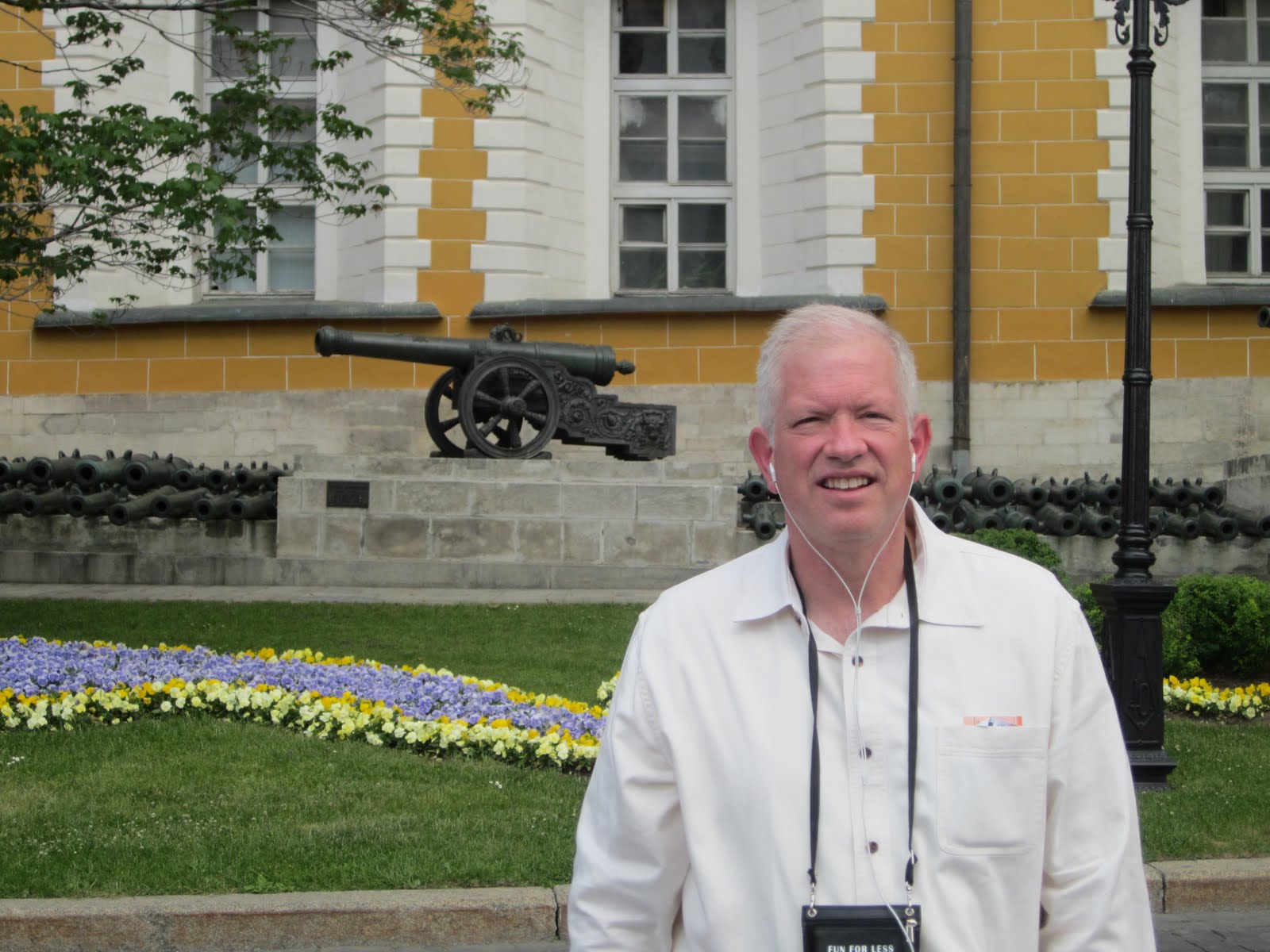
A cannon and a Cannon (You wouldn't believe how many of these pictures we have from various sites around the world.)

The former Supreme Soviet building, now the headquarters of the President of Russia

The Senate Building, which includes private quarters for the Soviet and Russian Presidents.  Both Lenin and Stalin lived here for a time, but the current president Medvedev has a private home just outside of Moscow.

The double-headed eagle, national symbol of Russia, decorating the cornices of the Grand Palace.

The Tsar Cannon, which has the largest caliber of any cannon in the world.  It weighs 39 tons.  Each of those cannonballs in front (which are actually too large to fit in the Cannon barrel--oops) weighs a ton.

I LOVE this lion head on the frame holding the cannon.  It makes me think of Aslan.

The Tsar Bell, the largest bell in the world, weighs 201 tons.  (Ring that, Quasimodo!)

It has just one little problem--there was a fire in the foundry and when workers doused the fire with water, they accidently doused the bell as well and this slab cracked off while the bell was still in the casting pit.  That shard weighs 11 tons all by itself.  A Russian legend says that on Judgment Day, this bell will be healed, lifted into heaven, and rung.  That would be awesome.  Considering its size, perhaps we'll hear it here in the United States.

There are four large cathedrals in the Kremlin, all very close together.  When we were traveling with Mom in Germany, she told us that some churches are built for God (example: Ulm Cathedral), and some are built for power (example: Speyer Cathedral).  I think these cathedrals built so close to the seat of power in the Kremlin must have been built as a show of power.  And yet, they are so hauntingly beautiful, so colorful and graceful, that one is still drawn to God in their sanctuaries.

Cathedral of the Dormition, also known as Cathedral of the Assumption, built under direction of Ivan the Great and completed in 1479.  It is considered the Mother Church of Muscovite Russia.  The tsars were crowned in this cathedral through the 1700s and many royal weddings have taken place within.  After the Revolution in 1918, all church services were banned, although there is one legend that Stalin ordered a secret service here in 1941 to pray for protection from the invading Nazis. That sounds a bit improbable, but it's a good story.  The Cathedral was returned to the Orthodox Church in 1990, although it operates largely as a museum.

The entrance to the Dormition Cathedral.  Note the black Deep Purple t-shirt on the man on the right.  Did you know that President Medvedev is a big Deep Purple fan?  Maybe this man is a Medvedev supporter.
The Cathedral of the Archangel, completed in 1508.  Victories of the Russian military were celebrated here, and 54 Russian tsars and grand princes are buried within, including Ivan the Great and Ivan the Terrible.
Another view of the Cathedral of the Archangel
The Cathedral of the Annunciation, completed in 1489 and expanded several times in the 16th century.  This cathedral hosted the royal families' private church services and is actually connected to the Grand Palace.
The Church of the Twelve Apostles and the Patriarch's Palace, completed in 1656, is the most recently built of the four cathedrals.  It was built specifically for the Patriarch of the Orthodox Church of the time.  He had it built on a tall platform so it could compete with the other churches in Cathedral Square.  This one was definitely built for power.
In addition to these four beautiful cathedrals, there is one more structure that is taller than anything else in the Kremlin, and in fact was the tallest structure in all of Moscow until the 19th century: the Ivan the Great Belltower.  Completed in 1508, it was made even taller in 1600.  Considered to be the exact center of Moscow, it houses 21 bells that supposedly can be heard all over the city when they are ringing.  The square building to the left of the tower is the Assumption Belfry, which houses 24 bells.  The bells were rung for the last time on Easter 1918 and were not allowed to ring again until 1992. I wish we could have heard them ring while we were there!
We think this belltower and belfry look a lot like the LDS Temple in St. George, Utah.

Another view of the Ivan the Great Belltower. Note the beautiful landscaping and cute guy in the foreground.
A view of the Cathedral of the Annunication, Cathedral of the Archangel, and Ivan the Great Belltower that shows how close together everything is.
Our final stop was the Kremlin Armory Museum, Moscow's oldest and most prestigious museum.  Visiting it was like seeing the Crown Jewels in London times 100.  It is stuffed full with the wealth of the Tsar Years--crowns and jewels, coronation dresses and robes, gilt and bejeweled thrones, Cinderella carriages by the dozen, and gifts given to and by the royal families, including a large Faberge collection.

After all those bling-bling Fabrege eggs, my favorite
Fabrege piece was this stunning crystal dandelion.
 The picture doesn't come close to doing it justice.
My next favorite item was Catherine the Great's coronation dress.
Talk about a subtle way to camouflage your hips...

The Alexander Gardens just outside Kremlin walls.  (Picture by Scott Zimmerman)
View of the Kremlin from the other side of the Moskva River: the green-roofed Grand Palace, the Cathedral of the Annunciation, the Cathedral of the Archangel, and the Ivan the Great Belltower
Our guide Svetlana, who has every right to be proud of her beautiful city. (Photo by Scott Zimmerman)


READING:
In November 2014, more than three years after taking our trip to Moscow, I attended a lecture by award-winning children's book author and artist Eugene Yelchin, a man born and raised in the Soviet Union who immigrated to the United States in 1983 when he was 27 years old. His Newbery Honor book, Breaking Stalin's Nose, is the moving story of Sasha Zaichik, a ten-year-old Muscovite preparing for his induction into the Soviet Young Pioneers during the years of Joseph's Stalin's terrorizing dictatorship over the Soviet Union. On the day of Sasha's induction, however, things start to go wrong, starting with the arrest of his father, a member of the secret police and a communist hero. As the day progresses, Sasha begins to get a glimpse of a world that does not mesh with what he has been told about his glorious homeland.

This is a heart-wrenching loss-of-innocence story that gives a glimpse into the pervasive fear that filled every corner of the Soviet Union during the Stalin years. It's a quick read, and Yelchin's many illustrations add an extra level of anguish to the story. Though written for children, I would recommend this to any adult interested in what it was like to grow up in the Soviet Union.


NEXT: RED SQUARE (I just couldn't fit it in this post)

Saturday, July 9, 2011

MOSCOW, PART 3: FOOD

Bob and I are both pretty adventurous when it comes to eating.  We believe that most things are worth trying once, and we are always anxious to try cuisine that is native to the places we visit.  We eschew eating at McDonald's when abroad (although I am on a mission to take pictures of McDonald's in as many foreign countries as possible), and we seek out small restaurants and grocery stores instead.

Our first night in Moscow found us venturing by ourselves away from tourist areas.  We stopped at a little "fast food" place where there was nothing written in English, and we pointed at pictures on the wall to order.  Another customer who spoke just a bit of English encouraged us to try a popular Russian soda which she promised us had "no alcohol."  


Our sandwich was pretty cheap and not bad.  On the other hand, we both had one drink of our Kbac (also known as kvass) and knew we'd had enough.  In researching this drink at home, I've learned that it is a fermented beverage made from rye bread.  Because the alcohol content is only about 1.2%, it's considered a non-alcoholic drink in Russia.  Right.

Another exploration of local eateries yielded better results, a delicious bakery.  Bob and I seem to be able to find good bakeries about anywhere we go.  This one was outstanding--perhaps the best bakery of the trip. We returned not just once, but twice.
 

We had absolutely incredible breakfasts in our hotel:

And we bought some very good meat, cheese, and bread at a grocery store:

However, we just couldn't make ourselves eat at this chain, which we saw in several places in Russia:


The other wonderful discovery we made in Russia was blinis.  These are traditional thin Russian pancakes, filled with both savory and sweet ingredients, and quite a bit like crepes.  Our guide pointed out a little blini place that we ended up visiting three times.  Again, we had to point at what we wanted--no English spoken there.  We had several fillings, including these:
Goose liver and pickles

Pork, cheese, and mushrooms
Chocolate and banana

Cherries
 We had a few meals with the group, and they were okay, but they tasted a bit like cafeteria food: 

My best food discovery in Moscow, and one that may someday cause me to return, was this:
HAZELNUT M&Ms
I bought several packages in Moscow (and ate them), then looked in every candy-selling establishment on our trip, but only found them again in St. Petersburg.
They are amazing.  I've looked on the internet, and they don't seem to be available anywhere but Russia.  Why oh why???

If you ever see M&Ms in a green bag, please buy a dozen or so bags for me. I will love you forever.

READING:
A wonderful romp through the culinary history of the Russia from the beginning of the 20th century through Putin's reign, Mastering the Art of Soviet Cooking: A Memoir of Food & Longing begins with Anya von Bremzen's childhood in the Soviet Union. Born to an anti-Soviet Muscovite in 1963, Anya grows up in a love/hate relationship with her native cuisine. In 1976, Anya and her mother immigrate to the United States, where Anya eventually becomes a very respected and well-known food writer.

However, her childhood memories of food fill her with nostalgia, and she and her mother decide to host a series of dinner parties for which they will cook their way through Soviet history, one decade at a time. The result is a creative exploration of the Soviet Union's, and then Russia's, political and cultural history.

The book ends with a recipe for each decade. After reading this book, I want to try making every single one of them.