Thursday, August 16, 2012

BUDAPEST PART 5: Hungarian Rhapsody

rhapsody, noun.  an ecstatic feeling or expression of enthusiasm.

Yep, this is how I feel about Hungarian food.

Before I get into the real thing, let me mention McDonald's.  Wherever we travel, I  like to check out McD's, always hoping that there is some regional adaptation of the menu.  The most unique McDonald's food we've had has been in Japan, but  usually we are disappointed to find that the standard menu is being served.
Yay! Stan found another ATM machine!  He was always on the lookout.
Aside from a few strange names,  everything seemed more or less the same as an American McD's.  Darn.
I figured a McWrap cost about $4.00, so even the prices were comparable. 
 Instead of eating at McDonald's, Julie and Alex took us to Nagyi Palacsintoazoja, or Granny's Pancakes, for our first Hungarian meal.   I'm not sure what is "Non Stop" there--perhaps the cooking, or maybe it refers to the type of eating you want to do once you see the menu.

We had a selection of both savory and sweet crepes.  *Drool*

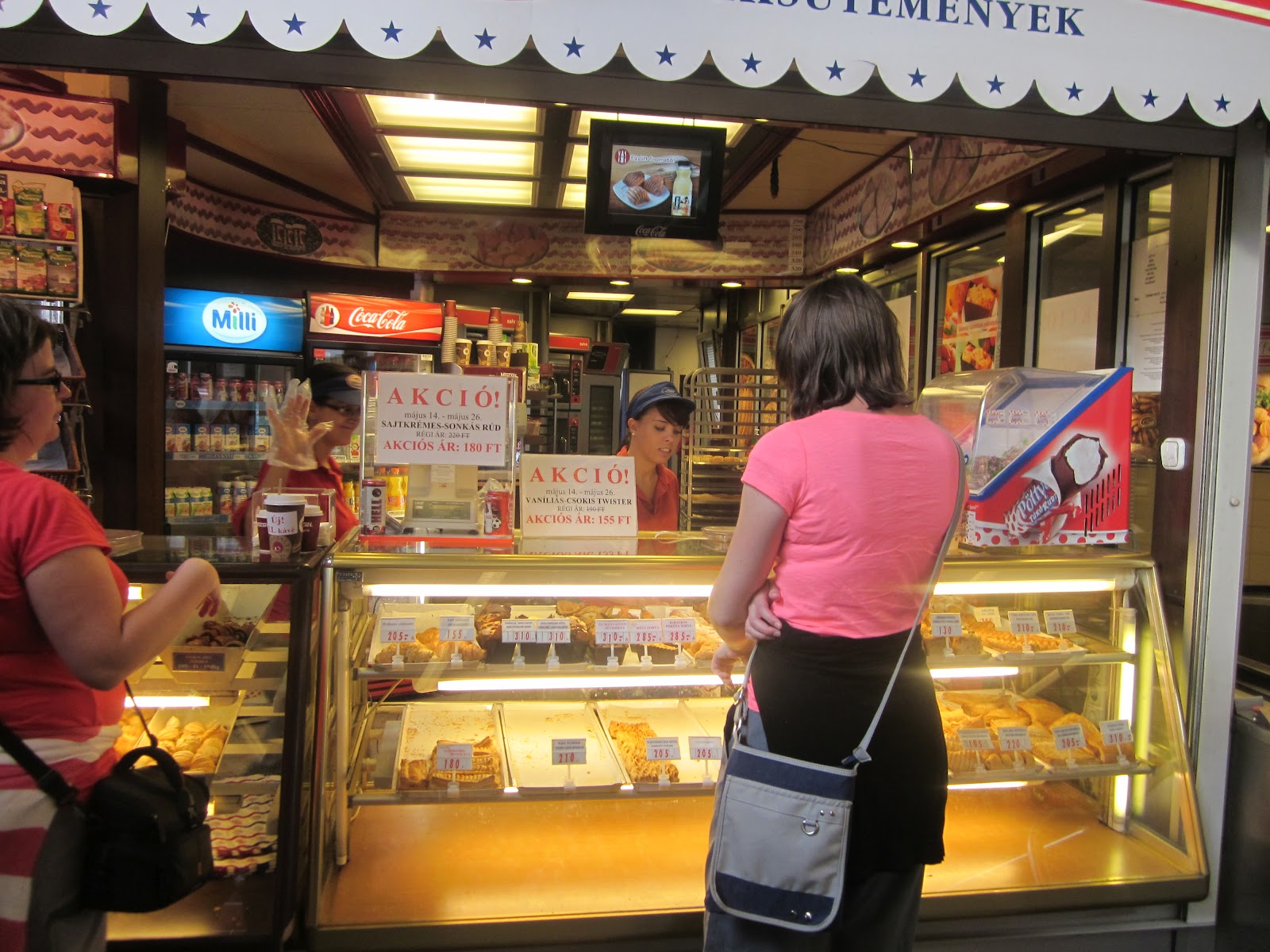
Our next stop was Fejedelmi Peksutemenyek (aka "Princess Bakery").  It's pretty obvious why Julie and Alex scored an A+ as tour guides.

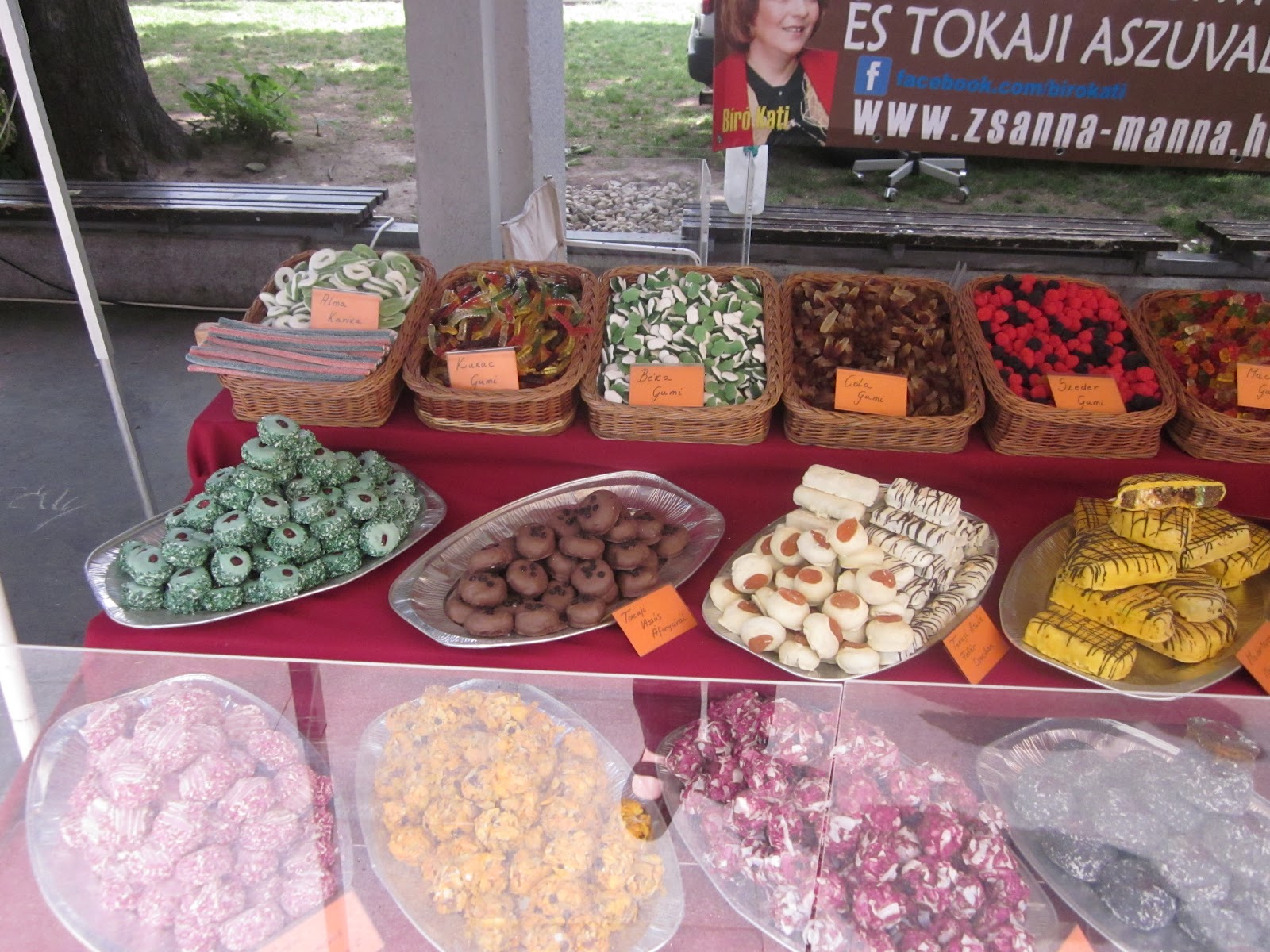
A day or two later, Julie and Alex took us to an outdoor market where there were tables of colorful, tempting treats:


. . . and a cheeseman . . .
. . . selling slices of all kinds of cheese.
He had Emmentaler, which I love, so we asked for a slice:
It was not your average-sized slice and was incredibly delicious:


Of course there was plenty of gelato:
I noted in my journal that this combination of Mozart gelato (marzipan-flavored) and dark chocolate was one of the best combinations of the entire trip:

That's Stan up there a the gelato stand, looking through his wallet for some coins.  He MADE Chris and me buy three scoops this time:

Cream cheese, chestnut, and chocolate gelato.  So which one was I supposed to turn down?

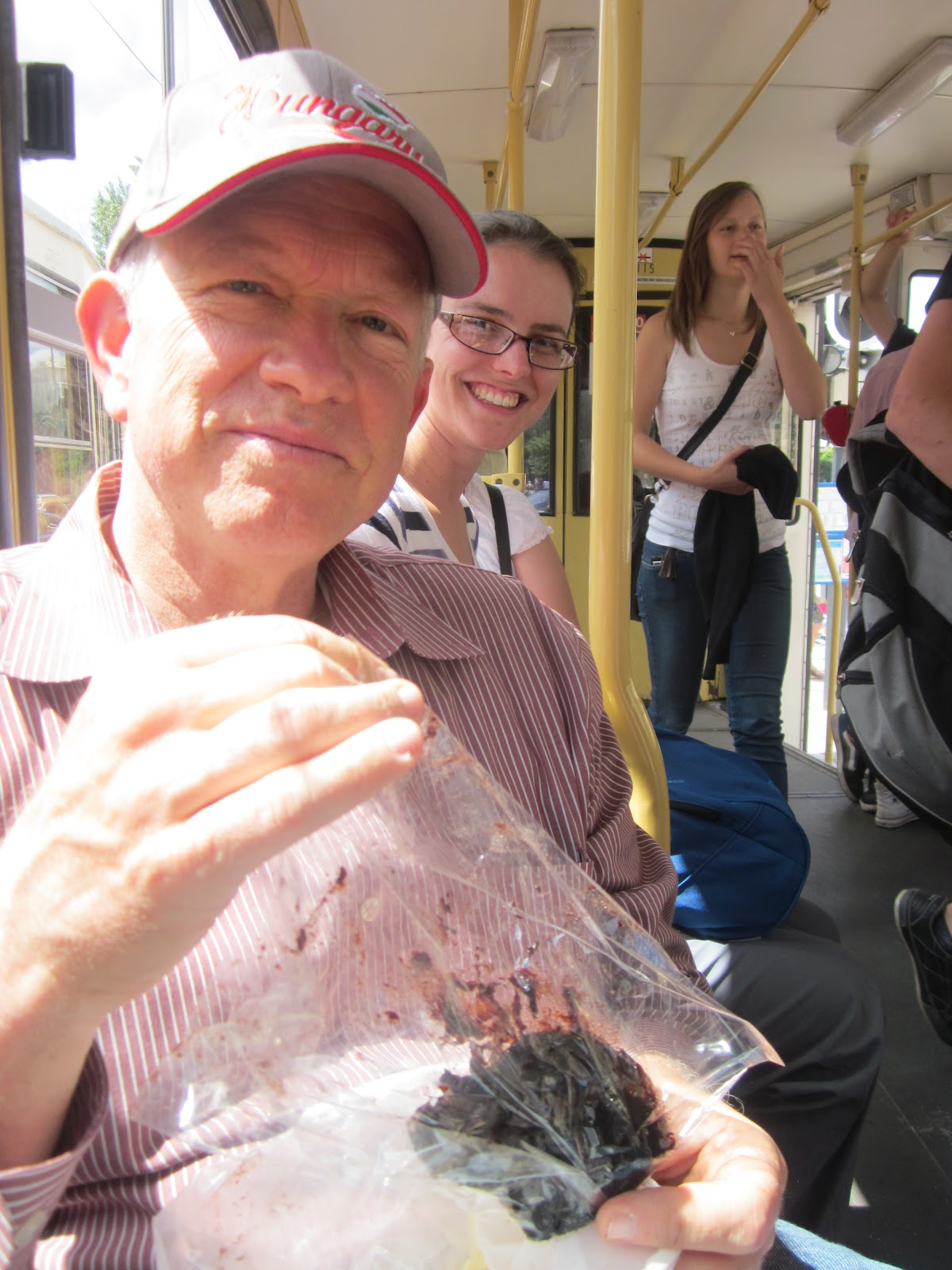
This bread that Julie was holding was much better than whatever that vegan glob in Bob's plastic bag was:
One of the meals we had been looking forward to the entire trip was Trofea Grill, a place Andrew had labeled "The Best Restaurant in Europe" after he ate there in 2007. He was living on a shoestring on that trip to Europe, and this place was one of his splurges.

In fact, one of my favorite pictures of Andrew of all time was taken in this very restaurant:

It wasn't exactly in a tourist part of town (which is actually a good sign as far as I'm concerned), and the decor was, well, rather unique.
It kinda made me wonder what was on the menu.


Well, pretty much everything you can think of was on the menu.  This was a Serve-Yourself-All-You-Can-Eat-Make-Sure-You-Get-Your-Money's-Worth Buffet.
Fruit bar
Salad bar part I
Salad bar part 2
Fish and sausage bar
Pate bar
Side dishes bar
Dessert bar
Unique water container "with gas."  I'm not sure if Stan was thinking about the way his stomach felt or about the bill.
We pretty much had to be carted off in wheelbarrows when we were done.

Trofea Grill did a great job of stretching our stomachs so that on our last day in Budapest we could eat at the Central Market Hall, the largest indoor market in Budapest.

I had a gigantic goose leg, spaetzle, and red cabbage.  Nirvana.

I don't remember exactly what this dish is that Stan had.  I think it was joint of something?  Whatever it was, it was enough food for a small army.

Even Bob was able to find enough vegan food to fill his tummy.

The Central Market was loaded with fun stuff to see.

The top floor had booth after booth of Hungarian crafts--clothing, ornaments, carvings, toys--typical tacky tourist stuff mixed in with some real finds.

Andrew is obsessed with mushrooms.  When I saw these hats at the Market, I knew I had to buy one for him.  They feel like leather,

but they are hand-made from a woody mushroom that grows in Hungarian forests:
Andrew was pretty excited about the hat.  Apparently he had seen them on his own trip to this market, but hadn't purchased one and had regretted it ever since.

The lower level of the Market was full of food products, both fresh and preserved.  There was one stall that had dozens of bags of chicken feet.  Yum!  (*cough*)

Paprika and paprika products were everywhere.  Paprika is made from the red peppers that can be seen in this picture:
Andrew told us to look for paprika paste in tubes.  We bought several kinds, along with a few bottles of paprika sauce, and when we got them home and tasted them, we wished we had shipped a few cases to California.  We have found a source in the States and have already replenished our supply, but everything cost three or four times what we paid in Budapest.  If anyone is planning a trip to Hungary and has just a bit of extra suitcase space . . . 


Alex and Julie were not only good tour guides, but they were good sherpas as well.


Of course, they also made sure we got the right nutrients to keep us going.

Next: Budapest Is a Quirky Place  (my final post about Hungary)

Sunday, August 12, 2012

BUDAPEST PART 4: Heroes, Terror, Music, and Romance

As the title indicates, I am going to try to cover a lot of ground in this post, which is what we did when we were in Budapest (covered a lot of ground).

I'll start with Heroes.  Many capital cities have a large, relatively open area historically used for parades, show of force, and to honor the men who played a key role in the establishment of the country.  In Budapest, I think Heroes' Square fills that function. It joins other great squares that we have visited, such as the National Mall in Washington, D.C., Tienamen Square in Beijing, Wenceslas Square in Prague, and Red Square in Moscow. I also remember visiting the huge Plaza de la Constitucion in Mexico City when I was there during a study abroad in college. While not as large as those squares, Budapest's Heroes' Square has a similar feeling of historical grandiosity.

It's hard to get a good idea of the size of Heroes' Square from my pictures, so I borrowed this one from the Internet:
The first metro station EVER in continental Europe leads to this spot.   (In all the world, only London has an older subway system than Budapest's.) The first subway line was built in 1896 to bring citizens out to this park to see this memorial, started in 1896 on the 1,000th anniversary of Hungary, and completed in 1900.  By the way, guess who was there in 1896 to inaugurate the metro and see the beginning of the construction project?  Emperor Franz Joseph, husband of Sisi.  Yeah, they really got around.

The large column in the center is topped by the Angel Gabriel, who is holding the crown of the Hungary's first King, St. Stephen, and the Hungarian double cross, which was awarded to Stephen by the Pope for his efforts to convert Hungary to Christianity.

At the bottom of the column are the seven Magyar chieftains who, according to legend, led various peoples to this region to settle:

On each side of the column are massive colonnades, each with seven statues of important historical figures:


On the top outside end of each colonnade is a statue of a naked man and a clothed woman.   Hungarians apparently like to switch things up. Anyway, on the left are figures representing Labor (the man) and Wealth (the woman), and on the right are Knowledge (the woman) and Glory (the man).  I like that the women are Wealth and Knowledge.  I think that is better than Labor and Glory, don't you?  Maybe the women are rich enough and smart enough to wear clothes.

There are two more statues on the inside end of the colonnades. This guy, whose whip is actually a snake, represents War.
And this one, appropriately a woman, represents Peace:

This large stone in front is dedicated "to the memory of the heroes who lost their lives for the freedom of our people and of our national independence."
Alex and Julie, tour guides extraordinaire:


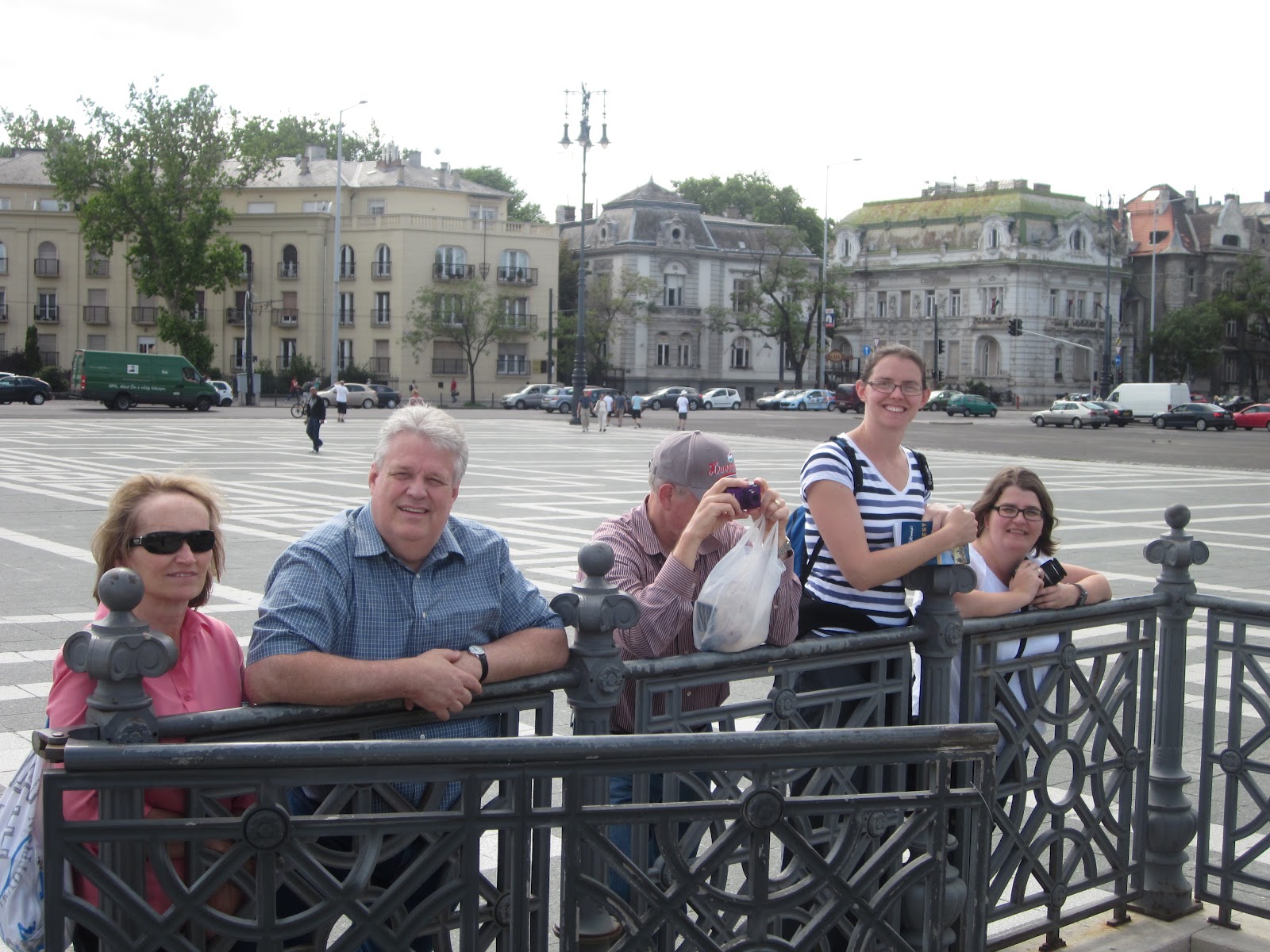
Happy tourists: Chris, Stan, Bob (hiding behind his camera and bag), Julie, and Alex:

Behind Heroes' Square is Vajdahunyad Castle, a replica of a Transylvanian Castle that was also built for the 1,000 anniversary of the country, kind of like a World's Fair exhibit:

The Castle complex includes several buildings representing various periods of Hungarian history:


Not far from Heroes' Square is what might be considered the ANTI-Hero place, the House of Terror.  This building was the headquarters for the secret police for the Nazis and then, for the forty years after the war, the Communists.  The transformation of the building into a museum was completed in 2002 and uses every means possible to convey the fear that pervaded the country during these two occupations.  For example, when the sun shines through the frame added to the building, the shadow of the word "Terror" is cast on those walking below, symbolic of the shadow of fear Hungarians lived under for so many years.
The inside was an interesting combination of actual offices and altered, museum-like space.  Many of the displays did not have English translations, so sometimes it was difficult to understand what was going on.  The interior was generally dark and eerie, almost like a haunted house.  For me, it was a bit over the top. I was much more affected by the understatement of the Shoes on the Danube Memorial.
Still, this is worth visiting because of the focus on the communist regime.  There are plenty of World War II memorials, but not much focus on the dark years of the 1950s through 1980s.

Switching gears and centuries again, we visited Budapest's beautiful Neo-Renaissance State Opera House.  Construction in the late 19th century was funded by (surprise!) Emperor Franz Joseph and Sisi. Although not the largest opera house in the world, it is considered to have some of the finest acoustics in the world.

I think this is supposed to represent an opera singer, but he looks more like a cannibal when he comes into contact with Alex:

Statue of Franz Liszt, the 19th century Hungarian composer, pianist, and conductor:
We'll have to go back to Budapest and get tickets for an opera here, right, Bob?

After a long day of trekking all over the city, our final stop was to see the Danube Folk Ensemble at the Neo-Baroque Duna Palota (or Danube Palace) Theater.

Bela Bartok and Antonin Dvorak played in this sumptuous concert hall.  If only walls could talk (or play music) . . .
(I confess. I stole these last three pictures from the Internet.)
I remember learning square dancing and the Virginia Reel in elementary school.  I guess those could be considered American folk dances, and I'm glad there is, or at least used to be, an effort to preserve them.  However, Hungary is much more serious about their folk dances, folk music, and traditional clothing.  They even have a college dedicated to teaching folk dances.  This particular group had twenty-four professional dances and ten extraordinary musicians:
The ol' Bottle-on-the-Head Dance.

There must have been about ten costume changes. 


It was exhilarating dancing, enough to make us want to dance our way back to the hotel.  We restrained ourselves, however, since we didn't want to end up in a Hungarian prison.

Besides, the nightscape was taking our breath away. I think walking along the Danube at night in Budapest has to be the world's most romantic evening stroll.


Next: Food, food, and more food, with a little bit of shopping thrown in.

READING

The Ancsas, a childless couple living on the outskirts of Budapest in a country struggling to recover from World War II, adopt a neighbor's young terrier, or rather, she adopts them.  Then Mr. Ancsa, an idealistic engineer who wants to help rebuild his country, is demoted for unknown reasons and the couple and Niki have to move into Budapest. Eventually Mr. Ancsa is taken away to prison, though he and his wife are not told why, and kept there for five years. His imprisonment takes a physical and psychological toll on both his wife and his little dog and reflects the devastating politics in Stalinist Hungary. Dery, a Hungarian political activist, wrote this book in 1956 as a commentary on the senselessness and arbitrary nature of the new regime.