
After two days in Charleston, South Carolina, we drove to Savannah, Georgia, a distance of just over 100 miles. Like Charleston, Savannah is an old city (at least by U.S. standards), having been founded in 1733. Savannah oozes Southern-ness.


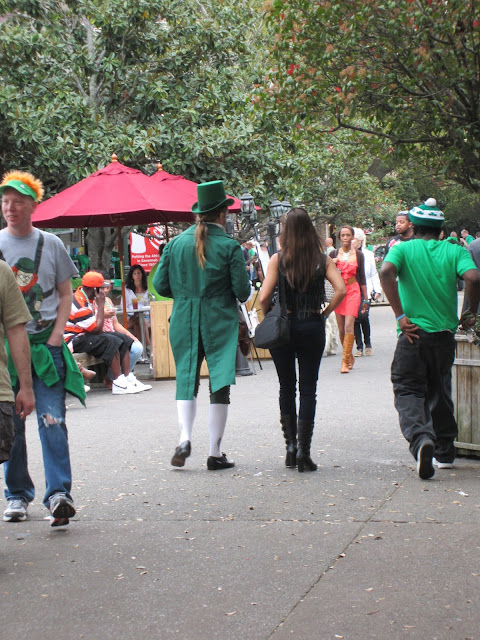
 On the day we were there (St. Patrick's Day), it also oozed Irish-ness. Who knew that Savannah has the second largest St. Patrick's Day parade in the U.S., second only to New York City? Everywhere we turned we saw the wearin' o' the green.


 Even the horsies got in on the action:


It so happened that we arrived just in time for mass at the Catholic Cathedral of St. John the Baptist. The building was undergoing some renovations that made the entrance difficult to find. We ended up following two cute young men who slipped into a side door we never would have dared enter on our own. One of them turned out to be the altar boy for the service:
 Unfortunately, we were two of only a handful of people in the entire congregation not wearing green. In fact, I was wearing orange, and it was downright awkward. These Savannahians are very serious about their holiday.
The organist for the mass was spectacular, as good as any I've heard in Europe. The soloist was equally impressive. I have only been to a Catholic mass a handful of times, but I'm pretty sure this is a first-class operation.

I've decided that stained glass windows are my thing. (I tend to include a lot of them in my posts. Have you noticed?) Really, stained glass is the one thing I wish we had more of in my own church.
.JPG)
.JPG)
I also like the soaring ceilings and gorgeous colors in cathedrals. This apse was particularly lovely, a peaceful combination of soft blue, rose pink, gold, and white:

.JPG)
.JPG)
.JPG) As it was just a few weeks before Easter, the service was centered on the final week in the life of Christ, and we enjoyed singing along with the congregation, listening to the homily (so nice to hear it in English), and watching the pageantry.
As it was just a few weeks before Easter, the service was centered on the final week in the life of Christ, and we enjoyed singing along with the congregation, listening to the homily (so nice to hear it in English), and watching the pageantry.
Later in the day we passed by the Mickve Synagogue, not too far from the cathedral. Founded in 1733 just five months after the establishment of the Colony of Georgia, it is the oldest Reform Judaism congregation in the United States. This particular synagogue building dates to 1878. We wish we could have gotten inside, but alas, it was all locked up.

However, I like this excerpt from a letter George Washington wrote to the congregation in 1789 that we found on a brass plaque outside the synagogue:
"May the same wonder-working Deity who long since delivering the Hebrews from their Egyptian oppressors, planted them in the promised land--whose providential agency has lately been conspicuous in establishing these United States as an independent nation--still continue to water them with the dews of Heaven and to make the inhabitants of every denomination participate in the temporal and spiritual blessing of that people whose God is Jehovah."
Although his syntax is a bit convoluted, that George had a way with words, didn't he?
Savannah is also the birthplace (1860) of Juliette Gordon Low, founder of the Girl Scouts. The very first Girl Scouts Headquarters Building is in the historic district of the city. Seeing it gave me a sudden craving for Thin Mints.
 We saw several men and women and even children bending and weaving sweetgrass into flowers. When I asked this man, "How much?" he replied, "Whatever you think it's worth." I gave him all I had in my wallet, $2.00, and he seemed to think that was just fine.

 We passed by one cemetery that had this marker:
 . . . and I was reminded how grateful I am for modern medicine.

 We did make one mistake as we explored the city. We walked down to the local pedestrian shopping area, where the St. Paddy's Day activities were in full swing, complete with loud music and staggering leprechauns who had apparently had a bit too much to drink of some beverage other than this one:
 However, at the end of the street was an interesting monument dedicated to the African-Americans who fought in the Revolutionary War:


Coming Next: Everything that rises must converge--on Flannery O'Connor's childhood home.


It so happened that we arrived just in time for mass at the Catholic Cathedral of St. John the Baptist. The building was undergoing some renovations that made the entrance difficult to find. We ended up following two cute young men who slipped into a side door we never would have dared enter on our own. One of them turned out to be the altar boy for the service:

The organist for the mass was spectacular, as good as any I've heard in Europe. The soloist was equally impressive. I have only been to a Catholic mass a handful of times, but I'm pretty sure this is a first-class operation.

(While you are listening to my recording of the organist's nimble fingers dancing on the keyboard, check out all the green clothing when I pan the departing parishioners.)
.JPG)
.JPG)
I also like the soaring ceilings and gorgeous colors in cathedrals. This apse was particularly lovely, a peaceful combination of soft blue, rose pink, gold, and white:

.JPG)
The nave was spacious and light, and the side aisle ceilings echoed the patterns and colors of the apse.
.JPG)
.JPG)
Later in the day we passed by the Mickve Synagogue, not too far from the cathedral. Founded in 1733 just five months after the establishment of the Colony of Georgia, it is the oldest Reform Judaism congregation in the United States. This particular synagogue building dates to 1878. We wish we could have gotten inside, but alas, it was all locked up.

However, I like this excerpt from a letter George Washington wrote to the congregation in 1789 that we found on a brass plaque outside the synagogue:
"May the same wonder-working Deity who long since delivering the Hebrews from their Egyptian oppressors, planted them in the promised land--whose providential agency has lately been conspicuous in establishing these United States as an independent nation--still continue to water them with the dews of Heaven and to make the inhabitants of every denomination participate in the temporal and spiritual blessing of that people whose God is Jehovah."
Although his syntax is a bit convoluted, that George had a way with words, didn't he?
Savannah is also the birthplace (1860) of Juliette Gordon Low, founder of the Girl Scouts. The very first Girl Scouts Headquarters Building is in the historic district of the city. Seeing it gave me a sudden craving for Thin Mints.


Coming Next: Everything that rises must converge--on Flannery O'Connor's childhood home.


