Thursday, September 16, 2021

TEXAS: McKITTRICK CANYON

 July 1, 2021

When we finished our trek through Carlsbad Cavern and got back to our car, Bob called the main ranger station in Guadalupe National Park to see if by any chance McKittrick Canyon had been opened up. We had already tried to get in twice, but it had been closed due to flooding caused by a couple of days of rain. Well, the third time was the charm--it was open!

I was really glad that Bob was persistent. We had a memorable late afternoon hike and had the place almost completely to ourselves.


The parking lot and ranger station are several miles in from the main road. We hit the trail right away because by the time we got to the station, it was 5:00 and the exit gate would be locked at 6:00.

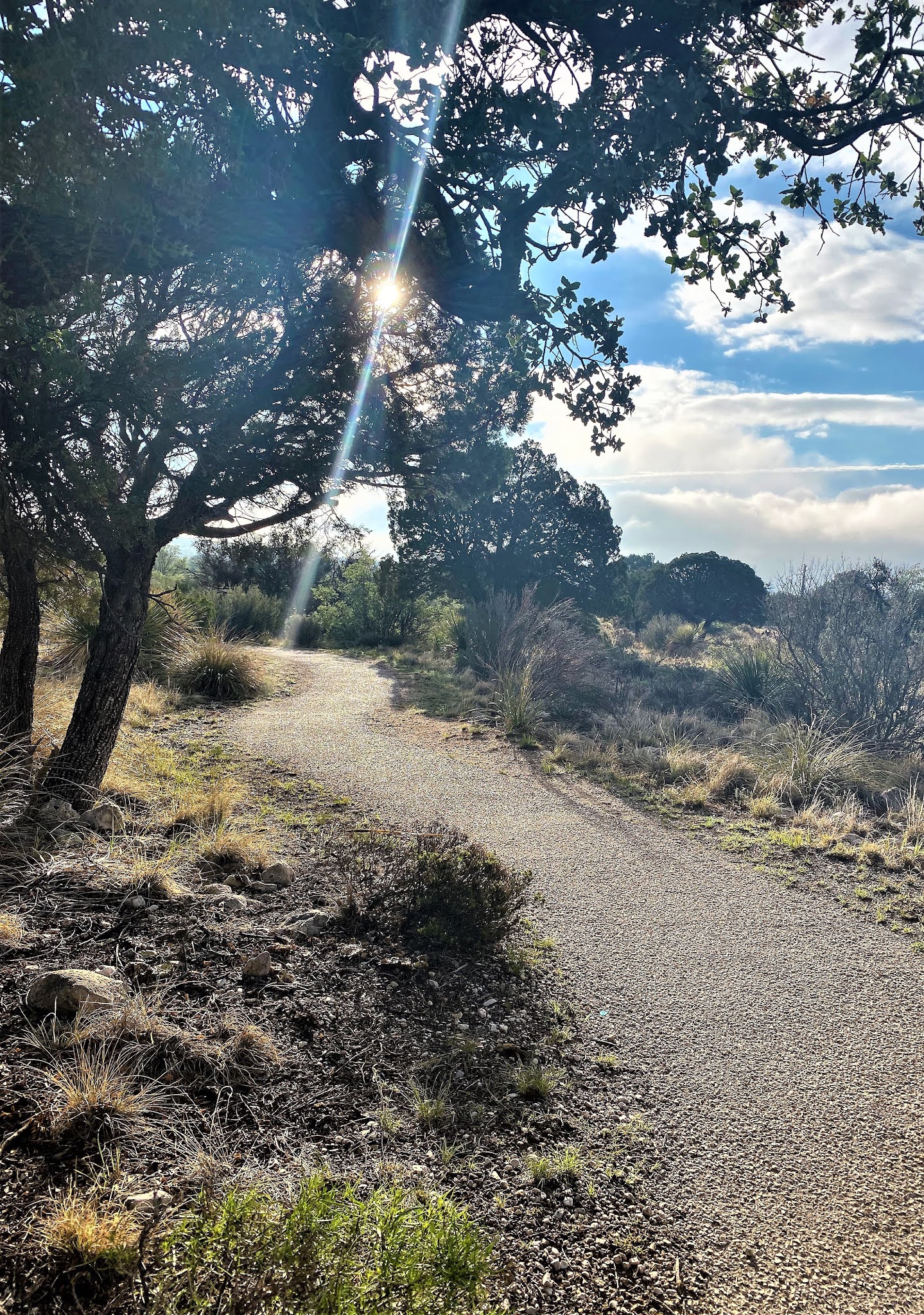
McKittrick Canyon is located just over the Texas border in Guadalupe Mountains National Park at an elevation of 5,018.  How is this for scenery?


Sunday, September 12, 2021

NEW MEXICO: CARLSBAD CAVERN

 July 1, 2021

Carlsbad Cavern (singular) is one of seventeen caves in Carlsbad Caverns (plural) National Park. About 250 years ago, an underground sea combined with sulfuric acid deep below the earth's surface to work on the limestone of the area of the Guadalupe Mountains, carving out huge caverns. Different kinds of forces created various formations, including the familiar stalactites and stalagmites, as well as formations less familiar (to me) such as straws, popcorn, flowstone, and travertine.

A fun thing happened before we went into the cave. I was wearing my "Redlands Strong" pandemic t-shirt, and someone got out of his car as we walked by and asked if we were from Redlands. He was a University of Redlands student and his girlfriend was a Redlands native! I seem to have a knack for running into people who I have a connection to.

Comedian Will Rogers once called Carlsbad Cavern "the Grand Canyon with a roof over it." When I saw this layout of the cave in the Visitor Center, I could see what he was talking about. 

It is possible to walk down the cave opening, and then walk through a section of the cave to get to the trailhead for the main cave. The 1.25 natural trail entrance is very steep and the equivalent of a 75-story building. We opted to take the elevator down instead, and we took it back up as well.

Signage notes there are at least 118 caves beneath the surface with over 180 total miles of known passages and rooms. I wasn't aware of any other options for cave walks, although I am sure there must be some.

This map reminds me of Lake Powell. It's interesting to note the similarities of caves to canyons.

Wednesday, September 8, 2021

NEW MEXICO AND TEXAS: GUADALUPE MOUNTAIN NATIONAL PARK AND WHITE'S CITY

July 1, 2021

We had a day of hiking planned and wanted to get an early start. We were out the door by 6:00 AM and on our way to McKittrick Canyon in Guadalupe Mountain National Park. Low clouds still clung to the Guadalupe Peaks, and the air was cool and fresh because of the rains of the previous two days.


We arrived at the gate to McKittrick Canyon at 6:50 AM. Since it wasn't supposed to open until 8:00, we drove to the Guadalupe Mountains National Park main visitor's center. It also did not open until 8:00, so we walked an easy one-mile loop trail that was nearby.


Saturday, September 4, 2021

NEW MEXICO: BITTER LAKE NATIONAL WILDLIFE REFUGE

 June 30, 2021

Bitter Lake National Wildlife Refuge lies a few miles northwest of Roswell. The Pecos River flows through the refuge and the Roswell aquifer lies under it. Together, they have created several deep lakes. The refuge hosts as many as 350 species of migratory birds and is also known for being the home to over 90 species of dragonflies and damselflies, which are at their peak in July and August. Being on the front end of that, we definitely saw some, but I didn't get pictures of any--except the one on the entrance sign.


As mentioned in my previous post, it had been raining all morning, as well as some of the day before, but the heavens parted and the sun began to emerge while we were in the wildlife refuge.

The puddles in the road acted like reflecting pools.


I'm glad we could stay in the car for the scenic drive. Walking would have been messy.

Tuesday, August 31, 2021

NEW MEXICO: ROSWELL

June 30, 2021

We spent the night at a Super 8 in Las Vegas (New Mexico), a quirky hotel in a quirky little town. I loved the peacock decoration that was part of the hotel landscaping.

However, Las Vegas didn't hold a candle to the quirkiness of our next destination: Roswell, New Mexico, home of the [in]famous July 1947 "Roswell UFO Incident." The basic story is that a "flying disc" crashed at a ranch about 75 miles from Roswell and was reported to authorities by the Roswell Army Air Field. However, the Army quickly retracted the statement, saying that it was actually a plain ol' weather balloon that crashed. 

Things were quiet until the late 1970s when a retired military man exposed the "cover-up" to a UFOlogist, or a researcher of UFO sightings. Many more "eyewitnesses" soon came out of the woodwork, including several who said that at least one alien spacecraft had crash-landed and bodies had been recovered by the military.

In 1994, the US Air Force came out with a report stating that the crashed object was a nuclear test surveillance balloon, and in 1997 they added that the recovered "alien bodies" were probably test dummies that had been dropped from high altitude.

What I can gather is this: 1) Something crashed into a field 75 miles outside Roswell in July 1947; 2) There was some kind of cover-up, although whether it was because it was a nuclear-related device or a UFO can be debated; 3) There are a lot of crazy people out there; 4) Roswell makes a big chunk of money off its UFO/alien image. As for #4, why else would we have gone to Roswell, except perhaps as a bathroom stop on our way to Carlsbad Caverns? 

As soon as you hit the edge of Roswell's business district, there is no question what the big draw is.


Friday, August 27, 2021

NEW MEXICO: FROM LAS CRUCES WATER TOWERS TO UTEP

July 3, 2021

We had spent the night in Las Cruces, so after our hike in the Organ Mountains we returned to our hotel, showered, and checked out. We hadn't eaten breakfast, so we searched online for the "Best Chile Relleno Burrito in Las Cruces."  We ended up at a run-down drive-thru called El Jacalito. A jacalito is a small adobe house (which this drive through was not). And if these are the best chile relleno burritos Las Cruces has to offer, I feel pretty sorry for them. We gave them a B-/C+. Very disappointing.

When he was planning the trip, Bob ran across information about a tour of the Las Cruces water tanks, each painted with historical/regional murals. He knows this is the kind of thing I enjoy, so we headed out to do that before driving on to El Paso.

Each of the water tanks is 32 feet tall and contains two million gallons of water. The artistic genius behind the murals painted on the tanks is Tony Pennock, who completed his first water tower when he was still a high school student.

The first water tank we saw was actually painted to honor New Mexico State University, Pennock's alma mater (although he did not paint this one).  Look at that background! The Organ Mountains are really spectacular.

Jornado del Muerto, or "Journey of the Dead Man," depicts the Conquistadors making the the 100-mile journey from Las Cruces to Socorro, New Mexico. This was Pennock's FIRST mural, completed over a six-month period when he was seventeen years old. He used a project and worked at night to transfer his design onto the tank. Pennock revitalized the flaking mural in 1991 and transformed it into La Entrada, or "The Entrance," focusing on Don Juan de Onate leading a procession of settlers and livestock into the American West.


NEW MEXICO: CUISINE, PECOS NATIONAL HISTORIC PARK, AND FRED HARVEY

 June 29, 2021

The one food I really wanted to eat in New Mexico was a Navajo taco. I remembered eating one on a visit to New Mexico 30 years earlier, and I remembered how amazing it was.

A Yelp search for Navajo tacos led us to Los Amigos in Santa Fe. We ordered two for take out (for a whopping $27!) and ate them in the car. I was so disappointed. They were just American-style tostadas on a piece of not-that-great fry bread. They were also huge and so loaded that we couldn't get to the bottom. We ended up eating about half and tossing the rest. I would have been happier with the giant Coke we saw at the side of the road as we left town.

On our way to Pecos National Historic Park, we passed this mural. I was intrigued enough to take a photo. Turns out it is a painting of Pecos Park itself!

The national park includes thousands of acres, but the main section contains the ruins of Pecos Pueblo, also known as Cicuye, "the village of 500 warriors." The pueblo's first buildings were built around AD 1100, and by about 1450, there were more than 2,000 people living on the site in a five-story building. According to Baltazar de Obregón, Pecos Pueblo "is congregated on a high and narrow hill. . . . It has the greatest and best buildings of these provinces and is most thickly settled. . . . It is enclosed and protected by a wall . . . and by tiers of walkways which look out on the countryside."

The Pecos people were farmers, and the broad valley we saw looks perfect for cultivated crops of the Three Sisters: bans, corn, and squash. The pueblo was strategically located and a major center of trade.

The base of the wall still snakes around what must have been the perimeter of the living quarters.