When Bob and I began planning this trip, Turkey was the #1 place on his list, and Greece was #1 on mine. For me, the Acropolis was the big draw to Greece. It did not disappoint. Coming into Athens, the Acropolis (Greek for "high city") dominates the skyline. My first sighting of it was one of those *gasp* moments--like when I first walked into the immensity of Westminster Abbey or saw the Eiffel Tower rising in the skyline or walked around the corner to see magical Machu Picchu spread out before me.
I've been so lucky to see so many incredible places.
 Before making our way to the actual Parthenon, however, we had to pay a visit to the New Acropolis Museum, located not too far from the Acropolis and just opened on June 21, 2009, a mere year and ten days before our visit. It replaces the OLD Acropolis Museum, built in 1874, remodeled in the 1950s, and too small to house the continuing archaeological discoveries being made in Athens.


The museum is built directly on top of an active archaeological dig, and a plexiglas floor allows visitors to walk right over the action:
Over 4,000 artifacts are housed in the museum, which has a stunning view of the Acropolis from every floor:

Of course, we had other great views from other points in the city:
This was our view from Wolf Hill (Mount Lycabettus):
After visiting the museum, it was time to ascend the rocky mountain itself. The first thing we came across on our way up the path to the top was the Odeon of Herodes Atticus Amphitheater. It was built in 161 A.D. and seats 5,000 people.
The day we saw the Odeon, a concert was being set up for the evening, and we watched as the chairs were placed on the marble stage (restored in the 1950s) and the musicians began to come in with their instruments. I would have loved to have gone to the concert. Oh well, maybe NEXT time we are in Athens. (Yeah, right. In my dreams.)


. . . and ascended the steps to the first structures (Prior to this trip, I only associated the Parthenon with the Acropolis; I had no idea there were many other structures up on top) . . .


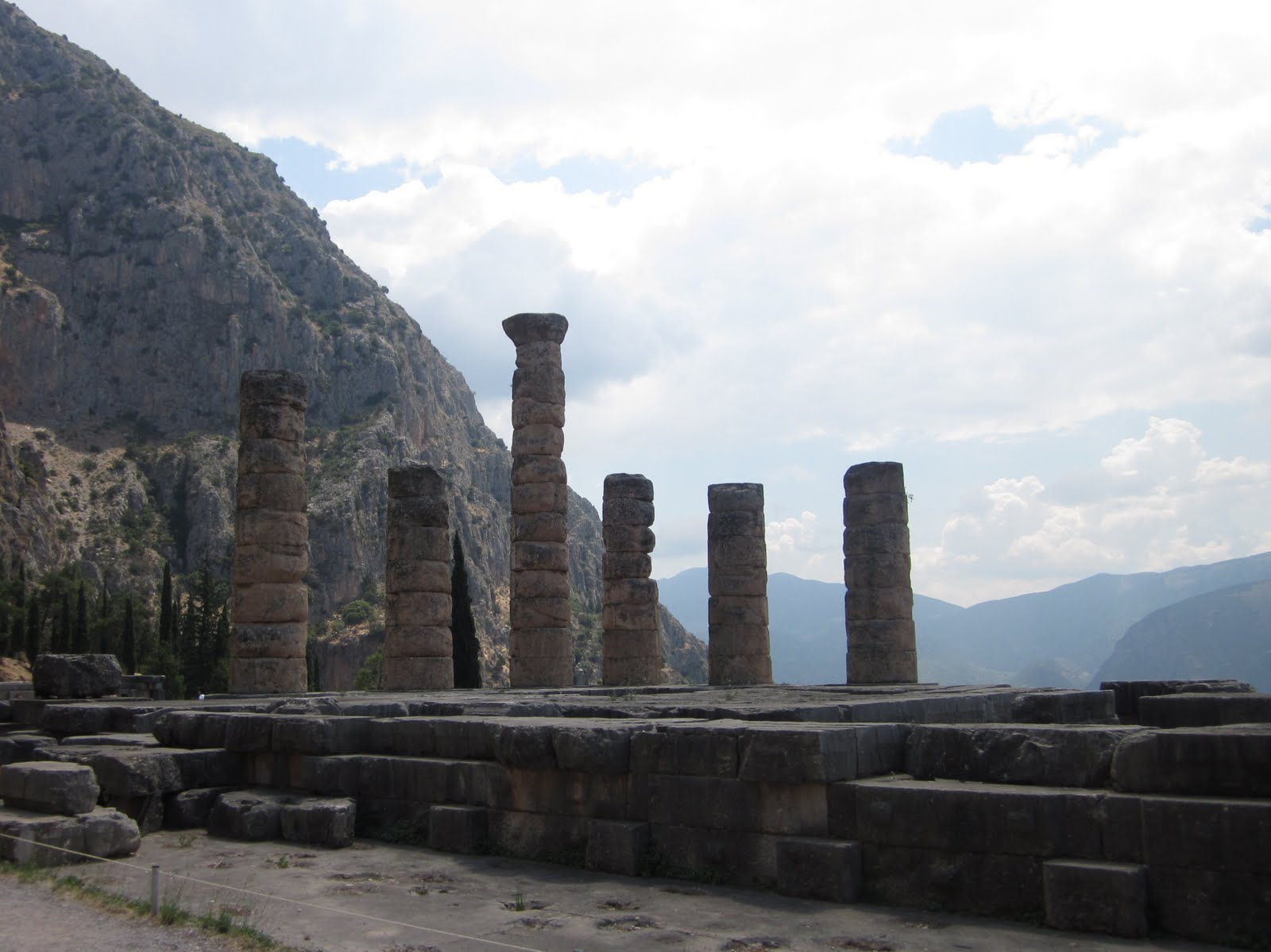
Completed in 438 B.C. and dedicated to Athena, the Parthenon is the icon of Classical Greece, and certainly its most important surviving structure. One of the things that surprised me was the ongoing restoration of it (and everything else in Greece). I guess I just assumed that this great stone edifice had survived the centuries to the present day, but that is not the case. It was actually blown up and almost destroyed in 1687 by the Venetians, who then preceded to loot it. For a time there was even a small mosque on the Acropolis. All signs of Ottoman rule were removed some time during the 1800s, but serious restoration of the Parthenon and other buildings on the Acropolis did not begin until 1975, well into my teenage years! You can see where columns have been patched and repaired, and where work is continuing to be done.


When I am old and my brain is calling up random memories, I hope this is one of them.
.JPG) It was the perfect finale to a perfect trip.
It was the perfect finale to a perfect trip.
I've been so lucky to see so many incredible places.
In Athens, thanks to Bob's careful planning, we were fortunate to have a hotel that was within just a few blocks of the entrance to the Acropolis. It certainly wasn't a five-star hotel, but it felt more real, more Greek, than a mega-chain Marriott or Hilton and the location just could not be beat. It was (Coincidentally? I think not) named The Parthenon Hotel:
 Before making our way to the actual Parthenon, however, we had to pay a visit to the New Acropolis Museum, located not too far from the Acropolis and just opened on June 21, 2009, a mere year and ten days before our visit. It replaces the OLD Acropolis Museum, built in 1874, remodeled in the 1950s, and too small to house the continuing archaeological discoveries being made in Athens.

The museum is built directly on top of an active archaeological dig, and a plexiglas floor allows visitors to walk right over the action:

Over 4,000 artifacts are housed in the museum, which has a stunning view of the Acropolis from every floor:

Of course, we had other great views from other points in the city:

This was our view from Wolf Hill (Mount Lycabettus):

After visiting the museum, it was time to ascend the rocky mountain itself. The first thing we came across on our way up the path to the top was the Odeon of Herodes Atticus Amphitheater. It was built in 161 A.D. and seats 5,000 people.
If you saw any of the famous concert, "Yanni, Live at the Acropolis," the 1993 concert that really started Yanni (a native Greek) on the road to superstardom, you have seen this amphitheater.
The day we saw the Odeon, a concert was being set up for the evening, and we watched as the chairs were placed on the marble stage (restored in the 1950s) and the musicians began to come in with their instruments. I would have loved to have gone to the concert. Oh well, maybe NEXT time we are in Athens. (Yeah, right. In my dreams.)


We continued upward, passing Mars Hill on our left . . .

. . . and ascended the steps to the first structures (Prior to this trip, I only associated the Parthenon with the Acropolis; I had no idea there were many other structures up on top) . . .

. . . and then finally reached the Parthenon itself: 

It was spectacular, just as I knew it would be:


Completed in 438 B.C. and dedicated to Athena, the Parthenon is the icon of Classical Greece, and certainly its most important surviving structure. One of the things that surprised me was the ongoing restoration of it (and everything else in Greece). I guess I just assumed that this great stone edifice had survived the centuries to the present day, but that is not the case. It was actually blown up and almost destroyed in 1687 by the Venetians, who then preceded to loot it. For a time there was even a small mosque on the Acropolis. All signs of Ottoman rule were removed some time during the 1800s, but serious restoration of the Parthenon and other buildings on the Acropolis did not begin until 1975, well into my teenage years! You can see where columns have been patched and repaired, and where work is continuing to be done.


It's a long way down from the top if you don't take the path:


The view from the top, as would be expected, is pretty spectacular, and includes other ruins from the ancient city:


We didn't see the usual cats on the Acropolis that we saw everywhere else in Greece, but we did see lots of homeless dogs. 


These two wild but friendly dogs roaming around the Parthenon like a couple of old, retired Greek guards reminded me of when our son Andrew was traveling Europe in 2007 with his friend, Andrew Moura. When they were at the base of the Acropolis, they too met a friendly stray dog, whom they named "Bronco Mendenhall" and adopted for the day. They grew quite attached to Bronco in their few hours together and tried to figure out how they could possibly keep him with them as they continued their journey. (They were already carting around two hamsters.) Ultimately, they had to him give up. I myself was NOT ready to reach out a give these dogs some love, but the thought of the Andrews doing it made me smile:

One of the other buildings on the Acropolis is the Erechtheion, built 20 to 30 years after the Parthenon and restored in the 1980s:


I especially loved "The Porch of the Maidens" with its six columns made out of draped female statues:


I especially loved "The Porch of the Maidens" with its six columns made out of draped female statues:


After several hours basking in what felt like the dawn of modern civilization, we returned to the 21st century and the plaka (or market) the surrounds the Acropolis. We stopped at a little gelato shop that we had previously noticed just half block from our hotel, and I got a scoop of chocolate hazelnut. Perhaps it was just the setting, but I think it rivaled any gelato we ate in Italy. It was so good that when we returned later that evening to stroll along the promenade at the base of the Acropolis, I had to try it again to make sure I hadn't deceived myself about its creamy goodness. 
 An outside view of the Odeon that shows a portion of the walkway.

 An outside view of the Odeon that shows a portion of the walkway.
The wide pedestrian boulevard shown above becomes a magical place when the sun goes down. Natives and tourists stroll up and down its paved surface, encountering street performers every 100 yards or so--just far enough apart that they don't interfere with each other. There were musicians (keyboard, violins, African drums), magicians, mimes, and this puppeteer with her marionette:.JPG)
The lights along the promenade are kept quite dim so that the spectacularly illuminated Parthenon can cast its mystical glow over the city. Families and students and the elderly and lovers alike shared the walkway, nodding and smiling at each other in passing. There was that unique sense of camaraderie that sometimes occurs when a diverse group of people share the same magical experience (and the silky gelato only intensified our feelings of well-being).
When I am old and my brain is calling up random memories, I hope this is one of them.
 It was the perfect finale to a perfect trip.