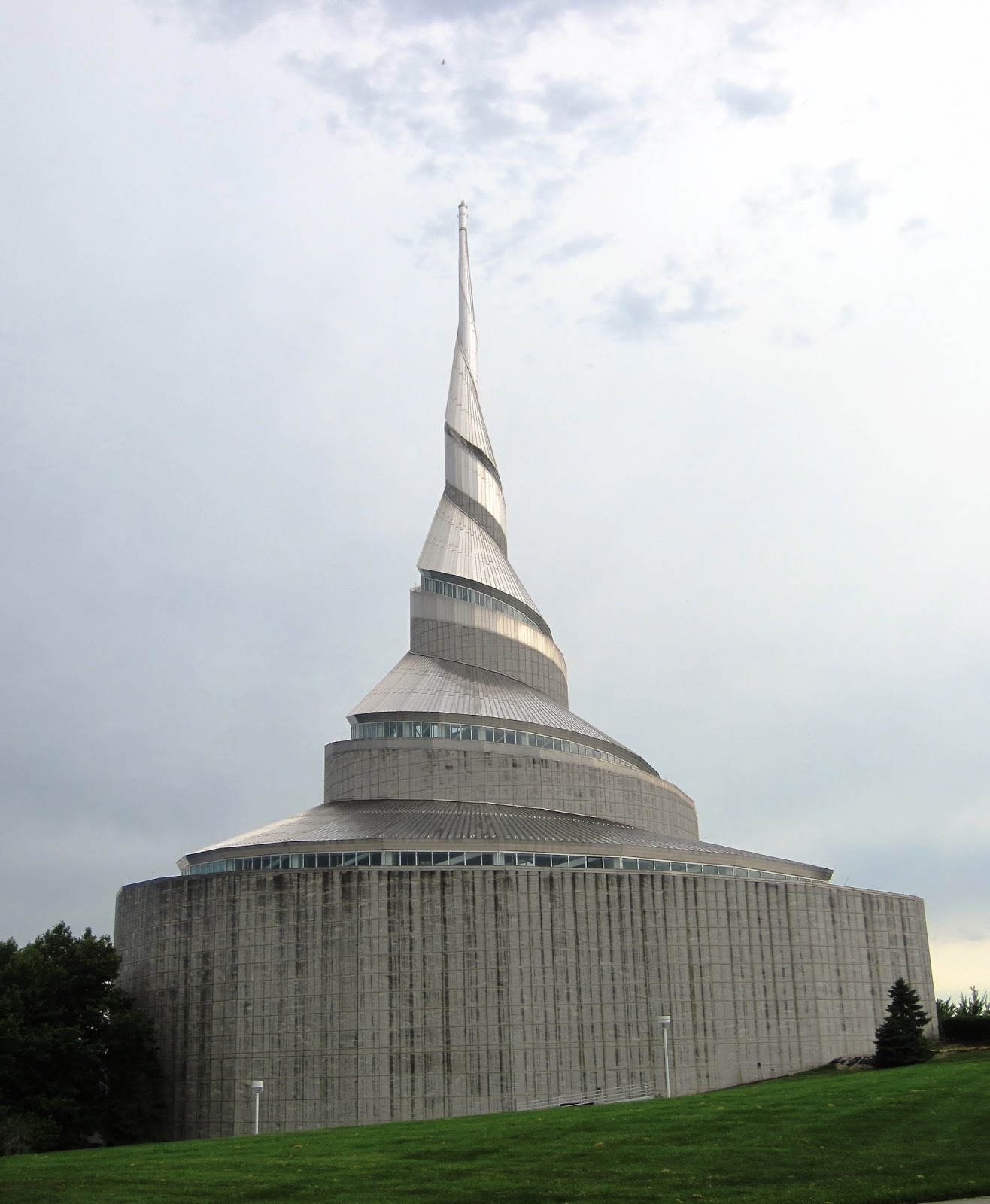
The Community of Christ Church, which was known as the Reorganized Church of Jesus Christ of Latter Day Saints from 1872 to 2001, is an offshoot of the Church of Jesus Christ of Latter-day Saints, commonly referred to as the LDS or "Mormon" Church. The two groups split after the death of the man considered the founder of both churches, Joseph Smith, Jr. The LDS church chose Brigham Young as their next leader, and those who did not support that choice eventually chose Joseph Smith III, who was 12 years old at the time of his father's death, to be their next leader. For years there was some animosity between the two groups, but recently their relationship has greatly improved.
Since Joseph Smith, Jr.'s death in 1844, the doctrine of the two churches has diverged greatly, and one of the places where this can be seen is in their concept of temples. While LDS Temples are closed to the general public and used for ordinances for the living that can be performed nowhere else, as well as for vicarious ordinances for the dead, the Community of Christ Temple located in Independence, Missouri, serves as the headquarters of the church and as a place of public worship "dedicated to the pursuit of peace." I was very curious about it and excited to visit.
Plans to build the temple were announced in 1984,groundbreaking took place on April 6, 1990, and the edifice was dedicated April 17, 1994. The cost was approximately $35 million.
I had seen photos of the building, and its strange twisting spire reminded me of some futuristic structure, perhaps a building out of
The Jetsons or
Star Wars. However, in person I found it quite striking. The twisting-turning steel and glass steeple looks like an ever-narrowing pathway that leads to heaven. The building was designed by an award-winning architect from Missouri named Gyo Obata, who also designed the National Air and Space Museum of the Smithsonian Institution.
Different angles provide changing views:
As this temple is dedicated to promoting peace, this primitive-style bronze statue on the grounds is especially appropriate. A plaque at the base quotes Isaiah 2:2-4: ". . . they shall beat their swords into plowshares and their spears into pruning hooks; nation shall not lift up sword against nation, neither shall they learn war anymore."