Showing posts with label Los Angeles. Show all posts

Wednesday, August 26, 2015

BEVERLY HILLS PART II: ARCHITECTURE, CHEESE, AND CHURCH

After our over-the-top chocolate indulgence experience, we decided to walk around Beverly Hills to see what additional damage we could do to our diets get some exercise and walk off a few calories.

Beverly Hills is kind of a surreal place. It was originally a lima bean ranch (I did NOT make that up), but was subdivided into building lots in 1906. It was one of several planned communities in the area that were specifically all-white and non-Jew. We Californians like to think we never had the discrimination issues so prevalent in the South, but BH is evidence that this is false, although lawsuits were settled in 1948 that allowed blacks and Jews to move into the city, years before major Civil Rights legislation. These days, African Americans still only make up 2.2% of the population, but Beverly Hills has the largest Jewish population per capita of any city in the United States. Iranian Jews are especially dominant and make up over 25% of the city's population of 35,000. Some sources say that overall, Beverly Hills is 60% Jewish, and Wikipedia says Beverly Hills High School is "predominantly Jewish."

Anyway, back to how BH became BH.  It helps to have good roots. A group of wealthy investors incorporated the city in 1914. Then it really got rolling when Douglas Fairbanks and Mary Pickford built a home in Beverly Hills in 1921, starting the mass migration of The Beautiful (and rich and famous) People to the area.

Oh, and it doesn't hurt that Beverly Hills is built on top of an active, continuously producing oil field discovered in 1900. Perhaps even more productive than the Beverly Hills Oil Field, however, is one of the most famous shopping streets in the world, Rodeo Drive, and the surrounding shopping area, the Golden Triangle.
The northern terminus of Rodeo Drive where it intersects with Sunset Boulevard.
I was willing to contribute to the local economy, but Bob wanted to press onward.
After bypassing the above entrance to Rodeo Drive, we came upon Jack Colker's 76 Station, a gas station straight out of the Jetsons. This unique futurist style of the 1950s and 1960s, known as "Googie" architecture, originated in Los Angeles and reflected America's obsession with cars, jets, space travel, and the Atomic Age.
The most famous example of Googie architecture is the Theme Building at LAX:
Photo from here
The term comes from "Googie's," the name of an LA coffee shop with this distinct architectural style. "Googie" was the nickname of the owner's wife.

Monday, August 24, 2015

BEVERLY HILLS PART I: CHOCOLATE TOUR

We interrupt the scheduled streams of post about travels in the Middle East with a breaking story that just can't wait. Yesterday Bob and I went on a CHOCOLATE TOUR of Beverly Hills. You read that right: a chocolate tour of Beverly Hills. Yeah, I'm living the sweet life.

Believe it or not, I had to drag Bob along. I'd purchased the discounted tickets last fall through Travel Zoo, and they were set to expire the end of August, so I told him he just had to come. Beverly Hills is a scary place, right? (At least to the pocketbook.) Also, if I took one of my friends, all the others would be jealous. It had to be him.

The tour was organized by BestTours.com.

#1 Sprinkles Cupcakes
We met our tour guide and the other members of our group in front of Sprinkles Cupcakes at 9635 S. Santa Monica Blvd. This store claims to be the first exclusively cupcake bakery in the world. There are lots of cupcake places now (there are even sixteen more Sprinkles shops), but this is the mother ship:
I am not a huge cake person. I generally find most bakery cakes dry and unimaginative. A Sprinkles mini cupcake changed my life forever. Let me tell you about the shock this little dark chocolate triple fudge gem was to my tastebuds. It was moist. It was rich. It was heavy. I was ready to forego the rest of the tour and just eat cupcakes. Wow. It was something worth going back for. If I lived close to a Sprinkles, I would be in serious trouble.
 

On the outside wall of the shop is a little innovation would add to my demise. Usually I am saved by early bakers' hours. If you don't get there by 4:00 PM or so, only the dregs are left in the display case. Not so at Sprinkles. Slide your ATM card, and instead of cash, this baby dispenses fresh cupcakes and cookies 24/7.
Did you notice the word "EAT" buried in the letters "CUPCAKEATM"?
It's centered right over the word "Sprinkles." Very subliminal.

Saturday, May 11, 2013

NOAH'S ARK AT THE SKIRBALL JEWISH CULTURAL CENTER, LOS ANGELES

There are seventeen members of my family living in Southern California right now (plus my sister Doris and her husband Reid in Bakersfield in central California), and we are making an effort to get together at least quarterly.  Last Saturday we all met up at the Skirball Jewish Cultural Center at 2701 N. Sepulveda Blvd., Los Angeles.

Jack Skirball was a Jewish rabbi who took a leave of absence from his congregation in 1933 to produce educational movies, one of which was the controversial The Birth of a Baby, the first film to show the actual birth of a child.  He eventually became a producer of mainstream movies, including a few Alfred Hitchcock flicks. In the 1950s, he began a third vocation as a real estate developer and was responsible for building San Diego's Vacation Village, a model for a slew of copycat resort hotels. It seems he was successful at just about everything he did, which is why he had plenty of money to donate to Jewish education, including building a cultural center in Los Angeles in the 1980s.

Six years ago, a new Noah's ark-themed children's museum opened in the Skirball. It is this museum where sixteen members of our family met on May 4th.  (We really missed the always-working Andrew, who would have loved the creativity of this place, and I didn't think to notify Doris and Reid.)

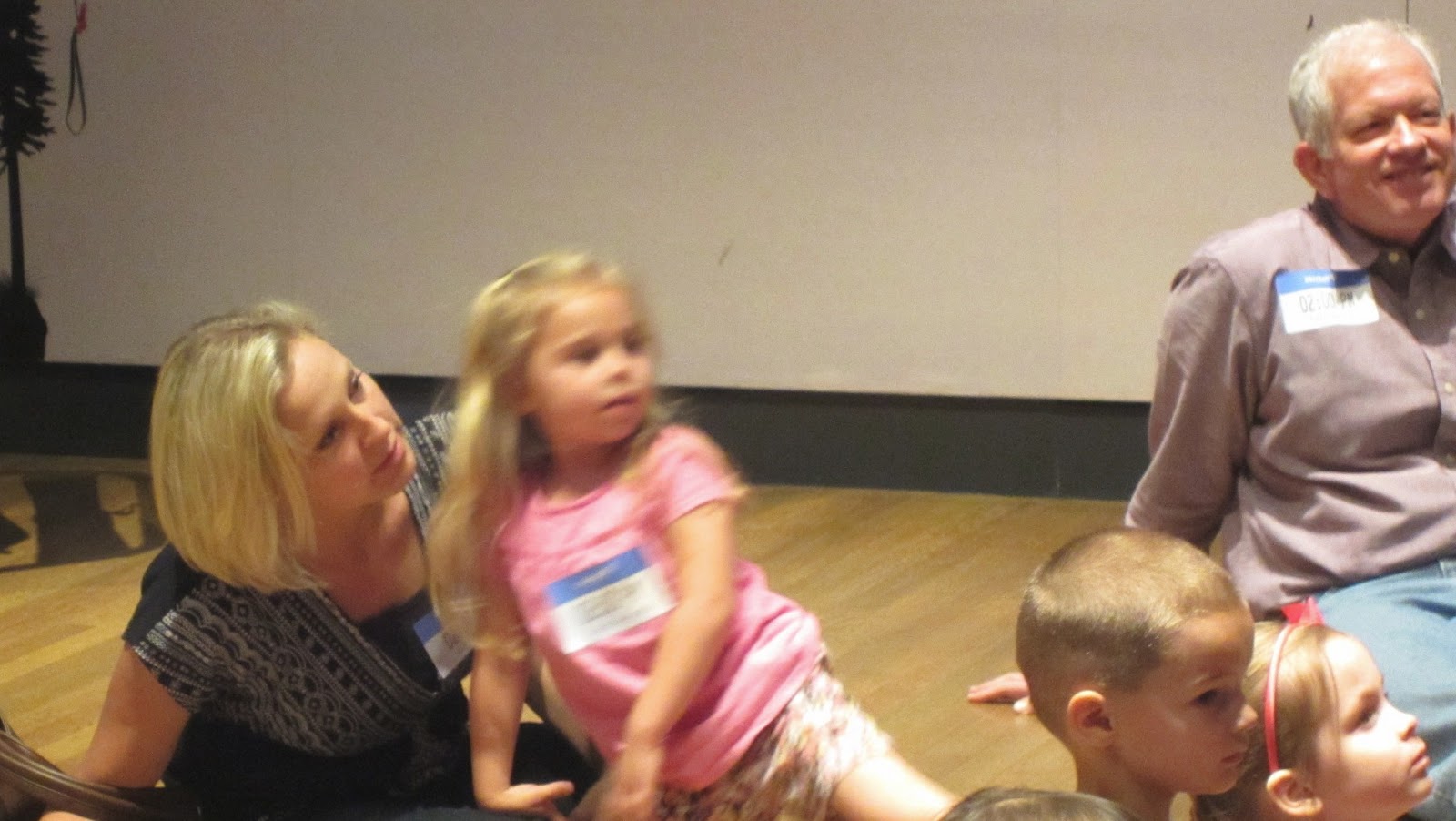
We purchased our tickets in advance using a great discount coupon I found on Google.  Only 100 people at a time are allowed into the museum, which makes for a nice, uncrowded experience.  The museum is staffed by enthusiastic college-aged young people who tell stories, keep things tidy, and guide the children's experiences.  We began by listening to the story of Noah, his ark, and a big storm that raged for forty days and nights.  The children (and adults) listened carefully:
. . . and participated in demonstrating the rain:
. . . and just looked cute:
Our storyteller explained the theme of the museum, which is that "Noah's ark teaches us that second chances are possible."  This quote comes from Lloyd E. Cotsen, the former president of Neutrogena who donated his collection of Noah's ark memorabilia and folk art from around the world.
A booklet available in the museum states: Here's our take on the story.  It's about surviving the challenges life throws our way by getting along and working together, and about making the most of second chances.  All of us have a role to play, so on this ark, all of us are Noahs.  And guess what?  All the animals are welcome, too--not just two of each, and not just the cute and cuddly ones.  As it turns out, Noah's Ark is just one of hundreds of flood stories from around the world. In some tales, the ark is a walnut shell; in others, a hollowed-out pumpkin., But they all have huge storms, safe shelters, and new beginnings.

Isn't that wonderful?

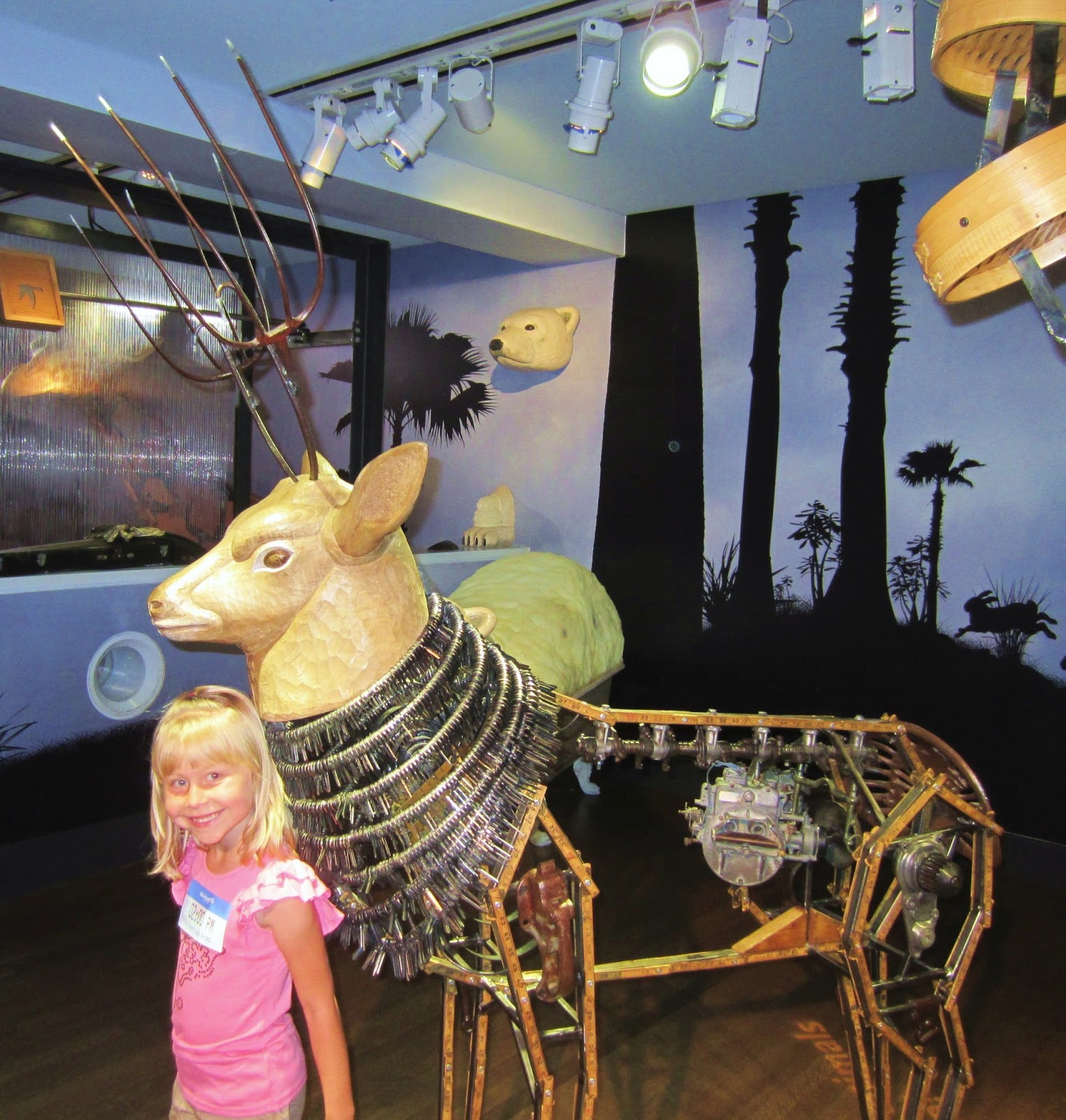
One of the really fun things in the museum is that all the animals that have been created from odds and ends--materials "given a second chance" at life.  The booklet notes, We used an old story, so we decided to use old stuff. Stuff from attics, stuff from e-bay, and some stuff right off the street. A John Deere tractor seat makes for a good deer derriere. And there's nothing here that lights up or reboots when you press a button. Our bells and whistles are actual bells and whistles. 

There are 386 animals aboard this ark, each one a creative masterpiece. See if you can identify the unusual parts of Noah's animals, such as the pink purses used for these flamingos bodies:
 Everything within reach of visitors is meant to be touched and explored.
There are multiple rooms in this museum, including a room on each side of the ark, and one large room within the ark.  The ark measures 15 feet high, 41 feet wide, and 65 feet long. The booklet points out that this is not the size of the ark in the Bible, which it says was about the length of three football fields.

There are lots of friendly faces waiting to greet visitors to the ark:
. . . and there is a child-sized ark with its own collection of plastic animals for kids to play with:

This sign gives context to the displays of arks from around the world:


Inside the ark itself are all sorts of fun treasures, including dozens of animal puppets (two of each, of course):
All the little kids really enjoyed playing with them:
There are some nice seating areas for the adults:

And lots more creative creatures to admire:
Of course, animals need food, so the ark has several storage areas:


There is also a place to prepare the meals for the ark's human inhabitants:

One of the features the kids loved was the rope course. The museum info says there are 30,000 knots in this course.
Even the big kids got in on the action:
With this many animals, there is bound to be some, um, waste material. According to our booklet, there are EIGHT kinds of poop on the ark.  Everyone poops . . . differently, the booklet says.

 Who is this strange man???

The final room was the other side of the ark.  The rainbow would appear every now and then on the far wall:
Of course, there was a dove with a bit of greenery in its mouth:
. . . and there were lots of animals anxious to disembark:

There were activities for the kids in this final room, including an art project:
. . . story time:

. . . and dancing:

Everybody had a really good time.

It was a great day with six really darling children enjoying being cousins: