Showing posts with label Uzbekistan. Show all posts

Sunday, June 24, 2018

BUKHARA, UZBEKISTAN: THE ROYAL PALACE, A SUFI TEMPLE AND MAUSOLEUM, AND LEAVING UZBEKISTAN

On our way out of Bukhara, we stopped at two historical sites: a royal summer palace and a Sufi mausoleum.

In the mid-19th century, the Emir of Bukhara (a descendant of Genghis Khan) decided he needed a place to escape the heat, to he asked his wise men where to build. They told him to kill and quarter a lamb, and then to put each quarter in a different location. Build where the meat stays fresh the longest. He did exactly that.

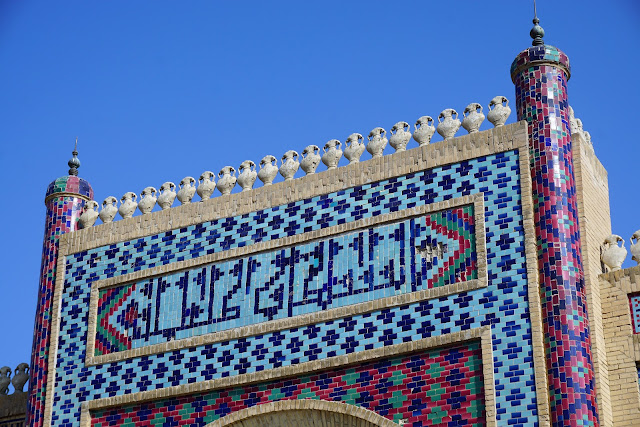
While his summer palace did not survive, a second one was built on the same site later in the 19th century. The Emir at the time had a beloved wife Sitora who died, so he named the palace after her: Sitorai Mokhi Khosa, translated as "Star, like the Moon."  The front gate, a fusion of central Asian and Russian design, still stands:


Apparently it wasn't fancy enough for the grandson of that emir, because when he inherited the throne, he built a third palace next to the old one. It was finished in 1917. Unfortunately, Russia took over Bukhara in 1920, and the emir fled to Afghanistan, where he lived out the rest of his life and died in 1944.

These days the palace serves as a museum of fine arts. As in days past, peacocks roam freely around the grounds:

There were many handmade items on display and for sale, including the ubiquitous suzanis, or embroidered tablecloths/wall hangings. In fact, there were quite a number of desperate artisans there, trying to sell their creations, but there were few if any buyers. We had been exposed to these products for days and had already filled our luggage with similar items. However, I think the quality and prices at the palace were as good and probably better than in the city.


Wednesday, June 20, 2018

BUKHARA, UZBEKISTAN: MONUMENTS, MOSQUES, AND MAUSOLEUMS

As a major stop along the Silk Road, Bukhara had exposure to many different cultures. That is still apparent today in their architecture and diet and appearance. Bukhara even has a Jewish synagogue, built in the 16th century:


The land for this synagogue was granted to the Jews in exchange for a piece of property owned by some local Jews and on which the local vizier wanted to build a madrasa. A deal was cut and the beautiful Madrasa of Nadir Divan-begi was built on the site in 1622:

It is best know for this unusual depiction of two phoenixes and a sun with a face on the entrance portal:


Saturday, June 16, 2018

BUKHARA, UZBEKISTAN: SHOPPING HEAVEN

The name "Bukhara" is supposed to mean "full of knowledge," but I think it really means "full of shopping." What we found, however, is that it is expensive shopping, at least as compared to Khiva, which had many of the same things for lower prices.  Bukhara is a much bigger tourist destination, which drives the prices up.

One of our activities was visiting another rug-making place.  (We had previously visited one in Samarkand, the city that became the most important city in Central Asia after Bukhara started to fade.) There were rugs for sale in all shapes, sizes, and colors:


 My personal favorite:

A knowledgeable woman educated us about quality, pattern, colors, etc., and her friendly henchman helper lifted up various rugs so that we could all buy them see them:

Tuesday, June 12, 2018

BUKHARA, UZBEKISTAN: THE GRAND MOSQUE

Our final stop in Uzbekistan was Bukhara, another monument-filled ancient city. Certainly of the five Stans we visited, Uzbekistan is the one with the most to see, at least as far as historical sites. By the time we left, we were on mosque and madrasa overload. Anyway, Bukhara is about 2,500 years old and was the main city of the region for almost 2,000 years. It was the center that preceded Samarkand.

Bukhara means "monk's house" or "monastery." When it was founded, Islam had not yet been established. Instead, the city had an abundance of Buddhists, then Zoroastrians. It was the religious center of Central Asia. Today it has a population of about 250,000 people who are mostly Muslims.

We were met at the train station by a group of performers called "The Strong Men of Bukhara."  One of the men was lifting 100-pound weights:

Now he is holding 300 pounds in his teeth and 200 in his hands:

That's 350 pounds on his back:

I assume the youngsters are there for show. We only saw the guy in red lifting.

We really loved the performances at all the train stations on our Silk Road journey. They are a nice welcome and a fun introduction to the city.

Our first stop was Po-i-Kalyan, aka "The Grand Mosque," one of the oldest and largest mosques in Central Asia. It is actually a complex that includes a madrasa and a famous minaret.

 Really, the walls aren't caving in; it just looks like they are:

Thursday, May 24, 2018

KHIVA, UZBEKISTAN

We left Khujand, Tajikistan, in the late afternoon and headed west to Uzbekistan. During the night we had a smooth border crossing, and when we woke up, we had breakfast on the train. We disembarked after covering about 600 miles.

The usual unusual welcoming committee greeted us at the train station. This particular group sounded a lot like my kids playing the kazoo and other instruments when they were little. There didn't seem to be any melody; it was just a matter of making a noise. There were also some dancers this time, and a few of our fellow travelers even got in on the act.


Our destination was the city of Khiva, about 35 miles from the train station. It has the distinction of being the most northern area in the world where cotton is grown. It is also known for its old walled city that has an unusual  number of madrasas, 60 to be exact. Here is one of them:

Khiva is a mix of the old and the VERY old. Some structures may date as far back as the 6th century.

From some angles, it looked like a giant sandcastle:

Friday, April 27, 2018

SAMARAKAND, UZBEKISTAN: ST. DANIEL'S MAUSOLEUM

I have one final post about Samarkand, one of the most amazing cities we have ever visited. The last place we stopped on our way out of town was St. Daniel's Mausoleum--yes, THAT St. Daniel, he of lion den fame and a prophet recognized by Muslims, Jews, and Christians alike.  However, eight other places around the world also claim to be Daniel's mausoleum. Wikipedia, for example, places Daniel's burial site in Susa, Iran.

On the other hand, the Uzbeks have a pretty good story, and guess who is involved in it? None other than Amir Timur, World Conqueror. The story goes that Timur, frustrated by his failed attempts to conquer a small city in Asia Minor (now known as *ta-da!* Susa, located in Iran), heard from one of his ministers that Daniel, a figure from the Bible who lived about 2500 years ago, was buried there and protected the land. Aha! Problem solved! One version says Timur sent an army to Daniel's burial place, disinterred the body after a fiery battle, and brought at least some of the remains back to Samarkand. Another version says he negotiated for part of the relics, and that is what was brought back to Samarkand. A third version says he brought back some dirt from Daniel's grave. (Now, does that sound like Timur to you?) Then he went on to win the battle, or maybe he did all this after he won the battle. No one knows.

In any case the remains/relics/dirt were re-interred on the shore of Siab, a small tributary of the Zerafshan River, which is one of the major rivers in Uzbekistan:

Another version of the story says that these are not the relics of that Daniel, but rather of Daniyor (or Danier), an associate of the prophet Muhammad's cousin Kussama ibn Abbas. Yet another version says the remains were brought here by early Christians. Even what is contained inside the tomb is contested. Some say it is the body, others say an arm, and yet others say it is only soil from the actual grave in Susa. No one seems to be bothered with the ambiguity, and the site attracts Jewish, Muslim, and Christian pilgrims.

In the 19th century, a large mausoleum was built on the top of a sandy mesa, but visiting this site is not all about the mausoleum.

Tuesday, April 24, 2018

SAMARKAND, UZBEKISTAN: BIBI-KHANYM MOSQUE

One of the most important monuments in Samarkand is the Bibi-Khanym Mosque, begun in 1399 and completed in 1404 and named after Timur's favorite wife. 
It is said to have been the largest building of the East in its day, and certainly the largest mosque. At least 15,000 people could fit in it. (Timur wanted the entire city to be able to pray together here simultaneously.) Timur had it built next to the bazaar (the same one we visited), and supposedly used 97 teams of elephants that he brought back from his India campaign to build it.

Sadly, the engineering of this mosque didn't measure up to its grandiosity, and soon after completion, the building began to collapse. From day one, it was what we would term a "money pit," and by the late sixteenth century, current  rulers were tired of draining their coffers to repair it and so ordered that no more restoration work be done. 

That anything remained at all by the 20th century amazes me. This photo was taken sometime between 1905-1915:
From Wikipedia

Reconstruction of the mosque started in 1974 under the auspices of the Soviet government, and continues to the present day.

The beautiful ribbed dome has been re-created:

Saturday, April 21, 2018

SAMARKAND, UZBEKISTAN: GUR-E-AMIR, AKA THE AMIR TIMUR MAUSOLEUM

By the time we got to the Gur-e-Amir, which is Persian for "Tomb of the King" (and which is also known as the Amir Timur Mausoleum), we had seen dozens of gasp-inducing, mind-bending, pinch-me-am-I-really-seeing-this edifices. You'd think we would have been jaded after all we had already seen. Judging by the number of photos I have of this Mausoleum, however, I still had room for a little more awe.

Some of this architecture was, by this time in the trip, very familiar--the huge vertical slabs used as portals to courtyards, the wide towers topped by azure domes, the unbelievably intricate details--but this mausoleum of the most powerful conqueror of Middle Asia was truly over the top, adding even more design features and ostentatious bling to architecture that I had thought could not be made any more elegant.

For example, take a look at the picture below. See that sidewalk leading up to the main entrance?

Here are two better views. Absolutely stunning.


Here is a better look of that vertical panel that frames the portal. Even a close-up shot can't really capture how magnificent this is. Let me remind you that we are talking TILES, not paint.


Sunday, April 15, 2018

SAMARKAND, UZBEKISTAN: SLEEPING, WALKING, SHOPPING, AND EATING

Our tour group spent two full days and two nights in Samarkand. After several days on the train and a crazy-busy itinerary, it was a relief to have a some unscheduled time in one of the most beautiful cities in the world. We stayed at the Registan Plaza, a nice hotel located within walking distance of Registan Square:

Samarkand celebrated its 2,750th birthday . . . ten years ago. Yeah, it is OLD:

The Samarkand coat of arms shows a winged lion (At first I thought it was a leopard, but that is a lion's tail) . . .

. . . that made me think of the winged Lion of St. Mark of Venice:
Picture from here
Or even more, this image, for which I can't find the source (I had it; I lost it.):

Our hotel was great--not the nicest hotel of the trip, but still at least four stars:
The best feature of the hotel was its location. One morning we had a few hours to kill, so Bob and I set out on a walk from out Hotel to Registan Square, a distance of about 1.7 miles. It was a very entertaining stroll.

Sunday, April 8, 2018

SAMARKAND, UZBEKISTAN: LUNCH, SILK CARPETS UZBEKISTAN, AND MEROS PAPER FACTORY

After all the intense sightseeing we were doing in Samarkand, a good meal was in order. It's possible to get an American meal even in Uzbekistan. Crazy.

But why would we go there when we could go to a restaurant with this lovely statue of a girl in shorts and a tank top greeting us? (I wonder what Muslims, who comprise about 93% of the population of the country, think of her choice in clothes?)

The inside was quite a bit more traditional than the statue led us to believe:


I love the way the bread in this part of the world looks--so much more complex in design. Note the pinhole pattern in the center. However, I wouldn't rank it among the best breads in the world. When it was hot, it was good, but when it was cool, it tended to be dry and a little flavorless.