Showing posts with label crucifix. Show all posts

Saturday, September 6, 2025

GERMANY: NUREMBERG'S MARKET SQUARE (OLD TOWN)

 May 18-19, 2025

We spent the morning in Dresden, then drove to Nuremberg in the mid-afternoon, a drive that took about 3 ½ hours. We arrived just in time for dinner. While on the road, I researched restaurants to try to find a good, authentic German dinner. We ended up at the Bratwursthäusle (House of Bratwurst). Founded in 1312, it is the oldest restaurant in the city and is famous for producing what the European Union has declared to be the first bratwurst (grilled sausages) in Germany. Their sausages are made onsite every morning.

I got an assortment of brats (boiled, grilled, and fried) and a chunk of some other kind of meat with sides of sauerkraut and potato salad. It was wonderful, and I had it again the next day when our guide took us to the same restaurant. (We didn't tell him we'd been here the night before.) The desserts were also very good. We had chocolate mousse with a berry sauce and apple strudel swimming in custard sauce.

Were we happy? Yes, yes, we were. In my journal I note that it was our best meal so far.

After dinner and then at the end of the day the following day, we explored the Hauptmarkt, or main market square. The Nuremberg Town Hall was basically destroyed during World War II but was painstakingly rebuilt afterwards. 

Wednesday, September 4, 2024

IRELAND, DAY 3: MINARD CASTLE, THE DINGLE PENINSULA, AND SLEA HEAD DRIVE

 July 6, 2024

Our plan had been to start the day at Blarney Castle, but when we tried to get tickets online, they were sold out. That's okay--we didn't feel a great need to kiss the Blarney Stone and taking one thing off the schedule made for a more relaxed day.

We left the B&B at about 9:30 or 10:00 and headed west towards the Dingle Peninsula.

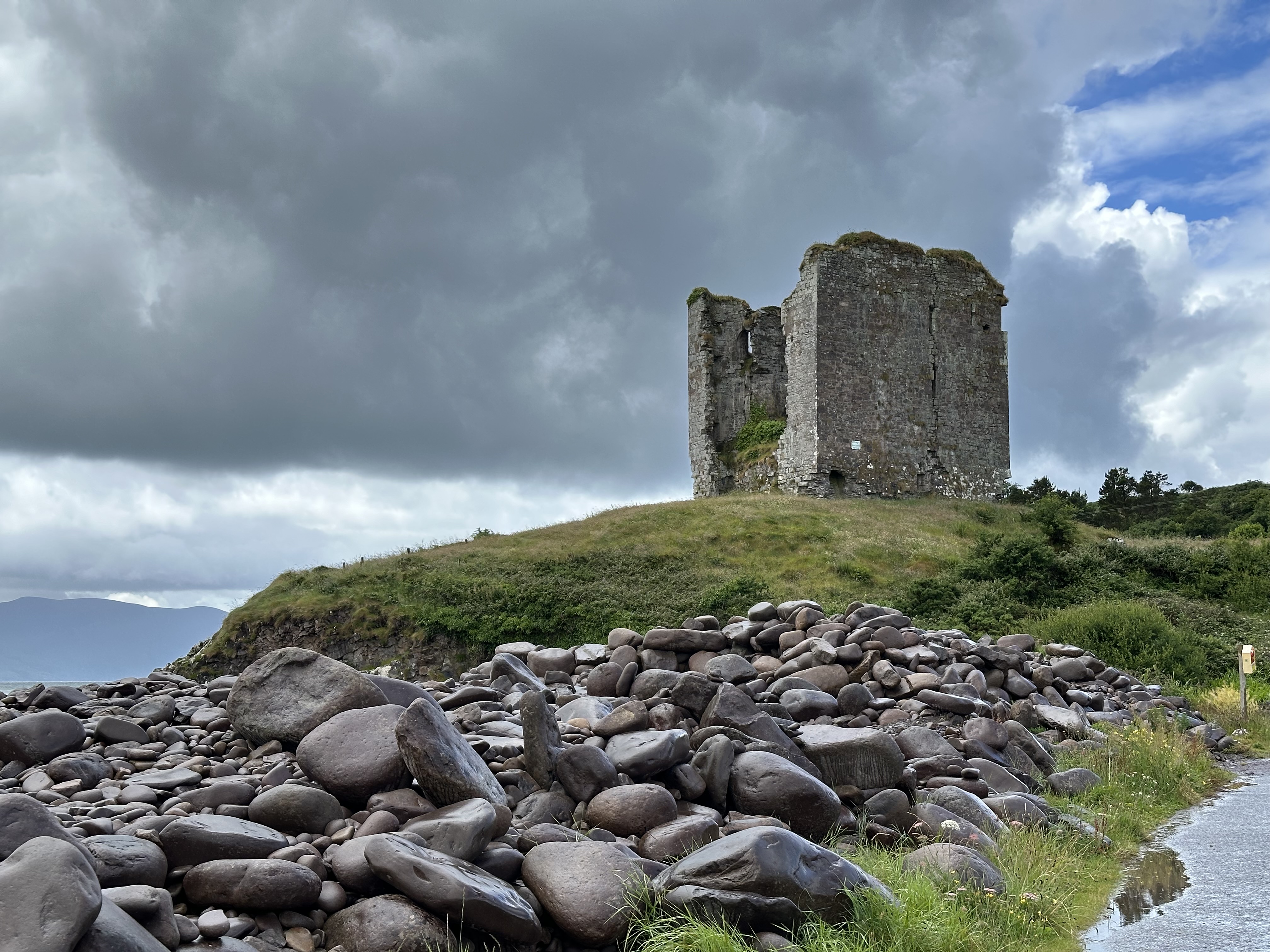
Our first stop on the Dingle Peninsula was Minard Castle.

To get there from the main road, we drove down a very narrow single-lane road. Every now and then there was a turnout so two cars could pass, but in most spots even our tiny car seemed to hug both sides of the road, and if two cars meet in an area like this, they both have to pull over into the weeds in order to pass.

Eventually, we came upon a windswept hill crowned by a lonely mid-16th century monolithic three-story ruin . . .

. . . that looks over a desolate bay of the cold Irish Sea.

Thursday, February 9, 2023

PORTUGAL: EVORA, PART I - ST. FRANCES CHURCH

 July 2, 2022

Évora, yet another UNESCO World Heritage Site, was the last city on our list before returning to Lisbon, and there were a lot of things we wanted to see there. However, most of them were closed between 12:00 and 2:00 PM,  so after parking our car we took a crazy, zig-zagging 12-minute walk through streets, alleys, and staircases, guided by the GPS on our phone.

We arrived at the Igreja São Francisco, or the St. Francis Church, not quite sure how we had gotten there.


Built between 1475 and 1550, it is a huge Gothic church--although it doesn't look very Gothic on the outside, and the inside has Renaissance and Baroque styles as well. The vaulted nave is the largest of its kind in Portugal.

The main altar includes an impressive "wedding cake Jesus" crucifix.


Wednesday, January 25, 2023

PORTUGAL: SANCTUARY OF OUR LADY OF FATIMA

 July 1, 2022

Our final destination of the day was our third pilgrimage site of the trip (the first two being Santiago de Compostela and Bom Jesus Cathedral), The Sanctuary of Our Lady of Fátima.


The story is that in 1917, Mary the Mother of Jesus appeared to three shepherd children--Francisco and Jacinta Marto and their cousin Lúcia--in a field in Fátima, Portugal. Over a period of five months, the children experienced six visitations. They told others that they were asked by the Virgin to say the rosary and were told three "secrets" regarding events that were to occur. In 1930, the Catholic Church recognized the visions as "worthy of belief" and granted a papal indulgence to pilgrims to the site. The site quickly became an important pilgrimage destination, and it now receives as many as six million pilgrims a year. 

The huge open courtyard of the shrine is twice as large as St. Peter's in Rome, and it reminded us a lot of the Shrine of the Virgin of Guadalupe in Mexico City that we visited in 2018. The Shrine of Fátima, built near the place where the children saw Mary, is one of the largest Marian shrines in the world.

There are two minor basilicas on the property, and we began our visit in the Basilica of Our Lady of the Rosary, which has a 213-foot-tall tower topped with a 15,000-pound bronze crown and a cross.


Wednesday, December 28, 2022

SPAIN: THE CATHEDRAL OF SANTIAGO DE COMPOSTELA AND THE CATHEDRAL MUSEUM

 June 29-30, 2022

As noted in the previous post, the current Cathedral of Santiago de Compostela was built in Romanesque style in the 13th century, with Gothic and Baroque additions in the 16th, 17th, and 18th centuries. It is a massive structure, and no doubt gets its notoriety from being the reputed burial spot of St. James (aka Santiago) the Greater, one of the twelve apostles of Jesus. However, it is a magnificent edifice of its own accord.

By the way, the only other churches in the world built over the tomb of an apostle are St. Peter's Basilica in Vatican City, St. Thomas Cathedral Basilica in Chennai, India, and the Basilica of St. John in Izmir, Turkey.

A sign of the importance of this cathedral is that it was visited THREE TIMES in a span of 28 years by two different popes--Pope John Paul II in 1982 and 1989 and Pope Benedict in 2010.

The interior of this cathedral is about 310 feet long, has a transept that measures 206 feet, and stands 72 feet high, making it the tallest building in Europe when it was built. Today it is still the largest Romanesque cathedral in Spain. At first glance it looks rather austere.


But then you see the main altar, and the closer you get, the more opulent it is.

Sunday, October 9, 2022

PORTUGAL: BATALHA MONASTERY (AKA SAINT MARY OF THE VICTORY MONASTERY)

  June 27, 2022

I thought it would be hard to top Alcobaça's Monastery of Santa Maria, but our next stop, only 12 miles away, was even better--Batalha Monastery. Built between 1386 and 1517 in the "Flamboyant Gothic" style, it looks very French from the outside--lots of gargoyles and buttresses. 

It seems that the Portuguese kings had a habit of bargaining with God. If he would give them victory in battle, they would build an over-the-top cathedral and monastery as a thank you. This one was built to thank the Virgin Mary for the Portuguese victory of the Castilians in the Battle of Aljubarrota in 1385. Seven kings, 15 architects, and 131 years later, it was done. It was granted to the Dominican order.

Like the Alcobaça Monastery, Batalha is also a UNESCO World Heritage Site.