Showing posts with label monastery. Show all posts

Friday, December 19, 2025

GERMANY: MAULBRONN MONASTERY AND NYMPHENBURG PALACE

May 24, 2025

Maulbronn is a small town of 6,700 people in southern Germany about 12 miles north of Pforzheim. Legend has it that in the 12th century, wandering monks followed a mule looking for water into the valley. (The name Maulbronn means "mule fountain.") Finding a beautiful lake, the monks settled here and established a monastery. Now a UNESCO World Heritage Site, the monastery draws about a quarter million tourists every year.

For being so old, it is in amazing condition and is, in fact, one of the best-preserved monastic sites in Europe. It's also surprisingly large.


Half-timbered building near the entrance

Granary building, early 13th century

Friday, October 24, 2025

GERMANY: ZWIEFALTEN

 May 22, 2025  

On our way from Grafeneck to Zwiefalten, we stopped to take a photo of a bar/inn where the Grafeneck staff came to relax, have a drink, or perhaps rent a room if overflow housing was needed. Today, this charming restaurant exhibits no evidence of its past, and I suppose it is a good example of the fact that life must go on.

Zwiefalten is a tranquil village of about 2,300 people in the Swabian region of southern Germany about 70 miles southeast of my mother's hometown of Pforzheim. The skyline is dominated by the twin towers of the Abbey of Our Lady of Zwiefalten, a former Benedictine monastery founded in 1089.


In 1812 part of the property became a lunatic asylum and then later a psychiatric hospital.

Zwiefalten State Hospital and Sanitorium was the last place my grandfather was held before he was transported to Grafeneck. Of the 10,654 people gassed at Grafeneck, more than 1,000 came from Zwiefalten. Once Grafeneck was shut down in December 1940, killings by injection continued at Zwiefalten.

This distance from Zwiefalten to Grafeneck is about 14 miles and takes just under 25 minutes to drive. Perhaps it took the gray transport busses a little longer in 1940, and certainly the patients who were passengers in the bus did not know where they were going.

We began our vist to Zwiefalten at the Württemberg Museum of Psychiatry. Apparently the psychiatric clinic at Zwiefalten is the oldest in the state of Baden-Württemberg.

Monday, April 1, 2024

FRANCE 2000: MONT-SAINT-MICHEL AND SAINT-MALO

 December 23, 2000

We got a good start the next day so that we could be at Mont-Saint-Michel at the exact time the tide was out. Mont-Saint-Michel is what is called a "tidal island," or an island when the tide is in but accessible by land when the tide is out. Mont-Saint-Michel and its bay are a UNESCO World Heritage Site.

No doubt you have seen photos of the Mont-Saint-Michel Abbey, topped by Michael the Archangel.

. . . and here is my photo, which I think is an amazing replica of the postcard (sans sheep and a bit dowdier in color):

According to legend, in 708 AD the Archangel Michael appeared to the Bishop of Avranches and directed him to build a church on the rocky island.

Sunday, October 9, 2022

PORTUGAL: BATALHA MONASTERY (AKA SAINT MARY OF THE VICTORY MONASTERY)

  June 27, 2022

I thought it would be hard to top Alcobaça's Monastery of Santa Maria, but our next stop, only 12 miles away, was even better--Batalha Monastery. Built between 1386 and 1517 in the "Flamboyant Gothic" style, it looks very French from the outside--lots of gargoyles and buttresses. 

It seems that the Portuguese kings had a habit of bargaining with God. If he would give them victory in battle, they would build an over-the-top cathedral and monastery as a thank you. This one was built to thank the Virgin Mary for the Portuguese victory of the Castilians in the Battle of Aljubarrota in 1385. Seven kings, 15 architects, and 131 years later, it was done. It was granted to the Dominican order.

Like the Alcobaça Monastery, Batalha is also a UNESCO World Heritage Site.


Sunday, October 2, 2022

PORTUGAL: ALCOBACA, MONASTERY OF SANTA MARIA

 June 27, 2022

Our first stop of the day was only a seven-mile drive from Nazaré--the city of Alcobaça, and more specifically, the Monastery of Santa Maria. The church that is the centerpiece of the monastery was built by order of the first king of Portugal to commemorate a victory over the Moors in 1147 and as a gift for the Cistercian Order (a Benedictine branch) under Bernard of Clairvaux. It took 76 years to complete the cathedral, and another 60 or so to add on the cloister. They are the first Gothic buildings in Portugal, and the church itself was the largest in Portugal at the time of its completion (and still is). The complex was named a UNESCO World Heritage Site in 1989.

The central church facade dates to 1702.

The interior was completed in 1269. The church was consecrated for the monks and the public was not permitted to enter until the 18th century. 

The dramatic nave is over 325 feet long.

The best things in the monastery are the twin tombs of Pedro I of Portugal (called both "Pedro the Just" and "Pedro the Cruel"), who died in 1367, and his mistress, Inês de Castro. The story of their affair is a little long, but worth your time.

Friday, August 26, 2022

PORTUGAL, LISBON: BELEM TOWER AND JERONIMOS MONASTERY

June 24, 2022

Borrowing the idea from history's Seven Wonders of the World, Portugal decided in the early 2000s to come up with the Seven Wonders of Portugal. Portugal is a wonder-filled place, and the initial list contained 793 national monuments. Experts whittled the list down to 77, and then to 21 finalists.  At that point, the public was allowed to vote. Six-month-long elections resulted in this final list:
          1. The Castle of Guimarães
          2. Castle of Óbidos
          3. Batalha Monastery
          4. Alcobaça Monastery
          5. Jerónimos Monastery
          6. Pena Palace
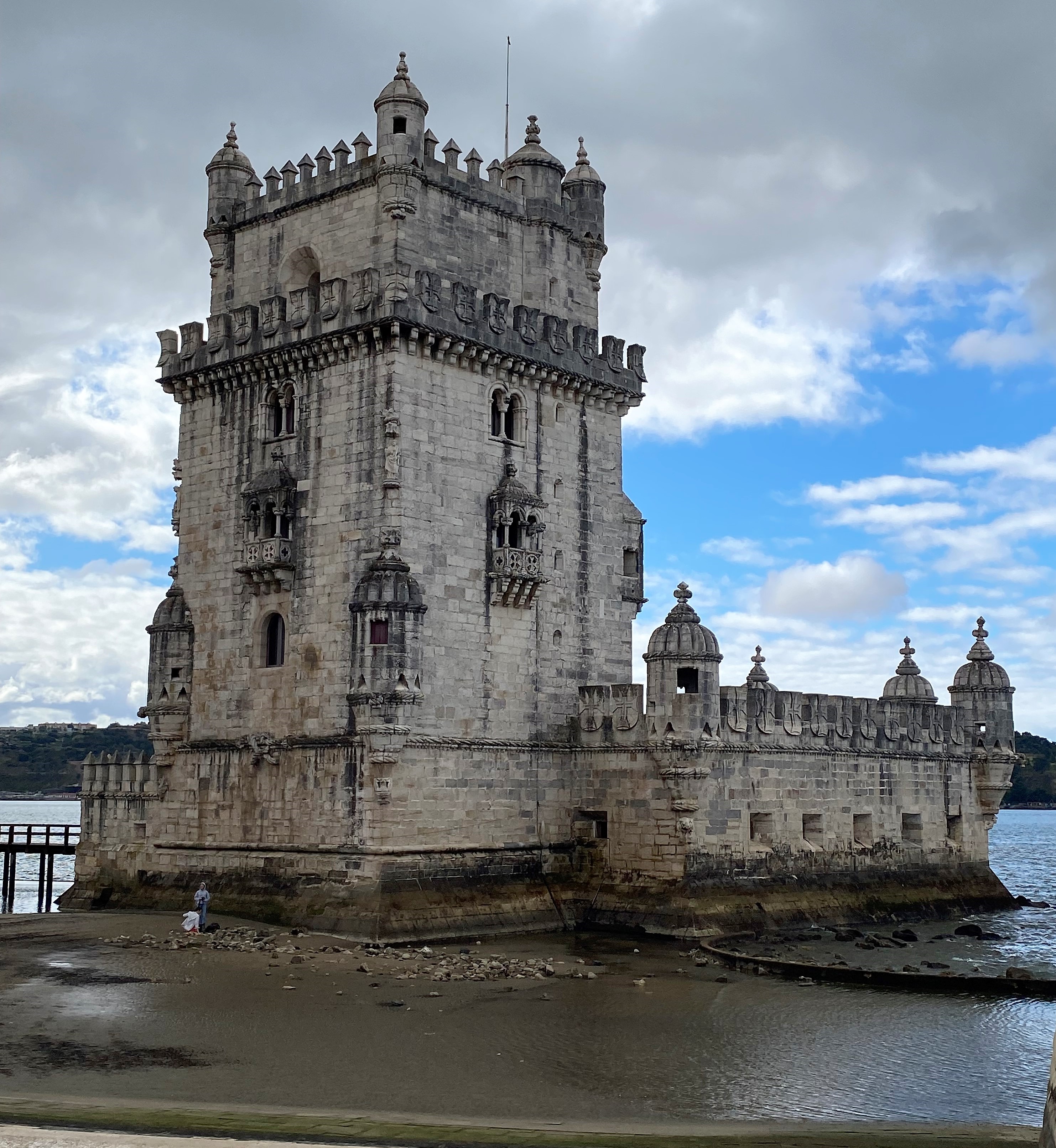
          7. Belém Tower

We had seen #6 the previous day, and on this day we were going to visit #7 and then #5, which is within walking distance of #7.  (Eventually we would get to all seven Portuguese Wonders.) 

The Belém Tower didn't open until 10:00, so there was no need to rush to get off early. We caught an Uber at about 9:30 AM and arrived in time to get our tickets and be among the first people to cross the bridge to the small, offshore island where the tower was built in the early 16th century to defend the entrance to the Tagus river and provide protection for the Jerónimos Monastery. It also served as a gateway to the city and a ceremonial point of arrival and departure for Portuguese explorers. Both the Belém Tower and the Jerónimos Monastery that we visited next are UNESCO World Heritage Sites.


The shallow water beneath the bridge was filled with small fish that were able to spot in the clear water.

Saturday, October 10, 2020

MEXICO: CHOLULA

 March 18, 2018

Our last day with our guide Arnold Pedroza in Mexico was very full. The map below shows our starting point, Mexico City, on the left. The two black circles mark the two Volcanos Popo and Ixta (which we had already visited), and the three red circles on the bottom right are our three destinations of the day: Huejotzingo, Cholula, and Puebla.


Our first stop was Huejotzingo (see my last post), so our next stop was Cholula, population 120,000. Arnold told us it is the oldest still-inhabited city in the Americas, having been populated since the 2nd century BC. 

It is said that Cholula has 365 churches, one for every day of the year or, alternately, one for every pre-Hispanic temple that used to be in the area. The truth is there are only a tenth that many churches--37 (or 159 if you want to be generous and include all the small chapels on the local haciendas). 

There were two main sites we were interested in: The San Gabriel Franciscan Monastery and the Nuestra Señora de los Remedios (Our Lady of Remedies) Church.  

We started at San Gabriel, built in the 1540s on top of a destroyed temple to Quetzalcoatl. The atrium, aka courtyard, enclosed by the monastery walls is huge.
San Gabriel Monastery

There were several vendors set up in the atrium, and we (okay, I) couldn't resist this frothy cold cacao milk. Notice that there are TWO straws. It was so good that later on I bought a molinillo, or a hand-carved tool used to create the froth, hoping to duplicate this drink at home. 

Two churches are part of the monastery. The Capilla Real (Royal Chapel) was built in the 17th century, replacing the original chapel built here in 1540. I loved the brilliant gold color of this and the other churches we saw in Cholula.
Capilla Real

Wednesday, September 30, 2020

MEXICO: HUEJOTZINGO, SAN MIGUEL ARCANGEL MONASTERY

 March 18, 2018

After our three days in the Villahermosa area, we flew back to Mexico City and took an Uber back to the Maria Cristina Hotel, the same place we had stayed in before going on our side trip, arriving after midnight.

Arnold Pedroza picked us up the following morning for a trip south.

Our first stop was the city of Heujotzingo, population about 60,000 and best known for the Franciscan monastery San Miguel Arcangel, founded in 1525. San Miguel Arcangel, whom we know as the Archangel Michael, is the patron saint of the city and vicinity. This building, finished in 1570, was the third one built on this site and is one of the fourteen monasteries around the base of the volcano Popocatepetl that together have been declared a UNESCO World Heritage Site.

You can see the monasteries marked on the map below. Heujotzingo/San Miguel Arcangel is in the top right quadrant.

UNESCO Monasteries in Mexico

The monastery is almost 450 years old--that is a long time for a brick structure to survive in earthquake country. One article I read about the monastery complex noted that it was in great shape and had never been severely damaged by any of the frequent earthquakes in the area. I'm guessing that either that article has not been updated since the 7.1 earthquake that hit just south of Huejotzingo in 2017, or the author of the article didn't consider the damage done by the earthquake to be very significant.

We did notice there was scaffolding holding up the main entrance.

Certainly the walls of the main church that anchors the monastery were still standing, and there didn't seem to be danger of the building collapsing, but it was closed to tourists and worshipers alike when we visited, with a large tent spanning the walkway serving as the temporary chapel.
San Miguel Arcangel Monastery

This beautifully carved sandstone cross with a base of a crown of thorns stands at the entrance to the temporary sanctuary, denoting a sacred space. 
San Miguel Arcangel Monastery

Tuesday, November 29, 2016

VALYERMO, CALIFORNIA: ST. ANDREW'S ABBEY AND A BENEDICTINE RETREAT

I have a dear Catholic friend named Diane who, about a year ago, invited me to go on a retreat with her to a Benedictine monastery in Valyermo, California, just over an hour from where we live. It was somewhat out of my comfort zone but exactly the type of interfaith experience I have learned to value, so I accepted her invitation. The earliest my schedule and the retreat schedule matched up, however, was the second week in July, so I had to wait a while.

It was worth the wait, and in fact I think I will go again if given the opportunity. I found at least ten things that visitors need to see/experience when at St. Andrew's Abbey in Valyermo.

1. THE CHAPEL
St. Benedict, who lived in Italy from c. 480-543 AD, is often called "The Founder of Western Monasticism" and is the Patron Saint of Europe. The Benedictines observe a strict daily schedule revolving around gathering in the monastery chapel five times a day for prayer. Guests are not required to attend all (or even any) of those prayers, but I tried to go with Diane (who went to them all) to two or three each day. The focus on prayer is one of the things that makes visiting St. Andrew's a unique spiritual experience.

Resounding peals of the bell standing outside the chapel call the monks and guests to prayer four times a day. (Out of respect for sleepy guests, the monks don't ring the bell for the earliest prayer at 6:00 AM, which I confess I never attended).

                                                                 This is the daily schedule:
6:00 AM: VIGILS (The first communal prayer of the morning)
6:30-7:30: Lecto Divina (Contemplative scripture study)
7:30: LAUDS (Morning prayer)
8:00: Breakfast (Eaten in total silence, called "Grand Silence")
8:30-11:30: Assigned labor or study (This was the first of our two daily session of lecture/discussion for the retreat)
12:00 PM: Conventional MASS
1:00: Lunch with guests
1:30-4:00: Assigned labor or study (Session two of retreat lectures and discussion)
4:00-5:30: Study, rest, exercise
5:30: Lectio Divina
6:00: VESPERS (Evening prayer)
6:30: Dinner (in silence)
8:00-8:30: Community recreation
8:30: COMPLINE (Night prayer)

The Benedictine liturgy and music focuses on the Psalms, which the monks sing through completely (even the more violent or salacious psalms) every month or so as part of their prayer services. One of the monks is the "lead" singer or cantor (I'm not sure if that is the correct term). He sings his part, and then the other monks and congregants sing other parts, sometimes a capella, sometimes accompanied by a small organ.