July 7, 2023
After our jaunt through the Arab quarter, our guide Anwar said he was taking us to our hotel. Bob was not happy and said so, noting we had only been out two hours and had paid for a half-day tour. Anwar asked if we were interested in seeing the Surabaya National Monument, aka the Heroes Monument, which pays tribute to the 1945 Battle of Surabaya that led to Indonesia's independence from the Dutch and British. It was definitely something I was interested in, and so we went, and it turned out to be my favorite part of the day.
The park opened in 1961 and contains artifacts from the Indonesian war for independence. There is an underground museum that we didn't visit, but we really enjoyed the park. The battle fought in Surabaya was the single biggest battle of the revolution. As in Colombia's Medellin uprising against the drug cartels, it was led by young people.
I'm not sure what it is supposed to represent, but the red entry gate is pretty spectacular.
Just beyond the gate is a statue of the hero of the day, Indonesia's first president, Sukarno. (He went by a single name.). He led the struggle for independence from the Dutch colonists and then was president of Indonesia from 1945 to 1967. The man standing behind and to his left is Mohammad Hatta, the country's vice president from 1945 to 1956. (NOTE: The largest airport in Jakarta is named after these two men: The Soekarno-Hatta International Airport.)

The plaque on the statue's base has an English translation, which surprised me. We hadn't seen much English in Indonesia.
By the way, these two also make it on the front of Indonesia's largest bill, the 100,000 Rupiah note (about $7). There is a serious version . . .
. . . and there is a happy version.
Behind the statues are pillars from the occupiers' government building, reminiscent of the pieces of the Berlin Wall on display around the world that have become symbols of freedom from outside control. However, the fresh-looking writing on these pillars
in English was a little disconcerting. It doesn't look authentic.
Gate, statues, and pillars from behind:
Sukarno, who helped build Indonesia as a democratic nation, was supported by the United States, but over the years he became more and more reliant on the communist party and the military to maintain his control over the country.
 |
| President Kennedy and Sukarno. Photo from here. |
Sukarno was made "president for life" in 1963 and had developed a personality cult. He was deposed by the military-backed Suharto regime in 1967 and placed under house arrest, where he died three years later of kidney failure. Nevertheless, this charismatic leader (who had 10 wives--some at the same time) is still revered as the father of Indonesian independence.
The focus of the park is a 135-foot-tall obelisk dedicated to the heroes of what they call the 10 November 1945 battle. Opened by Sukarno on the seven-year anniversary of the battle in 1952, the obelisk has become the symbol of the city.
The Indonesian flag waves in the background. (It is the reverse of the Polish flag, which has white on the top and red on the bottom. More on its history in the next post.)
View from the bottom looking up and with us in front for perspective on size:
The park surrounding the monument is really nice. I'm surprised there isn't more information about it on the web. I could hardly find anything.
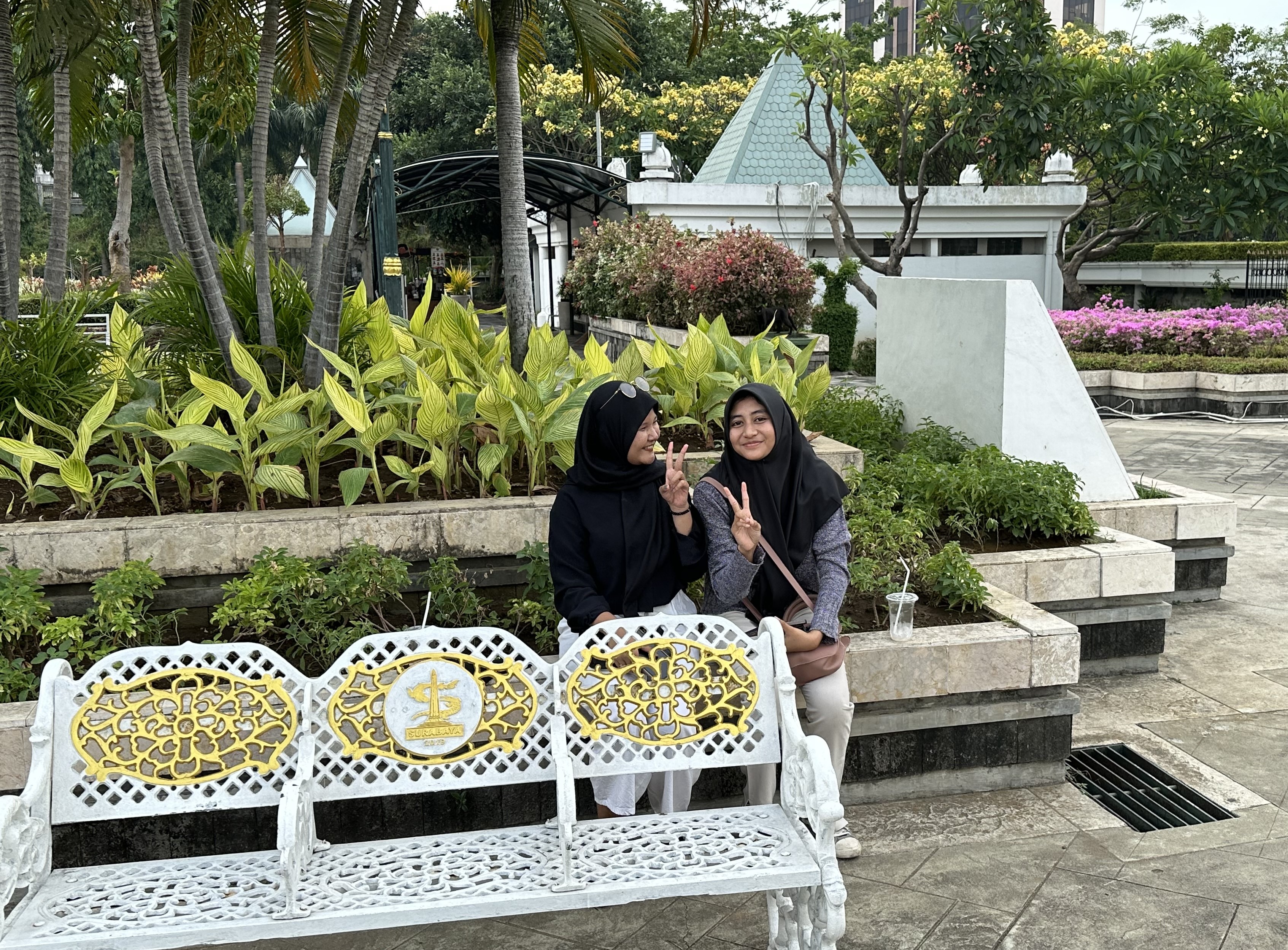
I noticed these two young women surreptitiously taking photos of us with their cell phones. (Was it my hat again?) I made Bob stop and pose with me, and then I asked them if I could take
their picture. Aren't they darling? More than any country we have traveled to except, perhaps, China, we got the sense they don't see many Americans. However, they must see a lot of Dutch tourists and other Europeans, so I wonder what makes us stand out?
It must have been my hat, as it had been in the farmers' market.
This is the Indonesian equivalent of the Tomb of the Unknown Soldier, known here as the Tomb of the Unsung Heroes. It is set in the middle of a beautiful water feature. I read somewhere that it includes remains not only of local soldiers and civilians killed in battle, but also of Dutch and British soldiers who also lost their lives in the conflict.
Close-up of the battle scene:
We were there (and looking a bit too jolly for the action behind us)!
The oddly-shaped building across the street from the park is the East Java Governor's Office.
I can't believe the Heroes Monument isn't the first thing on a tour guide's list of places to take visitors. This is where our tour of Surabaya should have begun. Having been there and gotten a taste for Indonesian history and nationalism, I began to notice other war-related items around the city, like this statue in front of a business.
In general, we have had pretty good luck with private tour guides around the world, but this was one of our worst experiences (although we had another bad guide coming up in Bali). We had gotten everything we could get out of Anwar at this point, we were starving, and Bob wasn't feeling very well, so our next stop was our hotel.
READING
In
The Year of Living Dangerously by
C.J. Koch, an Australian
journalist named Guy Hamilton finds himself in the middle of Indonesia’s
tumultuous civil war in 1965, the year the president/dictator has declared to
be “The Year of Living Dangerously.” Guy connects with Billy Kwan, a
Chinese-Australian cameraman, who in turn introduces him to Jill Bryant, a
secretary in the British Embassy. A love triangle plays out within the violence
of war, and there is plenty of betrayal on every front. I don’t know that I
would be interested in this book without my recent travels to Indonesia, but
our experience there made the tales of Sukarno's regime and lots of political intrigue that were part of the book's plot very interesting.
Under the Java Moon by Heather B. Morse is a work of
historical fiction but is based on interviews with Rita Vischer, a survivor of
the camps and the main character of the book. In 1941, at the
beginning of World War II, 5-year-old Rita and her pregnant mother and younger
brother are placed in a Japanese internment camp on the island of Java. Rita’s
father had joined the resistance army but is captured and placed in another
internment camp just a few miles away. For 3½ years, the family suffers under the hands of cruel
guards, horrible living conditions, inadequate food, and rampant disease. We
all know about the Nazi camps for Jews, and most of us know about the US
internment camps that held Japanese-Americans during World War II, but I had
never heard of the Japanese imprisonment of the Dutch in camps in Indonesia. An additional layer is that
after the Japanese surrendered, the Indonesians immediately waged their own war
against the Dutch colonists as they sought for independence. Dutch families
like Rita’s faced even more trauma as they tried to find a way out of the country.
Having seen the war for independence from the Indonesian point of view, this
book reminded me that there are two sides to every story and that war is
horrible.